How to Identify a Canonical Icon in Orthodox Tradition
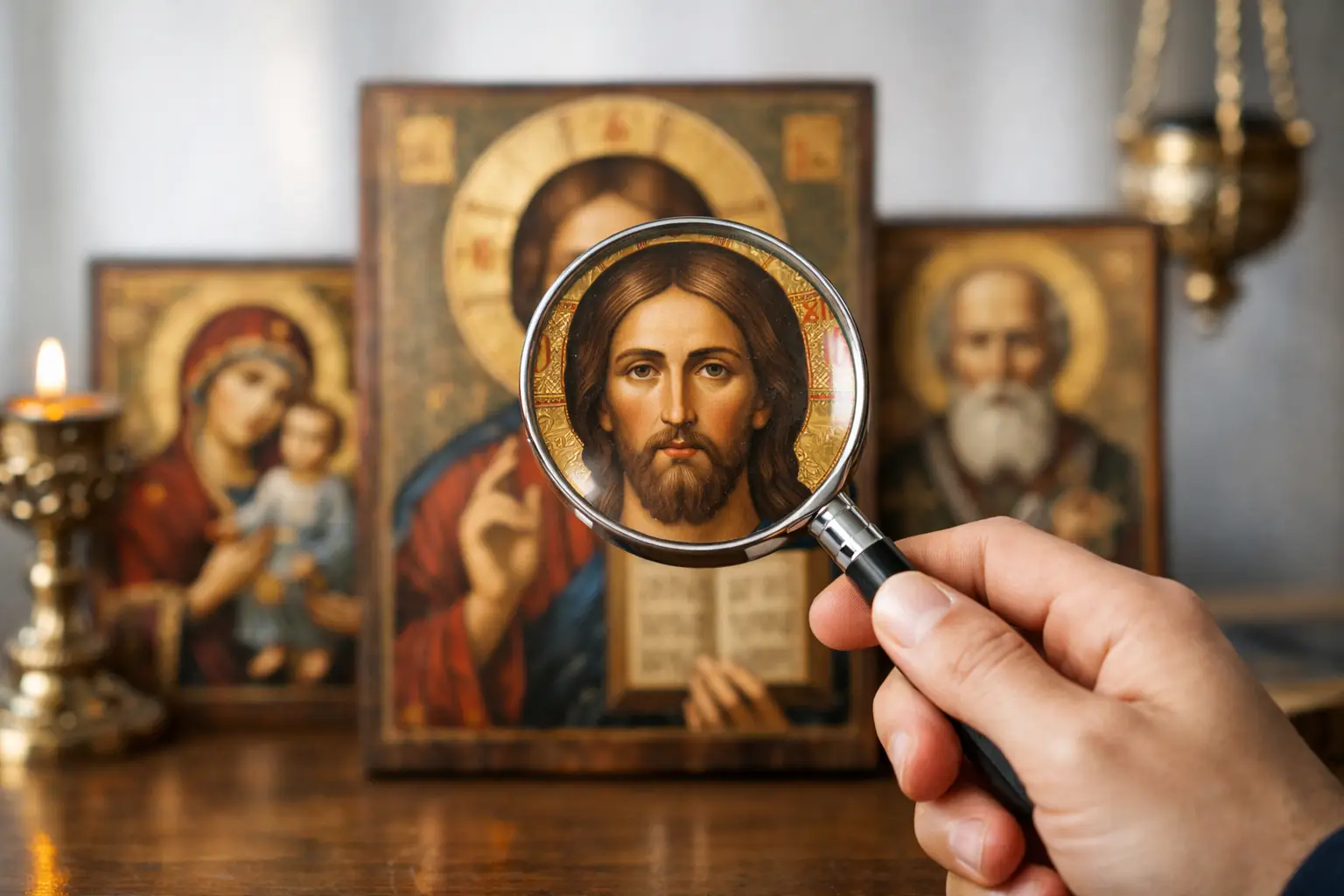
A beautiful image of Christ or a saint may stir the heart, yet beauty alone does not make it an icon in the Orthodox sense. To understand how to identify a canonical icon, look first for faithfulness to the Church’s received tradition: the holy person depicted, the theological meaning of the image, its inscriptions, and its reverent purpose in prayer.
An icon is not merely religious artwork or a spiritual decoration for the home. It is a sacred image that bears witness to the Incarnation of Christ and directs the faithful toward the Person represented. Orthodox Christians do not worship wood, paint, silver, or a printed image. We offer veneration to Christ, His Most Pure Mother, the angels, and the saints, asking their prayers before God.
What makes an icon canonical?
A canonical icon conforms to the tradition of Orthodox iconography as it has been guarded and handed down by the Church. This does not mean every icon must look identical. Russian, Greek, Serbian, Romanian, Georgian, and other Orthodox traditions have recognizable artistic schools. Colors, proportions, ornament, and painting techniques may differ, while the confession of faith remains the same.
Canon is not a brand name, a certificate, or a decorative style. It is the faithful expression of Orthodox teaching through an image. A canonical icon presents Christ, the Theotokos, an angel, a biblical event, or a saint in a manner consistent with Scripture, Holy Tradition, and established iconographic forms.
For this reason, an icon may be simple or richly adorned, hand-painted or carefully printed, old or newly made. A fine silver 999 covering, a carved wooden kiot, or a gift case can honor an icon, but these features do not determine whether the image itself is canonical. The sacred image comes first; its setting serves the image.
How to identify a canonical icon by its inscription
The clearest first sign is often the inscription. Orthodox icons traditionally name the One or the one depicted. Christ is commonly marked with the Greek letters IC XC, an abbreviation for Jesus Christ. Within His halo appear the letters O WN, meaning “He Who Is,” recalling God’s words to Moses: “I AM WHO I AM.” This is a profound confession that the Lord Jesus Christ is truly God.
Icons of the Mother of God often bear the Greek abbreviation MP ΘY, meaning Mother of God. In Slavonic or Russian tradition, the inscription may be written in Church Slavonic or Cyrillic. A saint should be identified by name, often with a title such as Holy Martyr, Venerable, Hierarch, Apostle, Wonderworker, or Great Martyr.
The wording matters. A properly titled icon helps the faithful recognize the saint and the feast or event shown. An image labeled only with a vague phrase such as “angel of peace,” “divine feminine,” or “spiritual healer” should be approached carefully. Such language may be devotional in a broad sense, but it is not the customary language of Orthodox iconography.
Spelling and language can vary by tradition, and older icons may use unfamiliar abbreviations. A missing or difficult-to-read inscription does not automatically prove that an icon is improper, especially when it has been worn by time or covered by a riza. Still, a clear, traditional inscription is one of the most reassuring signs for a buyer.
Look for recognized iconographic types
Many canonical icons follow beloved and recognizable forms. Christ Pantocrator presents the Lord as Almighty, usually blessing with His right hand and holding the Gospel in His left. The Theotokos of Kazan, Vladimir, Iveron, Tikhvin, and the Sign each has a distinct, received composition. Saint Nicholas the Wonderworker appears in episcopal vestments, frequently holding the Gospel and blessing. Saint George is often shown as a victorious martyr on horseback, overcoming the dragon as an image of triumph over evil.
A canonical icon does not have to reproduce one famous prototype line for line. Yet its central features should remain recognizable. When an image changes those features so greatly that the holy figure becomes a fantasy character, a sentimental portrait, or an indistinct religious symbol, it has moved away from traditional iconography.
Read the theology in the image
Orthodox icons speak through visual theology. Christ’s halo with the cross is reserved for Christ alone. The Theotokos is shown with three stars, traditionally placed on her forehead and shoulders, proclaiming her virginity before, during, and after the birth of Christ. Saints have halos because they shine with the grace of God, not because they possess power apart from Him.
The faces of saints are usually peaceful, sober, and transfigured rather than theatrical. Their eyes are often large and attentive, calling the person praying to inner watchfulness. Perspective may appear unfamiliar to modern viewers because the icon is not trying to imitate a photograph. Its purpose is to reveal the Kingdom of God, where the visible world is illumined by divine grace.
Be cautious when an image treats a saint as a romantic hero, a fashionable personality, or a source of luck. Orthodox Christians ask saints for intercession. We do not use icons as charms, talismans, or promises of automatic earthly success. Even an icon associated with a particular need – Saint Spyridon for assistance in hardship, Saint Panteleimon in illness, or the Guardian Angel for protection – remains an invitation to prayer, repentance, and trust in God’s will.
Canonical imagery and a church blessing are related, but not identical
Buyers sometimes expect a single feature to settle every question: “Is it blessed?” A blessing is a sacred and meaningful matter, but it is helpful to distinguish it from canonical content. An icon can faithfully depict a recognized Orthodox image even before it has been blessed for use in a home prayer corner. Conversely, a decorative religious image does not become canonical simply because a seller describes it in reverent terms.
Many icons are made in monasteries, workshops connected with temples, or by experienced Orthodox iconographers. Such provenance can offer confidence, particularly when the maker follows established models and uses traditional inscriptions. A priest may bless an icon, and many faithful rightly desire this before placing it among their family shrines.
Practices differ by parish and jurisdiction. Some priests bless newly purchased icons; others may explain that a properly made icon intended for Orthodox prayer is already treated with reverence. When in doubt, bring the icon to your parish priest. His pastoral counsel is more valuable than an online label or a sales description.
Examine the object with reverence and practical care
Authenticity also involves honest workmanship. Whether an icon is hand-painted on a wooden board, printed with a protective finish, or set beneath a silver-plated oklad, the materials and construction should be described plainly. A handmade icon may show the character of the artist’s hand. A quality printed icon can also be suitable for prayer and especially useful for travel, gifts, or a family icon corner.
If the icon has a metal covering, make sure the faces and hands are revealed respectfully and that the covering supports, rather than obscures, the holy image. Silver plating, gilding, enamel details, and a fitted case may make an icon a worthy baptismal, wedding, name-day, or feast-day gift. They should never be used to distract from a poor or confused depiction.
A few practical questions can help when choosing: Is the saint or feast clearly named? Does the composition correspond to a recognized Orthodox type? Is the seller open about the icon’s origin, materials, and method of making? Is it presented as an object for prayer rather than as a novelty? Clear answers are a good sign of care.
When an image needs further guidance
Not every concern can be settled by a checklist. Ancient icons may be damaged, regional forms may be unfamiliar, and family heirlooms may carry inscriptions in languages you do not read. Some icons also portray difficult subjects, such as the Holy Trinity, the Last Judgment, or visionary scenes from a saint’s life, which require particular theological care.
If an icon is unusual, do not rush to reject it. Compare it with trusted Orthodox examples, ask a knowledgeable iconographer, or seek the counsel of your priest. The goal is not to become suspicious of every variation. It is to receive sacred images with discernment, humility, and love for the tradition entrusted to the Church.
A canonical icon belongs where a lampada may be lit, a candle may be offered, and a quiet prayer may be spoken. Choose an image that leads your household beyond admiration of craftsmanship and into faithful remembrance of Christ, His Most Holy Mother, and all the saints.


