How to Choose Orthodox Religious Pendants
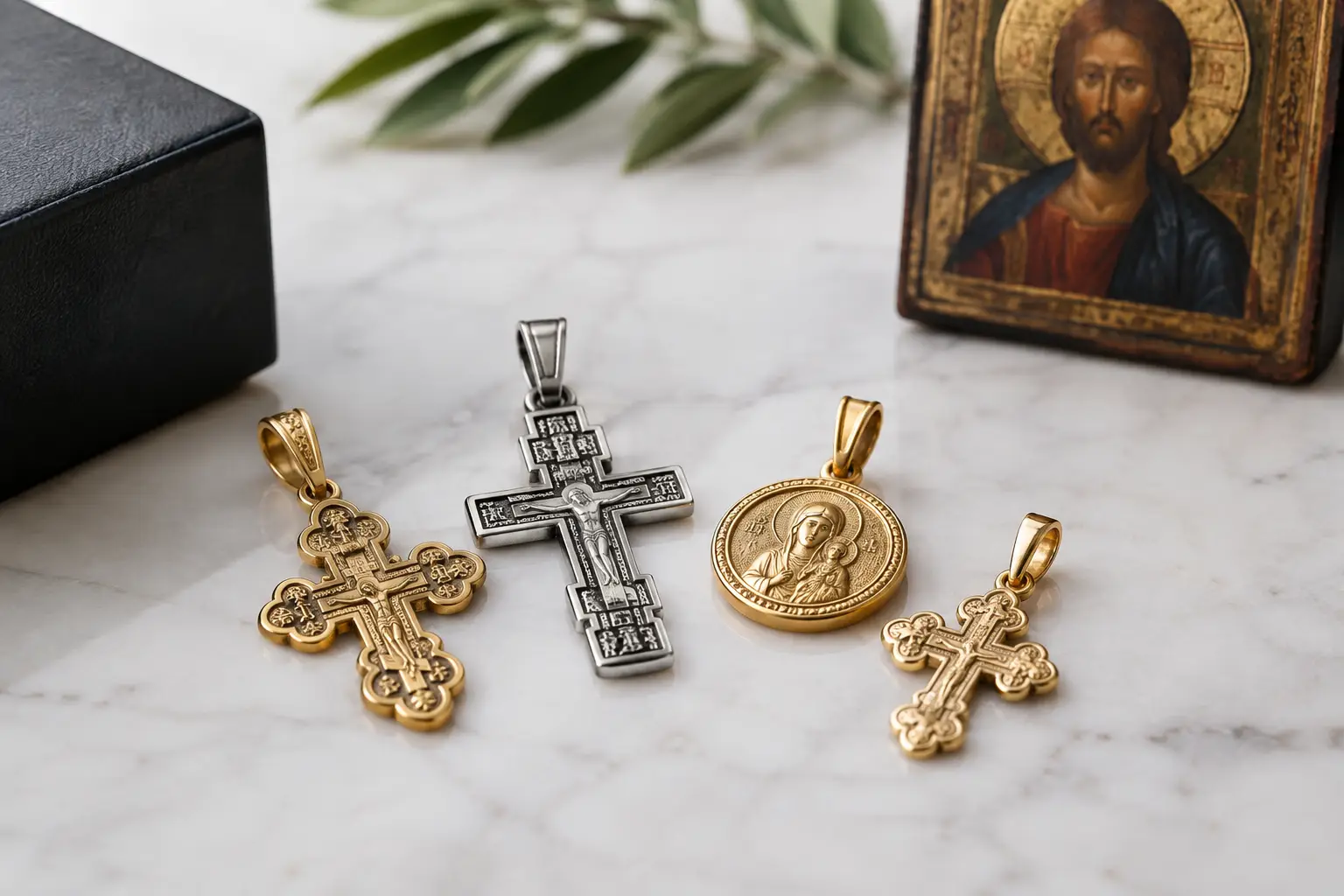
A pendant worn close to the heart should be chosen with more care than an ordinary piece of jewelry. For Orthodox Christians, religious pendants may accompany daily prayer, recall the protection and intercession of a beloved saint, or mark a holy beginning such as Baptism, a name day, wedding, or feast day. Their beauty matters, but their first purpose is to turn the mind and heart toward Christ.
The Orthodox tradition does not treat sacred images as charms or fashion accessories. A cross, an icon pendant, or a medal bearing a saint is a visible confession of faith and a quiet invitation to prayer. When chosen with reverence, it can become a treasured companion for many years and a gift carried through generations.
Begin With the Purpose of the Pendant
The right choice depends on who will wear it and why. A baptismal cross is traditionally simple, durable, and suitable for everyday wear. A pendant given for a name day may show the wearer’s heavenly patron, creating a deeply personal connection to the saint whose prayers are sought throughout life.
For someone building a regular prayer rule, an icon pendant of Christ, the Most Holy Theotokos, the Guardian Angel, or a revered saint can provide a gentle reminder to pause and pray. For a godchild, a smaller pendant with smooth edges and a secure bail is often more practical than an elaborate piece. Adults may prefer a more detailed handmade image in silver, gold-accented silver, or another precious metal.
It is wise to distinguish personal devotion from mere decoration. A sacred pendant can be finely made, richly engraved, and beautifully presented, yet it should remain fitting for its holy subject. Traditional Orthodox workmanship gives form to this reverence through canonical imagery, balanced proportions, and inscriptions that honor the Savior, the Theotokos, or the saints.
Religious Pendants and the Orthodox Cross
The cross remains the central Christian pendant. It proclaims the victory of Christ over death and is worn not as an ornament alone, but as a sign of faith. Many Orthodox Christians receive a cross at Baptism and continue wearing it beneath their clothing, close to the body.
Russian Orthodox crosses often include the familiar slanted lower bar and may bear traditional inscriptions. Some designs show the Crucified Lord; others are plain or engraved with prayers. There is no single correct style for every person. A small, simple cross may be ideal for daily use, while a more detailed silver cross can be chosen for an important gift or milestone.
Consider the wearer’s habits. A person who works with their hands, exercises regularly, or wears a pendant continuously may appreciate a compact cross with rounded contours. A larger cross can offer greater detail and visual presence, but it may be better suited to occasional wear or to a heavier chain. The chain itself should be strong enough for the pendant’s weight and comfortable at the chosen length.
If a cross has not been blessed, it may be brought to a priest for blessing. This is a fitting way to receive a new devotional object, especially when it has been given for Baptism, a wedding, or another sacred occasion.
Choosing an Icon Pendant of Christ, the Theotokos, or a Saint
An icon pendant brings the Orthodox understanding of holy images into a small, wearable form. Orthodox Christians venerate icons with honor directed toward the person depicted, never toward the material object itself. The pendant is therefore a reminder of communion with Christ and His saints.
An image of the Savior is a meaningful choice for any Orthodox Christian. Pendants of the Theotokos are especially beloved by those seeking her maternal protection and intercession. Traditional depictions may include the Kazan Mother of God, the Vladimir Mother of God, or other revered iconographic types. Each carries its own place within Orthodox memory and prayer.
A saint pendant can be selected according to a baptismal name, family devotion, vocation, or particular spiritual need. Saint Nicholas the Wonderworker is loved as a swift helper and protector of travelers. Saint George is honored for courage and steadfast confession. Saint Spyridon is often remembered in prayers during hardship, while the Guardian Angel is a fitting image for children and loved ones.
When selecting a saint, canonical imagery matters. The name should be clearly identified, the image should reflect Orthodox iconographic tradition, and the craftsmanship should preserve the dignity of the holy figure. A finely detailed pendant may include a small inscription, a cross on the reverse, or a short prayer. These details are not merely decorative. They help root the piece in the Church’s language of faith.
Materials That Serve Daily Devotion
Material affects appearance, durability, cost, and the way a pendant is worn. Sterling silver is a classic choice for Orthodox jewelry because it is luminous, enduring, and appropriate for both men and women. Fine silver 999 plating can give an icon pendant a bright, noble finish while bringing out engraved details in the halo, garments, and inscription.
Gold and gold-accented designs have long been associated with offerings of honor. A gold pendant may be chosen for a major sacramental gift, an anniversary, or a family heirloom. Platinum and multicolored gold may also be considered for custom work, especially when a family seeks a lasting, personal design. Yet precious metal is not a measure of faith. A modest silver cross, worn prayerfully, holds far greater meaning than an expensive item chosen only for display.
Handmade pendants often have subtle variations that reveal the touch of the artisan. This can be especially appealing in pieces made by Orthodox workshops, monasteries, or craftspeople working within a living tradition. Look closely at the quality of the relief, clarity of the saint’s face, secure attachment point, and finish of the reverse side. These practical details help ensure the pendant will remain beautiful in regular use.
Giving a Sacred Pendant as a Gift
Religious pendants are among the most meaningful Orthodox gifts because they unite a visible object with an enduring prayer. They are appropriate for Baptism, chrismation, birthdays, name days, Christmas, Pascha, graduation, marriage, and times when a loved one needs encouragement.
For a child, choose a light pendant that is comfortable and durable. For a godson or goddaughter, a baptismal cross or Guardian Angel pendant is a traditional expression of spiritual care. For parents or grandparents, an icon of a family patron saint may become a cherished reminder of shared faith. A gift case adds dignity to the presentation and offers safe storage when the pendant is not being worn.
It is helpful to include a few sincere words when giving the pendant. Rather than speaking only about the metal or workmanship, mention the saint depicted and ask for that saint’s prayers. A gift offered in this spirit becomes more than a keepsake. It becomes a witness of love in Christ.
Caring for a Pendant With Reverence
Sacred jewelry should be handled thoughtfully. Keep it away from harsh chemicals, perfume, chlorine, and abrasive cleaners, particularly if it has fine silver plating, enamel, or delicate engraved details. A soft, dry cloth is usually enough for gentle care. Store the pendant separately when possible so that the image and finish are not scratched by other jewelry.
A pendant is not a substitute for prayer, repentance, participation in the Divine Liturgy, or the sacraments. Its place is humbler and more beautiful: it can call the wearer back to these things. Whether you choose a baptismal cross, an icon of the Theotokos, or the image of a heavenly patron, let the pendant be received with gratitude and worn as a quiet remembrance that the Lord is near.


