A Russian Icon Symbolism Guide for Prayer
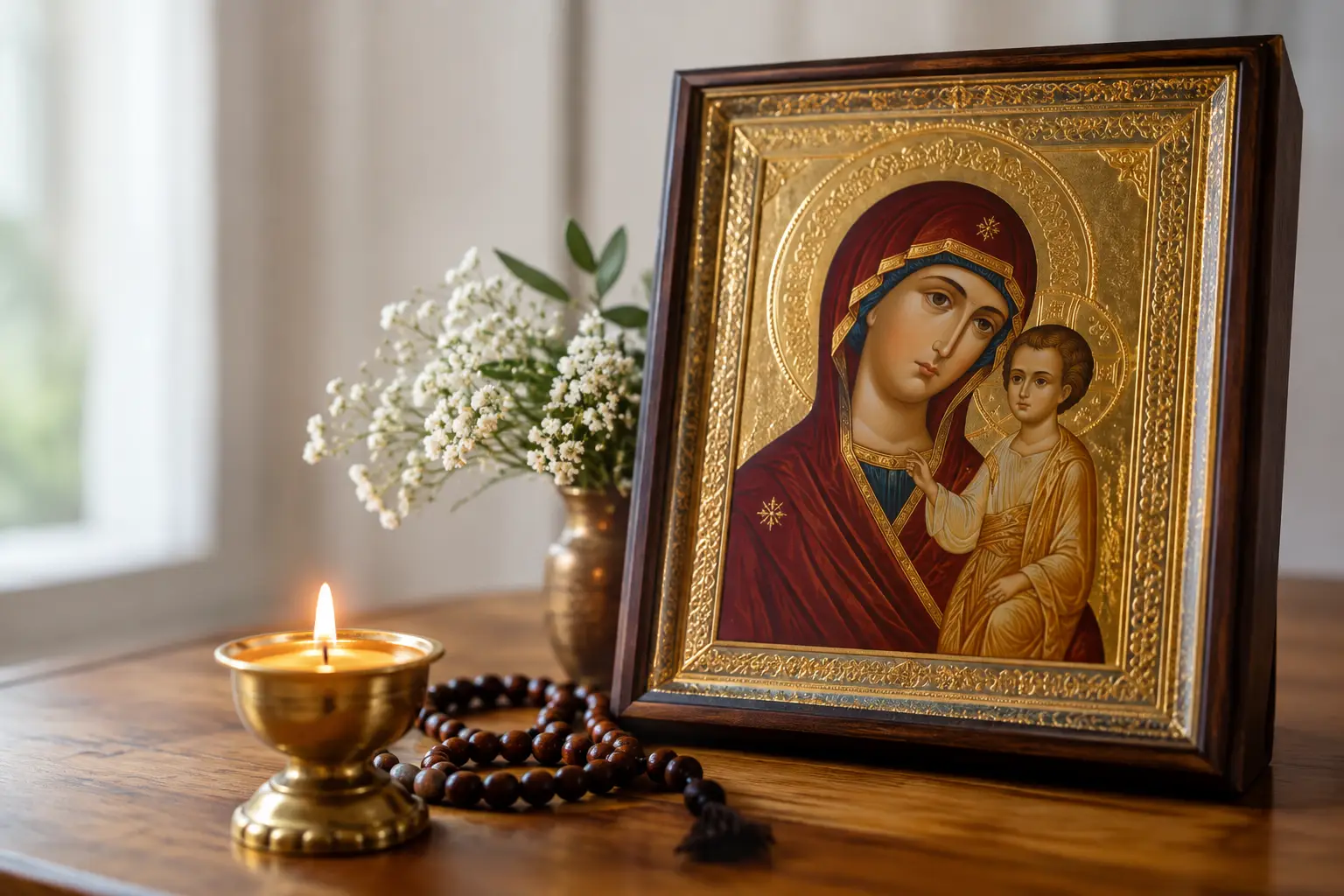
A Russian icon symbolism guide begins not with art history, but with the prayer corner. When an Orthodox Christian stands before an icon of Christ, the Theotokos, or a beloved saint, the image is received as a sacred witness to the Incarnation and to the communion of saints. Its colors, gestures, inscriptions, and carefully ordered forms direct the heart toward prayer. They are not decorative details added for beauty alone.
Holy icons are venerated, never worshiped. As the Church teaches, honor shown to the image passes to the person depicted. This distinction helps a family approach an icon with proper reverence: lighting a beeswax candle, making the sign of the Cross, and asking the Lord or His saint for mercy and intercession.
Why Russian Icons Speak in Symbols
Russian iconography belongs to the wider sacred tradition of the Orthodox Church. While particular schools may differ in color, line, ornament, and local devotion, the theological language remains recognizable. An icon does not attempt to reproduce an ordinary passing moment. It reveals a transfigured reality, where Christ reigns, the Mother of God intercedes, and the saints stand alive before God.
That is why the figures may appear still, solemn, and direct. The saint is not posed for a portrait. He or she meets the faithful in prayer. The measured features and restrained expressions teach inward attention, humility, and peace.
An icon should therefore be chosen first for devotion, not merely for how it complements a room. A family may select Christ Pantocrator for the central place in a prayer corner, the Kazan or Vladimir Mother of God for maternal intercession, Saint Nicholas for a beloved heavenly helper, or a guardian angel icon for a child or godchild. Fine silver 999 plating, a handmade wood base, or a protective icon case can honor the sacred image, but material beauty serves the holy subject it contains.
The Face, Eyes, and Halo
The peaceful face
The face in an Orthodox icon is often called the countenance. It is rendered with calm gravity because holiness is not emotional display. A saint may have suffered persecution, struggled in the desert, or carried the burden of pastoral care, yet the icon shows a person illumined by grace. The quiet expression invites the faithful to lay aside distraction and turn toward God.
Large, attentive eyes are especially meaningful. They suggest spiritual watchfulness and the sight of the heart. Small mouths point to restraint in speech, while slender noses and elongated features move attention away from bodily realism. These are not claims that saints looked physically identical. They are a canonical language that places the inner life before outward appearance.
The halo of sanctity
A halo indicates that the person participates in divine light. Around Christ’s halo, Russian icons commonly bear a cross with the Greek letters O, W, and N, meaning He Who Is. This is a confession of Christ’s divinity, recalling God’s revelation to Moses.
The Theotokos and saints also receive halos, but Christ’s cross halo is unique. A halo is not a general sign of goodness or fame. In an icon, it proclaims holiness and life in God.
Christ and the Theotokos
The hand of Christ may be raised in blessing. In many traditional icons, the fingers are arranged to form the sacred monogram of Jesus Christ, affirming that the blessing comes from the Lord Himself. In His other hand, Christ may hold the Gospel book. When it is open, the visible words often reveal His teaching; when closed, it expresses the fullness and authority of the Gospel.
Christ’s garments frequently combine red and blue. Though color can vary by school and period, red is often associated with His divine glory and blue with His humanity. The visual confession is clear: Jesus Christ is fully God and fully man.
Icons of the Mother of God carry three stars, usually on her forehead and shoulders. They proclaim her ever-virginity before, during, and after the birth of Christ. Sometimes one star is hidden by the Christ Child, which does not lessen its meaning. Her garments are commonly deep red or burgundy over blue, a color order traditionally understood to show that the human Virgin was overshadowed by divine grace.
Her right hand often points toward Christ. This is especially evident in the Hodegetria type, meaning She Who Shows the Way. The gesture tells the faithful where every true prayer leads: to her Son. The Mother of God does not draw attention to herself apart from Christ. She intercedes for the world and directs all toward Him.
A Russian Icon Symbolism Guide to Color and Light
Color in an icon is theological, yet it should not be treated as a fixed code that works the same way in every image. Russian icon painters worked within received tradition, but pigments, regional schools, centuries, and the subject of the icon all matter. A color supports the meaning of the whole image.
Gold backgrounds are among the clearest examples. Gold does not represent ordinary sunlight or a landscape at a particular hour. It suggests the uncreated light and glory of God’s Kingdom. For this reason, a gold field can make the saint appear not placed inside a worldly scene, but present before eternity.
Blue commonly speaks of heaven, mystery, and spiritual depth. Red can signify life, sacrifice, royal dignity, divine love, or martyrdom. White is associated with purity, resurrection, and divine radiance, as in the garments of Christ at the Transfiguration. Green may signify life, renewal, and the Holy Spirit, especially in icons of Pentecost or saintly ascetics. Dark tones can recall the fallen world, grief, or the hidden depth from which divine light shines.
The colors of martyr saints may be particularly vivid. A red cloak can point to blood shed for Christ, while a military saint such as Saint George may appear in armor to witness that his true victory came through faith, not worldly power.
Gestures, Garments, and Sacred Objects
Every object held by a saint deserves attention. A bishop may carry the Gospel or wear the omophorion, showing his pastoral office. A monk may hold a scroll, prayer rope, or cross, revealing a life of ascetic struggle. A martyr commonly holds a cross as the sign of faithful suffering. Prophets hold scrolls because they proclaimed God’s word. Apostles may carry books or scrolls as preachers of the Gospel.
The clothing also identifies vocation. Royal garments can show spiritual authority or a saint’s earthly station. Military armor belongs to warrior saints. Simple monastic garments speak of renunciation and obedience. These details help distinguish saints who may otherwise look similar, especially in family icons containing several holy patrons.
Hands matter as much as objects. An open palm can signal blessing, instruction, or intercession. A hand placed near the heart may express humility. A pointing hand, as in many icons of the Theotokos, directs the gaze toward Christ. Such gestures are restrained because an icon teaches through silence as well as form.
Inscriptions Are Part of the Icon
Names and titles are not optional labels. They identify the holy person depicted and preserve the Church’s confession. Christ is commonly marked with IC XC, the Greek abbreviation for Jesus Christ. The Mother of God may bear MP OY, meaning Mother of God. Russian and Church Slavonic inscriptions may name the saint, feast, or wonder shown in the icon.
For families purchasing an icon as a baptism, name-day, wedding, or housewarming gift, the inscription is worth checking carefully. A patron saint icon should name the saint intended, especially where several saints share a first name. A clear canonical inscription brings confidence that the image is properly identified for prayer.
Perspective That Draws the Faithful In
Western painting often uses a vanishing point that pulls the scene away from the viewer. Icons frequently use reverse perspective, where architectural lines seem to open outward. The effect is subtle but profound: the sacred event is not locked in the past. It comes forward to meet the person praying.
Buildings may appear tilted or strangely proportioned because they are not meant to be architectural drawings. Mountains may rise in sharp, rhythmic forms; a cave may be dark even when the rest of the image shines. These forms describe spiritual meaning. The cave of the Nativity recalls the world awaiting salvation. The cave of the Resurrection speaks of Hades defeated by Christ.
When an icon enters the home, give it the honor of a clean and prayerful place. Keep it away from casual clutter, place a candle or lamp before it when appropriate, and teach children to cross themselves with care. Whether the icon is a monastery-made image, a color icon in a gift case, or a silver-plated icon chosen for a loved one, let its symbolism become a quiet invitation: stand before the holy image, remember God, and pray with faith.


