Icon Veneration Meaning in Orthodox Christian Faith
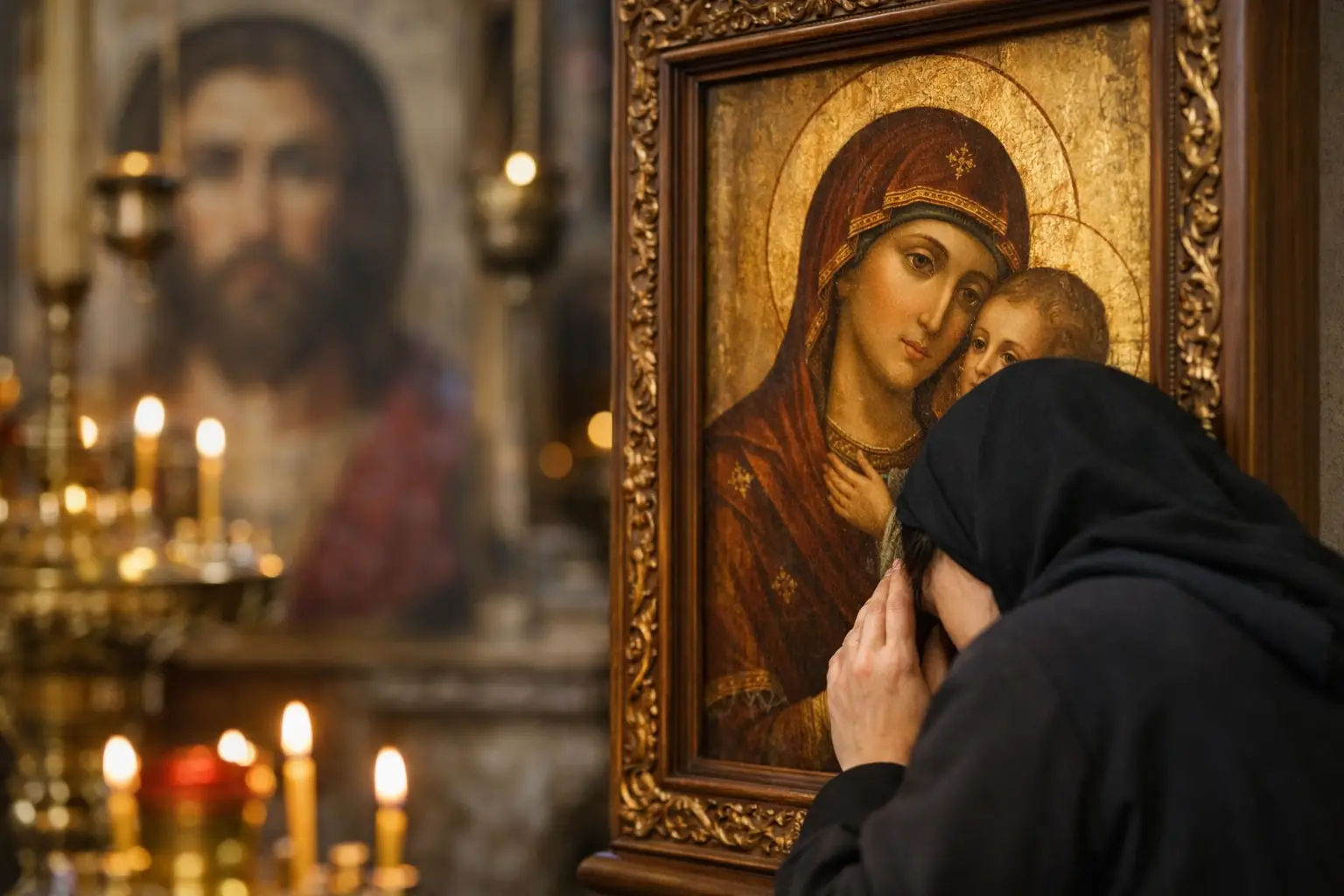
A Christian enters a church, approaches an icon of Christ or His Most Pure Mother, makes the sign of the Cross, bows, and kisses the image. To someone unfamiliar with Orthodox worship, this act can appear puzzling. The icon veneration meaning becomes clear only when it is seen through the Church’s confession that the Son of God truly became man, visible and present among us for our salvation.
Icons are not decorations, good-luck objects, or substitutes for God. They are holy images that direct the heart toward the Lord, the Theotokos, the angels, and the saints who stand before God. In a home prayer corner as in a church, an icon calls the faithful person to prayer, repentance, gratitude, and the remembrance of God’s saving work.
Icon Veneration Meaning: Honor, Not Worship
Orthodox Christianity makes a careful distinction between worship and veneration. Worship belongs to God alone: the Father, the Son, and the Holy Spirit. In theological language, this adoration is called latreia. No saint, angel, relic, cross, or painted image receives it.
Veneration is honor shown to what is holy. The Greek term often used is proskynesis, which can include bowing, kissing, censing, or lighting a candle. When Orthodox Christians venerate an icon of Christ, they worship Christ Himself, not wood, paint, silver, or glass. When they kiss an icon of the Mother of God or a saint, they honor the person depicted and ask for that person’s prayers before the throne of God.
The Church expresses this truth simply: the honor shown to the image passes to its prototype. A family photograph is not the person portrayed, yet it may be treated with affection because it brings that person to mind. An icon is far more than a sentimental picture, but the comparison helps explain that Orthodox Christians do not confuse an image with the holy person represented by it.
Material beauty therefore has a proper place in Christian devotion. Fine silver 999 plating, careful handwork, rich color, and a dignified icon case can honor a sacred image, but precious materials do not make an icon magical. Their purpose is reverence: to offer the best of human craftsmanship to the glory of God.
Why Icons Are Possible Because Christ Became Man
The central reason for icons is the Incarnation. Before the coming of Christ in the flesh, God had not been seen in His divine essence. Yet Jesus Christ, the eternal Word, took a real human body from the Virgin Mary. He was born, touched, seen, and heard. As Scripture says, “The Word became flesh and dwelt among us.”
Because the invisible God was revealed in the visible humanity of Christ, Christians may portray Christ according to His human appearance. An icon does not attempt to depict God’s invisible essence. It confesses that the Son truly entered history and sanctified human nature.
This is why the rejection of holy icons became such a serious matter in the Church. During the iconoclastic controversy, some believers feared that images inevitably led to idolatry. The Seventh Ecumenical Council, held at Nicaea in 787, answered by affirming the ancient Christian practice of honoring icons. The council did not permit idolatry. It defended the truth that Christ came in the flesh and that matter can serve as a bearer of grace.
The same principle is present throughout Orthodox life. Water is blessed at Theophany. Bread and wine become the Holy Gifts by the action of the Holy Spirit. Oil is used in anointing. Beeswax candles burn before icons as offerings of prayer. God does not save the human person as a disembodied idea. He saves body and soul, and He allows created things to participate in His holy work.
What an Icon Shows the Faithful
An Orthodox icon is not intended to be religious art in the modern sense, where personal expression or naturalistic appearance is the chief goal. It follows a sacred language shaped by Scripture, worship, and Church tradition. The halo reveals holiness. Inscriptions identify the person portrayed. The calm, prayerful face invites stillness rather than mere admiration.
The icon of Christ Pantocrator proclaims Him as the Lord and Judge of all. The icon of the Theotokos reveals the mystery of the Incarnation, for she holds the Child who is truly God and truly man. Icons of Saint Nicholas, Saint Spyridon, Saint George, the Guardian Angel, and other beloved saints remind us that holiness is not distant. These faithful servants of God lived on earth, struggled, repented, and now intercede for us.
Some icons are especially revered because of their history, association with a monastery or temple, or the many prayers offered before them. The word “miraculous” should be understood with sobriety. The grace and mercy belong to God, not to an object as if it possessed power apart from Him. Still, God has often consoled, healed, protected, and guided His people through prayers before particular icons. The faithful honor these testimonies with gratitude and humility.
How to Venerate an Icon Prayerfully
Veneration does not require complicated gestures. It requires a sincere heart. Before an icon, a person may make the sign of the Cross, bow, and offer a brief prayer. At home, this may happen in the morning and evening, before a journey, in a time of illness, or when interceding for family members.
A common practice is to light a beeswax candle or lamp before the icons and stand quietly. One might pray before an icon of Christ, “Lord Jesus Christ, have mercy on me.” Before the Theotokos, one may ask her maternal intercession. Before a saint, the prayer is not directed as worship to the saint, but as a request: holy servant of God, pray to God for us.
Kissing an icon is a traditional expression of reverence, but it should never become hurried or superstitious. We do not approach a sacred image to demand a particular outcome. We come to place our need before God, accepting His wisdom and mercy. If someone is ill or cannot kiss an icon, a bow, a sign of the Cross, or a prayerful gaze is fully fitting.
There are also practical customs that preserve reverence. Icons should be kept in a clean, dignified place, ideally in the prayer corner rather than among ordinary household decorations. Avoid placing them carelessly on the floor or treating them as seasonal ornaments. When an icon is given for a baptism, wedding, name day, feast day, or house blessing, its greatest value is not its frame or finish but the prayerful life it encourages.
Choosing an Icon for Home or Gift
The best icon is often the one that supports a real spiritual need. A newly married couple may receive an icon of Christ and the Theotokos for their home. Parents may choose a Guardian Angel icon for a child. A person named Nicholas, George, or Spyridon may treasure an icon of his heavenly patron. A portable icon in a protective case can accompany travel, while a larger hand-finished icon may become the center of a family prayer corner.
Craftsmanship matters because an icon deserves careful treatment. A canonically faithful image, made with prayerful attention by experienced artisans or connected with monastery tradition, gives confidence that the sacred subject has been represented with dignity. Yet cost and ornament should be considered honestly. A modest color icon can serve a household’s prayer as faithfully as an elaborate silver-plated icon. The right choice depends on the occasion, the space, and the means of the family.
At Andcross Orthodox Online Store, icons, crosses, prayer books, candles, and gift cases are offered not merely as religious articles, but as companions for a Christian home shaped by prayer and tradition. A well-chosen icon can become a lasting baptismal gift, a comfort during hardship, and a quiet witness of faith passed from one generation to the next.
The faithful do not stand before an icon to remain with the image. They stand before it so that the heart may rise to God. In that reverent movement of prayer, the face of Christ, His Mother, or His saint becomes a reminder that heaven is near, and that no sincere prayer is offered alone.


