How to Arrange an Icon Corner in Your Home
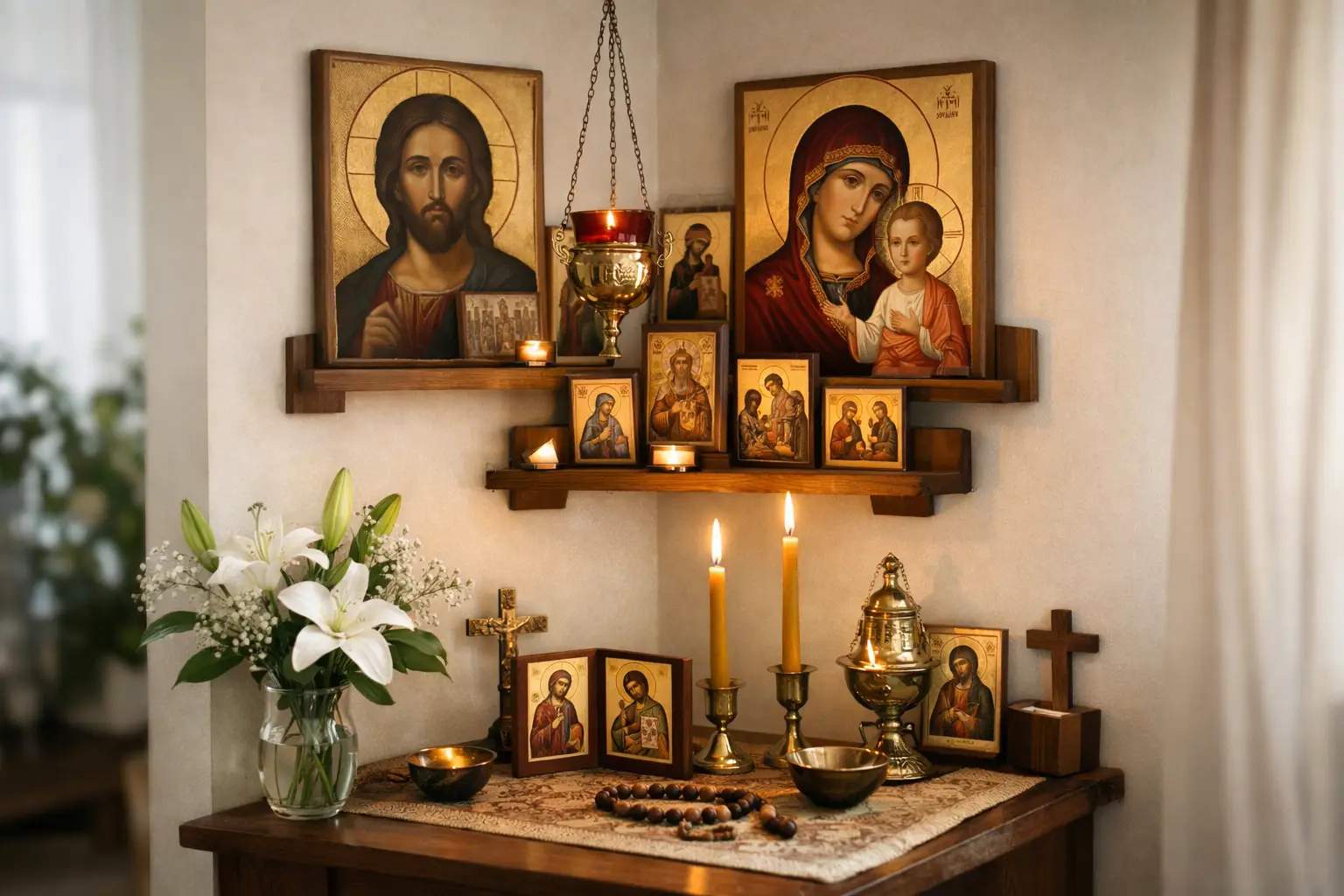
A home icon corner is not a display of religious art. It is a small domestic sanctuary: a place to stand before Christ, ask the prayers of His Most Pure Mother and the saints, light a candle, and begin or end the day with attention turned toward God. Learning how to arrange an icon corner begins not with decoration, but with this purpose.
Orthodox families have kept prayer corners for centuries, whether in spacious homes, city apartments, or a single quiet room. The size may change, and the number of icons may be modest, but the calling remains the same: to set apart a place for prayer and to keep it with reverence.
Choose a Place Set Apart for Prayer
Traditionally, the icon corner is placed on the eastern wall of the home, so that those praying face east, toward the rising sun and the expectation of Christ’s glorious return. If an eastern wall is practical, it is a beautiful custom to follow. Yet a home should not be made anxious by its floor plan. In many apartments and modern houses, windows, doors, furniture, and limited wall space make this impossible.
Choose instead a clean, quiet place where the household can stand to pray without distraction. A corner of the living room, a wall in a bedroom, or a dedicated shelf in a family room can become a worthy place for icons. Avoid placing icons where they will be treated casually, crowded by clutter, or positioned directly beside objects that distract from prayer.
The icon corner should also be reasonably accessible. If it is hidden behind furniture or placed so high that no one can approach it with a candle or prayer book, it can become merely symbolic. A prayer corner invites use. Even a small shelf with two icons and a beeswax candle can become the spiritual heart of a home when the family gathers there faithfully.
How to Arrange an Icon Corner with Reverence
The central foundation of an Orthodox icon corner is an icon of Our Lord Jesus Christ and an icon of the Theotokos, the Mother of God. Christ is the Savior and Lord of the home; the Theotokos is honored as the one who bore God in the flesh and continually intercedes for the faithful.
A common arrangement places the icon of Christ on the right and the icon of the Theotokos on the left as you face the icons. Local customs may differ, and there is no need to turn a prayer corner into a matter of rigid measurement. What matters is that Christ and His Mother hold the principal place, with other icons arranged around them in an orderly and prayerful manner.
Many families place a cross above the icons or at the highest point of the arrangement. This gives visible expression to the mystery at the center of Christian life: Christ crucified and risen for the salvation of the world. A wall cross, a small crucifix, or a carefully placed blessing cross may be used according to the space available.
If the icons rest on a shelf, use a stable surface. An icon stand, a carved wooden shelf, or a protective icon case can help keep sacred images upright, clean, and safe from accidental damage. Fine silver 999-plated icons and handmade wooden icons especially deserve protection from moisture, smoke buildup, and direct sunlight.
Add Family and Patron Saint Icons Thoughtfully
After Christ and the Theotokos, add the saints most closely connected with your household. This may include the patron saint of each family member, the Guardian Angel, Saint Nicholas the Wonderworker, Saint George, Saint Spyridon, Saint Seraphim of Sarov, or saints especially beloved in your parish and cultural tradition.
An icon of the feast day of a child, a baptismal saint, or a family patron can make the corner more personal without making it crowded. There is no required number of icons. A small home may have only the Savior, the Theotokos, and Saint Nicholas. Another family may keep a larger collection gathered over many years, including wedding icons, baptismal gifts, monastery-made icons, and treasured images received from parents or grandparents.
Arrange additional icons below or beside the primary icons, rather than allowing them to compete visually with Christ and the Theotokos. If your collection is growing, it is often better to create a second prayer shelf than to layer icons so closely that none can be properly seen or venerated.
Keep the Prayer Corner Simple and Clean
A prayer corner should be beautiful, but beauty in an Orthodox home is not the same as ornament for ornament’s sake. A clean cloth, embroidered rushnyk, small shelf covering, or modest floral arrangement may be fitting. Fresh flowers are especially appropriate on feasts, for Pascha, and in honor of the Theotokos. Keep artificial decorations and unrelated household objects away from the icons.
It is customary to keep a candleholder or oil lamp before the icons. Beeswax candles are especially cherished for home prayer because of their natural fragrance and long association with Orthodox worship. Light them attentively and only when they can be safely watched. Place the candleholder on a nonflammable surface, well away from curtains, paper icons, dried flowers, and low shelves.
A small prayer book, Gospel book, prayer rope, holy water, and a list of names for commemoration may also be kept nearby. These objects serve prayer directly and belong naturally in the icon corner. If there is room, a small container for blessed bread or a vial of oil from a holy place may be stored respectfully as well.
Avoid making the corner a storage shelf for keys, mail, receipts, chargers, or everyday household items. This is not about perfection or fear of making a mistake. It is about teaching the eye and the heart that prayer has a place in the life of the home.
Venerate Icons Properly
Icons are venerated, not worshiped. Worship belongs to God alone. When Orthodox Christians bow before an icon or kiss it, the honor passes to the person depicted: Christ, His Mother, or the saint who stands before God in prayer for us.
When approaching the icon corner, many faithful begin with the sign of the cross and a bow. It is customary to venerate the icon of Christ first, then the Theotokos, followed by the saints. During prayer, stand quietly if health permits. A chair may be kept nearby for an elderly person, someone recovering from illness, or anyone unable to stand for long periods.
The home is not a church temple, and the prayer corner does not replace participation in the Divine Liturgy, confession, Holy Communion, or the blessing of a priest. Rather, it helps carry the prayer of the Church into daily life. Morning prayers, evening prayers, reading the Psalms, and brief petitions for departed loved ones all find a natural place here.
Blessing a New Icon Corner
If possible, ask your parish priest to bless your home and icon corner, especially when establishing one for the first time. His prayer brings pastoral care and connects the household more deeply with the worshiping life of the parish. If a priest cannot visit soon, do not delay prayer until every detail is complete. Set up the icons reverently, begin your rule of prayer, and arrange a home blessing when it becomes possible.
Icons acquired from a monastery, temple, or trusted Orthodox source are often already blessed or prepared for devotional use. Even so, what gives life to an icon corner is not a label, a costly frame, or the number of sacred objects it contains. It is the faithful turning of the household toward Christ.
For a gift of lasting spiritual value, an icon of Christ, the Theotokos, a Guardian Angel, or a family’s patron saint can help a newly married couple, godchild, or new homeowner establish this sacred place. Andija offers devotional icons, prayer articles, beeswax candles, and gift-ready pieces chosen with this same purpose in mind.
Let the Corner Grow with the Prayer of Your Home
Do not feel pressure to complete an icon corner in one purchase. A prayer corner often grows slowly, receiving an icon at baptism, another at marriage, a feast-day gift, or an image of a saint whose intercession becomes especially dear during a season of trial. This gradual gathering can become part of a family’s living history of faith.
Keep the place orderly, refresh the candle supply, dust the icons gently, and return to it even on hurried days. A single prayer before the icons – “Lord Jesus Christ, have mercy on me” – is never small when offered with humility. In this way, the icon corner becomes not simply a corner of the home, but a quiet witness that the home belongs to God.


