Silver Plated Icon Guide for Prayer and Gifting
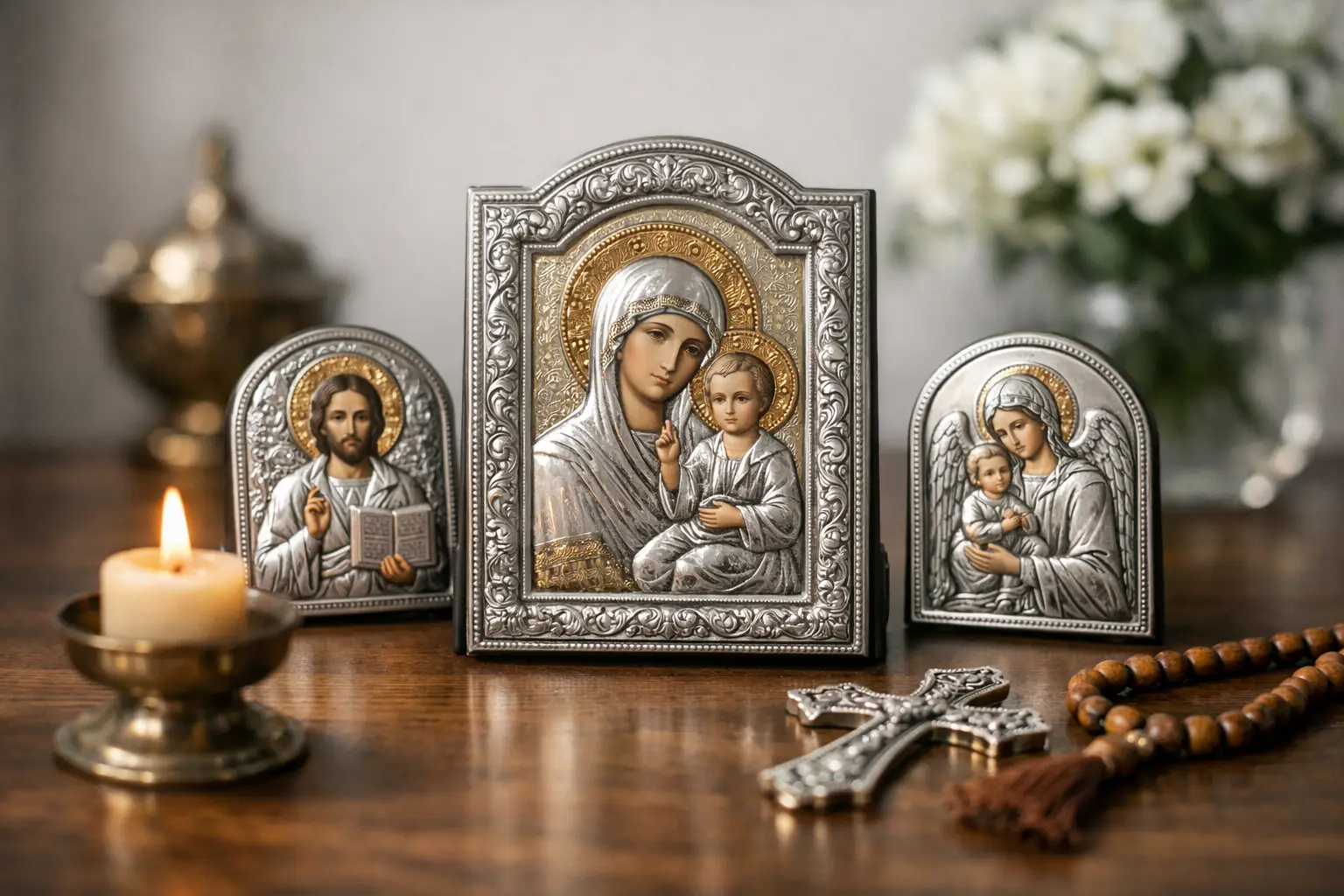
A silver plated icon is not chosen in the same way as an ordinary household object. It enters the prayer life of a home, stands before the faithful in moments of gratitude and sorrow, and may be handed down as a blessing from one generation to the next. This silver plated icon guide is intended to help you select an icon with reverence for its sacred image, attention to its workmanship, and care for the person who will pray before it.
Orthodox Christians do not worship wood, paint, or silver. We venerate the holy persons depicted, giving honor to the prototype through the image. As the Seventh Ecumenical Council taught, honor shown to the icon passes to the one represented. For this reason, a well-made icon belongs naturally in the red corner, beside a family prayer book, or as a meaningful gift for a baptism, wedding, name day, or feast.
What Makes a Silver Plated Icon Special?
A silver plated icon unites a printed or painted sacred image with a carefully worked metal covering, often called a riza or oklad. The covering typically reveals the face and hands of Christ, the Theotokos, or the saint, while fine silver plating forms the halo, garments, border, and ornamental details around them.
This presentation has deep roots in Orthodox lands. For centuries, the faithful have adorned revered icons with precious materials as an offering of love and thanksgiving. Silver is valued not merely for its brightness, but for the dignity it lends to an image of the Savior, His Most Pure Mother, or His saints.
Fine silver 999 plating is especially prized for its high purity and luminous finish. It can bring out the folds of a mantle, the rays of a halo, the delicate pattern of a border, and other details that may not be as visible in a standard printed icon. The result is solemn rather than showy when the workmanship is faithful to the icon’s sacred purpose.
A silver plated icon is not necessarily a fully solid silver icon, and this distinction matters when comparing pieces. Plating offers the beauty and traditional appearance of silver while making a devotional icon more accessible for family prayer corners and gift occasions. The value rests in the quality of the image, the metalwork, the materials beneath the covering, the craftsmanship, and the spiritual care with which the icon is received.
Silver Plated Icon Guide: Begin With the Holy Image
The first question is not, “Which frame matches the room?” It is, “Before whom am I seeking to pray?” Orthodox icons are windows toward the heavenly kingdom, and the image should be selected according to devotion, need, and established tradition.
An icon of Christ Pantocrator is a fitting foundation for a home prayer corner. The Savior is often shown blessing with His right hand and holding the Gospel with His left, reminding the faithful that He is both Lord and Teacher. An icon of the Most Holy Theotokos, especially the Kazan, Vladimir, or Tenderness type, is beloved for prayers for family protection, mercy, comfort, and maternal intercession.
For a personal gift, consider the recipient’s baptismal or patron saint. Saint Nicholas the Wonderworker is cherished by travelers, families, and all who seek help in difficulty. Saint George is often chosen for courage and steadfastness. Saint Spyridon is invoked in times of material hardship and urgent need. A Guardian Angel icon is especially appropriate for a child, godchild, or loved one beginning a new chapter of life.
It also helps to distinguish between an icon chosen for daily prayer and one chosen for a particular occasion. A family may need Christ and the Theotokos as the center of its prayer corner, while a name-day gift may be more personal when it bears the recipient’s heavenly patron. Neither choice is more decorative or more fashionable than the other. Both should lead the heart toward prayer.
Canonical Image Matters
A silver covering cannot make an unsuitable image spiritually meaningful. Look for iconography rooted in Orthodox tradition, with recognizable inscriptions, traditional gestures, and a reverent portrayal of the holy person. Canonical imagery protects the continuity of faith and helps ensure that the icon may be received naturally into Orthodox prayer.
This does not mean every icon must look identical. Orthodox iconography includes regional schools, Russian, Greek, Serbian, Romanian, and other inherited styles. Colors, borders, and artistic details may vary. What should remain constant is the theological truth expressed through the image and its faithful connection to the Church’s sacred tradition.
Choose Size for the Place of Prayer
Size influences how an icon will serve its household. A smaller silver plated icon is often suitable for a desk, bedside table, travel case, or a child’s prayer space. Medium sizes are practical for a shelf or home icon corner. A larger icon can become a central image for a family prayer area or a place where relatives gather on feast days.
Before choosing, measure the intended space. Consider whether the icon will stand on a shelf, hang on a wall, or be displayed in an icon case. Leave room for a lampada, beeswax candles, a Gospel book, or additional icons, without crowding the sacred images together.
Gift presentation also deserves thought. A compact icon in a fitted gift box is especially fitting for a baptism, wedding, or name day because it can be kept safely and carried home with ease. A larger icon may be better for a family establishing a new home or for parents and grandparents who wish to create a lasting prayer corner.
Look Closely at Craftsmanship and Materials
The beauty of a silver plated icon is found in details that photographs do not always fully reveal. Examine the clarity of the face, the evenness of the metal covering, the definition of the halo, and the care taken with the border and corners. Fine workmanship should draw attention toward the holy image, not distract from it.
A quality backing is also important. Wood, solid composite board, or other stable materials help the icon rest securely and retain its form. Check whether there is a stand, a hanging fixture, or both, depending on how the icon will be placed. If it is meant as a gift, a protective box or case provides both a dignified presentation and practical safekeeping.
Handmade details may mean that small variations occur from one icon to another. This is not necessarily a flaw. When the metalwork is created or finished by hand, slight differences can testify to the work of an artisan rather than mass-produced uniformity. Still, handmade should never excuse poor alignment, loose fittings, or an unclear image.
Some icons are produced by workshops connected with monasteries or are made according to traditional methods by Orthodox artisans. For many faithful, this provenance carries special meaning. It is wise, however, to understand descriptions accurately. An icon may be monastery-made, created by an artisan, blessed in a church, or supplied with a blessing for use in prayer. These are meaningful distinctions, and a reputable Orthodox seller should describe them plainly.
Caring for a Silver Plated Icon
An icon should be treated with cleanliness and respect, but it does not require harsh cleaning products. Keep it away from persistent dampness, direct heat, and prolonged strong sunlight. Dust the surface gently with a soft, dry cloth. Do not use abrasive polishes, chemical sprays, or rough paper towels on the silver-plated covering, as these may dull the finish or damage delicate relief work.
If the icon is kept near candles or an oil lamp, place it safely above and behind the flame, never where soot, heat, or an accidental flame can reach it. Candles are offered in prayer, not used as decoration, and their placement should always protect the icons and those praying nearby.
When moving or storing the icon, wrap it in a clean soft cloth or return it to its gift box. Do not stack heavy objects on top of it. Such simple care preserves the icon’s appearance while honoring the sacred image it bears.
Giving an Icon With Reverence
A silver plated icon is among the most enduring Orthodox gifts because it is both personal and prayerful. It can mark a baptism, chrismation, wedding, name day, birthday, graduation, house blessing, or a season when someone needs comfort and intercession. Unlike a gift chosen only for a moment, an icon remains present through the years.
When selecting an icon for another person, let the occasion guide you without reducing the gift to an occasion. A Guardian Angel or patron saint icon suits a child or godchild. Christ and the Theotokos are fitting for newly married couples and new homes. Saint Nicholas, Saint Spyridon, or another beloved saint may bring particular comfort to someone facing a burden.
Andija has served Orthodox faithful since 1999 with icons, crosses, prayer articles, and gift-ready sacred objects rooted in Russian and wider Orthodox tradition. Whether an icon is chosen for one’s own prayer corner or offered to someone dearly loved, its true place is found when it becomes a quiet companion in prayer.
Set the icon where it may be approached with attention. Light a candle when appropriate, make the sign of the Cross, and ask the Lord, His Most Pure Mother, or the saint depicted to guide the home in peace, faith, and steadfast hope.


