A Prayerful Guide to Byzantine Icon Symbolism
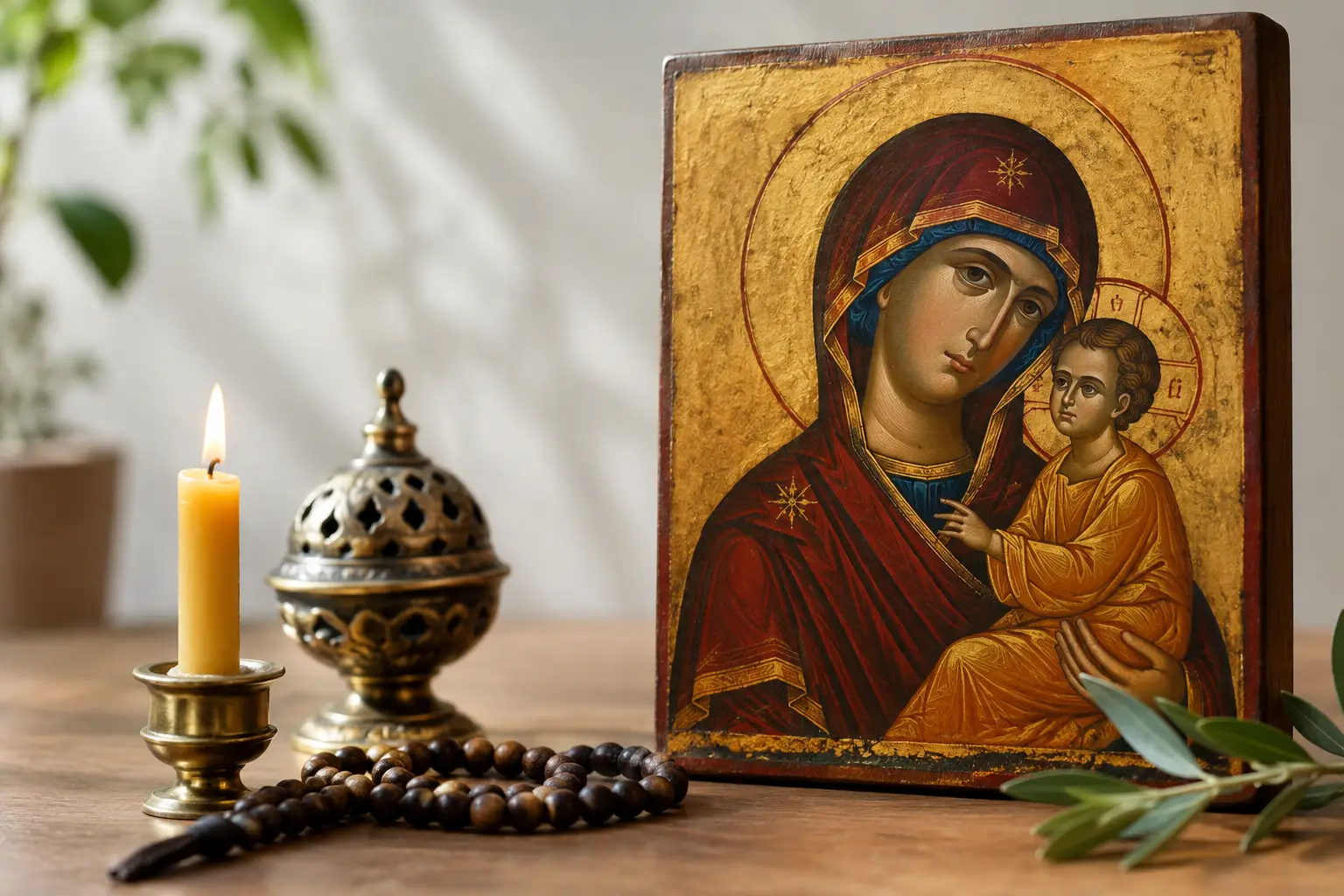
An Orthodox icon is not a religious illustration meant to make a room feel historic or beautiful, though a finely made icon brings beauty to the home. It is a sacred image that calls the faithful to prayer and bears witness to the Incarnation of Christ. This guide to Byzantine icon symbolism helps the faithful read an icon with greater reverence: not as a puzzle to solve, but as a meeting with the Lord, His Most Pure Mother, the angels, and the saints.
The Church honors icons because the Son of God truly took flesh and became visible. As Saint John of Damascus taught, the honor offered to the image passes to the prototype. Orthodox Christians do not worship wood, paint, or silver. We venerate the person depicted, asking for prayerful intercession and turning our hearts toward God.
A Guide to Byzantine Icon Symbolism in Prayer
Byzantine iconography is governed by tradition and church canons. Its visual language has developed across centuries of worship, preserving the theology of the Church in color, line, gesture, and inscription. For this reason, an icon can seem quiet at first glance, yet every faithful detail speaks.
The icon does not attempt to copy ordinary visual experience. A portrait may seek a natural likeness, with changing light, deep shadows, and a particular moment of emotion. An icon reveals a person transfigured by grace. The saint is recognizable as a real human person, but is shown in the light of the Kingdom rather than through the passing conditions of daily life.
This is why canonical icons often have solemn faces, elongated features, and restrained expressions. The purpose is not sadness or distance. The stillness calls the viewer away from distraction. Large, attentive eyes suggest spiritual watchfulness; small mouths suggest restraint in speech; refined ears suggest readiness to hear the word of God. These are theological signs, not decorative conventions.
The halo and the name
A halo, also called a nimbus, is one of the clearest signs of holiness. It does not mean that the saint was less human. It signifies that the person participates in divine grace. In an icon of Christ, the halo contains a cross and the Greek letters O ON, meaning He Who Is. This confession identifies Jesus Christ with the eternal God revealed in Scripture.
The inscription is equally important. Icons are named because Orthodox devotion is personal, not vague. The letters beside the Savior, the Theotokos, an angel, or a saint tell the faithful whom they are venerating. In traditional Greek icons, the Mother of God is often marked MP ΘY, an abbreviation for Mother of God. Slavic icons may use Church Slavonic inscriptions. A well-made icon preserves these holy names with care.
Christ blesses and teaches
Christ is frequently shown with His right hand raised in blessing and the Gospel book in His left hand. The blessing hand is not merely a pleasant gesture. It proclaims His divine authority and gives peace to those who approach Him in faith. The Gospel may be open, bearing words of teaching, or closed, expressing the fullness of divine wisdom.
The colors of Christ’s garments are also meaningful. In many traditional icons, He wears a red inner garment and a blue outer garment. Red may signify His divinity and royal dignity, while blue speaks of His humanity assumed in the Incarnation. Details can vary according to iconographic school and feast, so color should not be treated as a rigid code detached from the whole icon.
The Theotokos points to her Son
Icons of the Most Holy Theotokos reveal her unique place in the life of the Church: she is honored above all saints because she gave birth to God the Word in the flesh. Yet canonical images never present her as separate from Christ. Her hand often points toward the Savior, especially in the Hodigitria type, meaning She Who Shows the Way. Her prayerful gesture teaches the faithful where to look.
Her outer mantle is commonly deep red or burgundy, signifying her human nature and royal dignity, while the blue beneath may point to heavenly grace. Three stars, commonly placed on her head and shoulders, proclaim her virginity before, during, and after the birth of Christ. One may be hidden by the Christ Child in a particular composition, but its meaning remains.
Saints carry the signs of their witness
Saints are not chosen for an icon because they are distant heroes. They are living intercessors in Christ. Their garments, hands, and attributes often recall their earthly ministry or martyrdom. Saint Nicholas may hold the Gospel and bless. Saint George may appear on horseback, overcoming the dragon as a sign of victory over evil. Saint Spyridon is often recognized by his simple woven cap, recalling his humility as a shepherd.
Martyrs may carry crosses, showing that they bore witness to Christ even unto death. Bishops wear liturgical vestments and may hold the Gospel. Monastics are depicted in the garments of their calling, reminding the faithful of repentance, prayer, and obedience. Guardian Angel icons portray the heavenly protector given by God, usually with a staff, wings, and a cross.
These attributes help identify the saint, but the central message is always holiness. A saint’s icon asks a quiet question of the person standing before it: how may I follow Christ more faithfully in the life given to me?
Color, Light, and Sacred Space
Gold backgrounds and gold halos are not simply signs of luxury. Gold does not behave like ordinary paint. It catches and reflects light, suggesting the uncreated light of God and the radiance of the heavenly Kingdom. Fine silver 999 plating, often used on revered icons and icon coverings, can likewise honor the sacred image through careful craftsmanship while allowing the painted faces and hands to remain visible.
White often signifies divine light, purity, resurrection, and glory. At the Transfiguration, Christ’s garments shine with radiant whiteness. Blue can evoke heaven, mystery, and divine grace. Green is associated with life, renewal, and the Holy Spirit, while red can speak of sacrifice, kingship, love, and martyrdom. Dark colors may express mourning, humility, or the fallen condition of the world awaiting redemption.
No color has one mechanical meaning in every icon. Context matters. A feast icon, a Mother of God icon, and an icon of a martyr may use the same color differently. The faithful should read color in relation to the holy person, the event depicted, and the Church’s confession of faith.
Byzantine icons also use a perspective that can seem unfamiliar. Buildings may tilt forward, and lines may appear to widen toward the viewer rather than recede into the distance. This is often called inverse perspective. Instead of drawing the eye into an imagined landscape, the icon opens sacred space toward the person praying. The icon does not imprison heaven behind a painted horizon. It invites the faithful to stand before the mystery.
How to Read an Icon at the Prayer Corner
Begin by identifying the person or feast depicted through the inscription. Make the sign of the cross, light a beeswax candle or lampada if this is part of your household practice, and stand quietly. A short prayer is enough: ask Christ for mercy, ask the Theotokos for her maternal intercession, or ask the saint to pray for you.
Then notice what the icon presents. Is Christ blessing? Is the Theotokos directing your gaze toward Him? Is the saint holding a cross, a Gospel, or another sign of service? Do not rush to interpret every fold of a garment. Prayer comes before analysis. The purpose of sacred symbolism is to lead the heart toward repentance, gratitude, courage, and communion with God.
For a home prayer corner, an icon of Christ and an icon of the Theotokos form a fitting foundation. Families often add their patron saints, the Guardian Angel, Saint Nicholas, or feast icons cherished through family tradition. A carefully made color icon or silver-plated icon in a protective case may also become a meaningful baptism, wedding, name-day, or housewarming gift.
Material beauty has its proper place when it serves reverence. Handmade workmanship, a dignified icon case, and a blessed image from a monastery or Orthodox workshop can help a family preserve an icon for generations. Yet size, precious-metal details, and presentation should never overshadow the first question: will this image become a faithful companion in prayer?
Set the icon in a clean and honorable place, away from ordinary clutter. Venerate it with a bow and a kiss when appropriate, not on the face but traditionally on the hand, feet, or edge of the icon. Teach children the holy names they see there. Over time, the colors and symbols become familiar, and the prayer corner becomes not a display, but a small witness to the Kingdom within the home.
The deepest meaning of an icon is discovered slowly, in the repeated turning of the heart toward God. Stand before it with attention, call upon the saint by name, and let the sacred image lead you to the One whom every icon proclaims.


