Miraculous Orthodox Icons and Prayer at Home
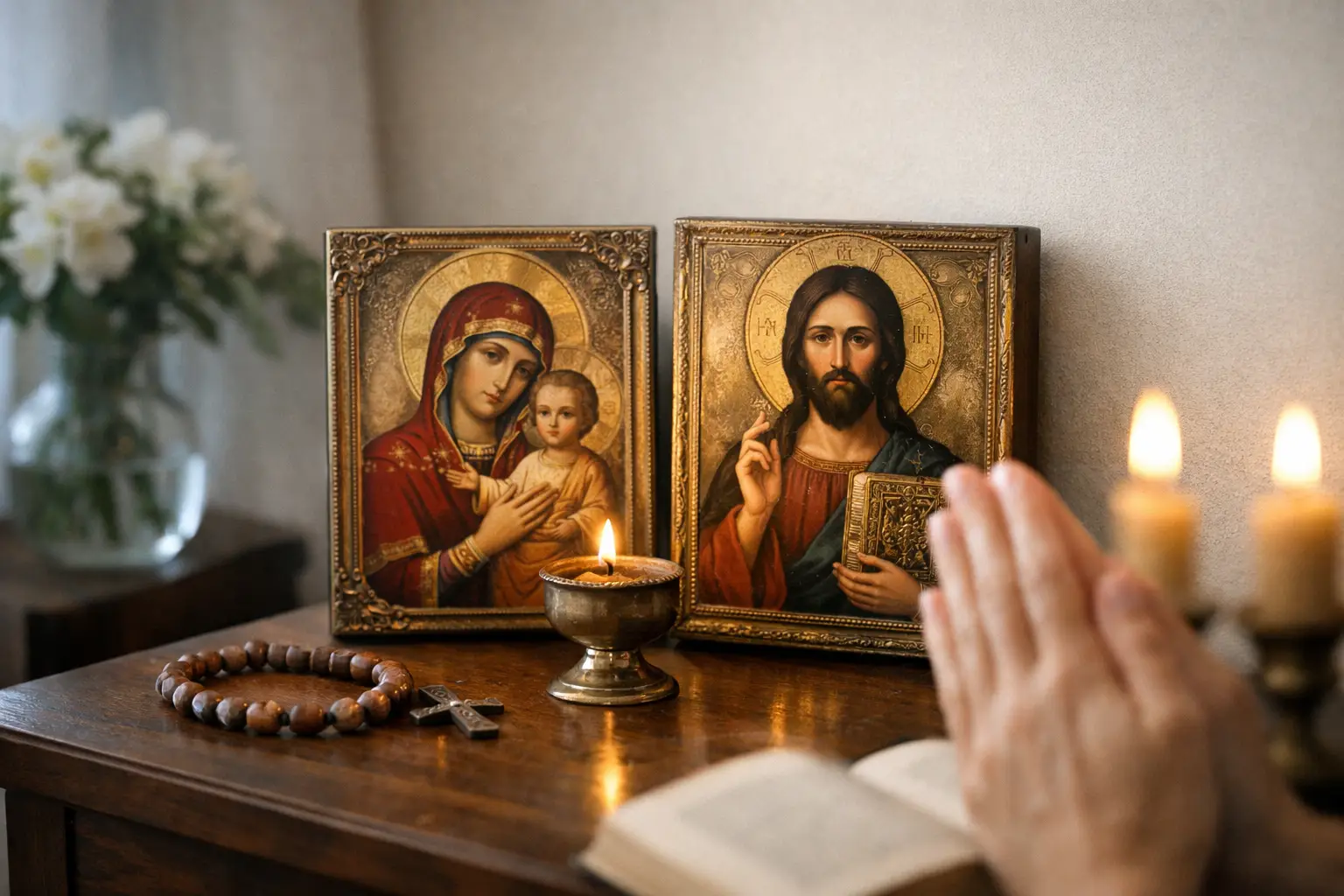
A family may remember that help came during an illness, a difficult journey, or a season of grief after standing before a particular icon with prayer. Such testimonies explain why miraculous Orthodox icons are treasured across generations. Yet the Orthodox Christian does not approach an icon as a charm or a source of impersonal power. Before the holy image, the faithful person turns to the living Lord, His Most Pure Mother, or the saint depicted, asking for mercy, intercession, strength, and peace.
The Church honors icons because the Son of God truly became man. In the Incarnation, the invisible God was revealed in the face of Jesus Christ. An Orthodox icon therefore bears witness to a central confession of faith: God has entered human history, sanctified matter, and called human persons into communion with Him. When an icon becomes known as miraculous, its place in the life of the Church is not spectacle. It is a call to deeper repentance, gratitude, and prayer.
What Makes an Orthodox Icon Miraculous?
The word miraculous is used carefully in Orthodox tradition. It may refer to an icon associated with healings, protection, consolation, answered prayers, or other signs of God’s mercy. Often, devotion grows over many years as believers bring their experience to the Church. A revered icon may be connected with a monastery, temple, pilgrimage site, or a local community that has prayed before it faithfully through hardship.
The miracle is never understood as belonging to wood, paint, silver, or any other material by itself. Honor offered to the image passes to the person represented. Christians venerate an icon with a kiss, a bow, or a lighted candle, but worship belongs to God alone. This distinction protects the sacred meaning of the icon and keeps devotion rooted in the Gospel rather than superstition.
Many of the most beloved miraculous icons portray the Theotokos, the Mother of God. The faithful seek her maternal intercession because she led the world to Christ and continues to pray for those who call upon her Son. Icons of Christ, Saint Nicholas the Wonderworker, Saint Spyridon, Saint George, the Guardian Angel, and other saints are also received with heartfelt devotion. Each image directs the gaze beyond itself, toward the heavenly person whose life reveals God’s grace.
A miracle may be outward and unmistakable, but it can also be quiet. Reconciliation within a family, courage before surgery, freedom from despair, or the return of a person to confession and the Holy Mysteries may be the mercy for which someone has prayed. No one should demand a particular result from God. Prayer is not a transaction. It is the humble placing of one’s need before the Lord: “Thy will be done.”
Miraculous Orthodox Icons in the Prayer Corner
A home icon corner is not a display shelf. It is a small place of prayer where the household remembers that Christ is the true center of the home. An icon known for miracles can be a precious part of this prayer corner, especially when it is chosen with reverence and given a fitting place.
Traditionally, Orthodox families place icons on an eastern wall when possible, though the practical arrangement of a home may require another location. A clean, quiet area is more important than forcing a placement that does not work. Icons should not be treated casually or placed where they can easily be damaged. A small lampada or beeswax candle may be used during prayer, provided it can be attended safely.
The customary foundation of a prayer corner is an icon of Christ and an icon of the Theotokos. From there, a family may add its patron saint, the Guardian Angel, or saints especially connected to the household’s life. An icon of Saint Nicholas may be chosen by a traveler or a family seeking his intercession. Saint Spyridon is beloved by many who bring material needs and anxious circumstances before God. Saint George strengthens those who ask for courage and steadfast faith.
There is no need to crowd the space with many images at once. A modest prayer corner, maintained with care and used daily, is more spiritually useful than an elaborate arrangement left untouched. For apartments, dormitories, and smaller homes, a compact color icon or a finely made silver-plated icon can provide a dignified focal point without requiring much room.
Choosing an Icon With Reverence
When selecting an icon, canonical imagery matters. Orthodox iconography does not simply aim to create a pleasing religious picture. Its forms, gestures, inscriptions, colors, and symbols have been shaped by the prayer and theological understanding of the Church. A canonical icon helps the faithful recognize whom they are addressing and enter the tradition handed down by generations of believers.
It is wise to begin with the saint or feast that has a genuine place in your life. A baptismal patron, a family saint, a beloved icon of the Theotokos, or Christ Pantocrator can be a natural choice. If you are purchasing a gift for a wedding, baptism, name day, house blessing, or feast day, consider the recipient’s patron saint and the size of the place where the icon will be kept.
Material and workmanship deserve attention, not because costly materials create holiness, but because beauty can be an offering. A handmade icon, monastery-made image, or icon covered in fine silver 999 plating can express honor for the holy person represented. Silver-plated icons also make enduring gifts, particularly when accompanied by a protective case. The right choice depends on purpose: a small travel icon serves differently from a larger icon intended for the family prayer corner.
For a sacred gift, presentation can be practical as well as beautiful. A fitted gift box or icon case helps protect the icon during travel and gives the recipient a proper way to keep it. If an icon is intended for a child, godchild, or someone newly entering Orthodox life, a durable, clearly rendered image is often more fitting than an overly ornate piece. The aim is not to impress, but to give an object that can remain close through years of prayer.
How to Pray Before a Revered Icon
Prayer before an icon need not be complicated. Begin by making the sign of the Cross with attention. Stand quietly for a moment. Light a candle if appropriate, then offer the prayer that is already in your heart. The Jesus Prayer, the Trisagion prayers, a Psalm, or a short request for the saint’s intercession may be enough.
For example, before an icon of the Theotokos, one may ask: “Most Holy Theotokos, save us.” Before the icon of a saint: “Holy Father Nicholas, pray to God for us,” or “Holy Great Martyr George, pray to God for us.” These are not formulas meant to control God. They are words of trust spoken within the communion of the Church.
If you have received an answer to prayer, give thanks. If the answer has not come as hoped, continue with humility and speak with a priest when sorrow or confusion becomes heavy. Orthodox faith does not deny suffering, and no icon promises an easy life. The saints themselves endured trials. Their intercession teaches us to remain near Christ within every trial.
Blessing and Caring for an Icon
A new icon may be blessed by a priest, especially if it is being placed in a prayer corner or given for an important occasion. While a blessing is a cherished practice, the faithful should avoid anxiety or magical thinking about the process. The icon’s holy purpose rests in its canonical image and in the Church’s prayerful use of it.
Keep the icon clean and protected from moisture, smoke, and direct sun. Do not place drinks, household clutter, or unrelated objects in front of it. If an icon becomes damaged, treat it respectfully and ask your parish priest how it should be repaired, stored, or disposed of. These simple acts of care teach children and guests that the icon is not ordinary decoration.
Andija offers icons made with traditional Orthodox devotion, including revered images in color and fine silver 999 plating, for homes, prayer corners, and sacred gifts. The finest icon is not merely one that is beautifully finished, though careful workmanship is a worthy offering. It is the icon that draws its owner back to prayer, back to the saints, and above all back to Christ, who receives every sincere cry for mercy.


