Handmade Icons Versus Printed Icons for Prayer
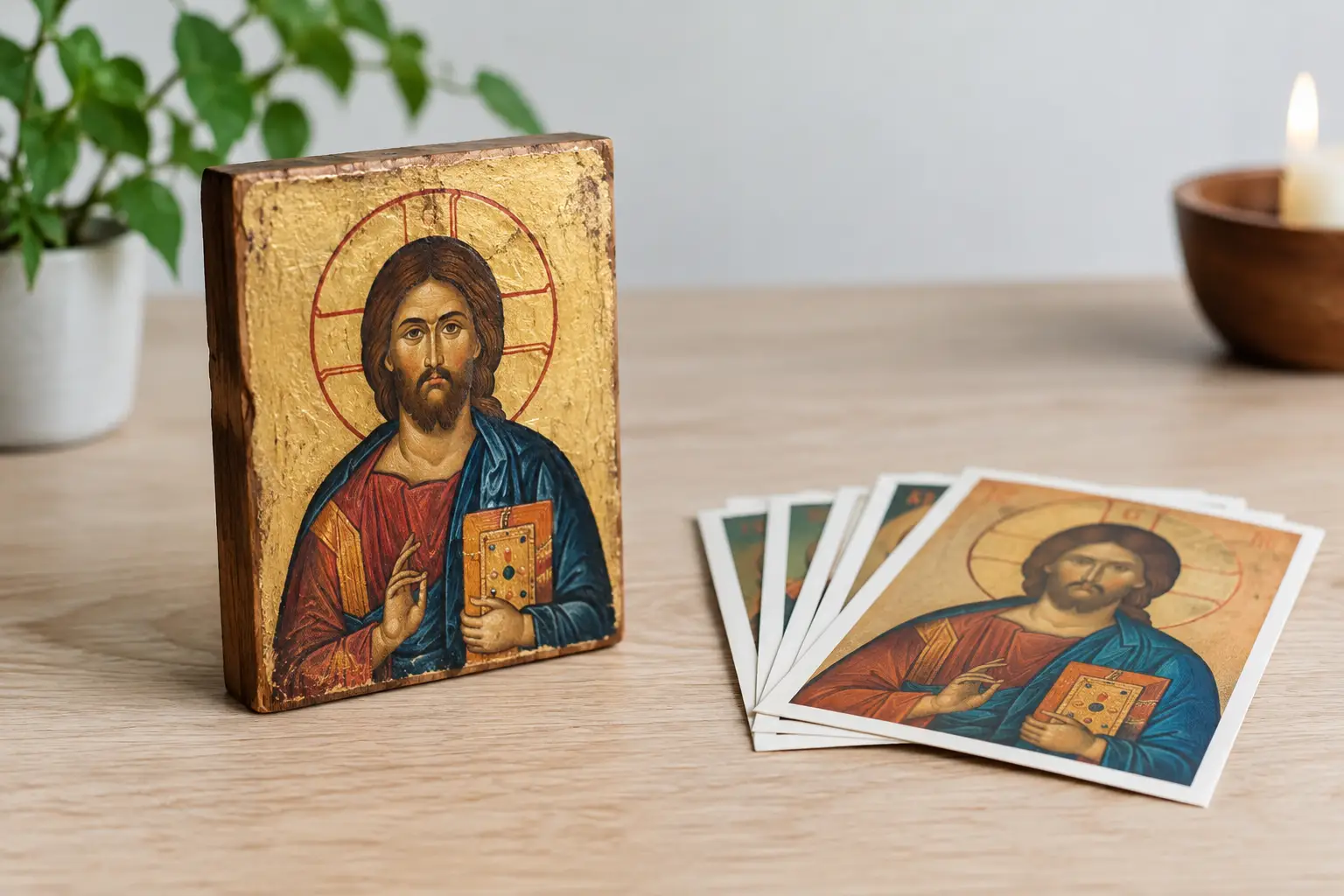
A family preparing a prayer corner may pause over one question: should the icon be hand-painted or printed? In the choice of handmade icons versus printed icons, the first concern is not decoration or price alone. An Orthodox icon is an image offered for veneration, directing the heart toward Christ, His Most Pure Mother, the angels, and the saints. The right choice is the one that supports sincere prayer, honors sacred tradition, and suits the place and purpose for which it is received.
The Church does not teach that a printed icon is without value simply because it is printed. A faithful image of the Savior, the Theotokos, or a saint can help gather the mind in prayer whether it was painted by hand or reproduced with great care. Yet the material form of an icon matters. It shapes how the image is received, cared for, given, and kept through the years.
Handmade Icons Versus Printed Icons: The Essential Difference
A true handmade icon is ordinarily written by an iconographer on a prepared wooden board. Traditional work may include a levkas ground, egg tempera, gold leaf, and protective varnish. The process is slow, disciplined, and guided by the established language of Orthodox iconography. The iconographer does not invent a religious portrait according to personal taste. He or she works within the Church’s inherited forms: the features, gestures, inscriptions, colors, and theological meaning that have been preserved across generations.
This labor gives a hand-painted icon a particular depth. Small variations in the brushwork, the modeling of the faces, and the application of gold make each piece distinct. A carefully written icon has the presence of an object made patiently for a sacred purpose, rather than an image multiplied by a machine. For many Orthodox homes, such an icon becomes a family treasure, carried through moves, feasts, sorrows, and many years of daily prayer.
Printed icons begin with an original image, photograph, or approved iconographic reproduction and are produced on paper, canvas, wood, metal, or another prepared surface. High-quality color icons can preserve remarkable detail, including the fine lines of an ancient Russian image or the luminous color of a revered depiction of the Theotokos. They are often mounted in a wooden case, placed beneath glass, or made with a silver-plated oklad that leaves the sacred face and hands visible.
A printed icon is not necessarily a lesser choice. It can be an accessible, beautiful, and canonically appropriate image for a bedside, office, travel bag, or a child’s first prayer corner. The difference lies chiefly in the method of making, the materials, the uniqueness of the object, and the level of artistry desired.
What Makes an Icon Worthy for Veneration
The question is not merely handmade or printed. Before choosing either, look first for a faithful and recognizable Orthodox image. Christ should be portrayed according to Orthodox tradition, with the proper inscriptions. The Theotokos and saints should be identifiable through their accepted iconographic types and names. A sentimental religious picture may be pleasant, but it is not always suited to the same devotional use as a canonical icon.
Provenance also deserves attention. An icon made in a monastery, received from an Orthodox workshop, or produced by experienced artisans carries a meaningful connection to the living tradition of the Church. When an icon is described as blessed, understand what the seller means and follow the practice of your parish. Many faithful also ask their priest to bless a newly acquired icon before placing it in the home.
Reverent craftsmanship matters in both forms. A printed image should be clear, color-stable, and respectfully mounted. A handmade icon should show careful adherence to canonical imagery rather than novelty for its own sake. Fine silver 999 plating, a well-made wooden киот or icon case, and dignified gift packaging can further protect and honor an icon intended for lasting use.
When a Handmade Icon Is the Right Choice
A handmade icon is especially fitting for a major spiritual milestone. It may be chosen for a baptism, wedding, house blessing, name day, ordination gift, or the beginning of a family’s prayer corner. An icon of a patron saint, written for a child who bears that saint’s name, can become a precious lifelong companion in faith.
It is also a wise choice when the icon will be the principal image in the home. Many families place an icon of Christ and the Theotokos together in the eastern corner, with a cross, prayer book, and beeswax candles nearby. In such a place, the warmth of painted wood and the quiet radiance of gold leaf can give the prayer corner a sense of permanence.
There are practical considerations as well. Hand-painted icons usually cost more because the work requires time, skilled hands, and traditional materials. They may also require more careful protection from direct sun, dampness, excessive heat, and careless handling. This is not a disadvantage when the icon is being selected as an heirloom, but it may not be the best answer for every need.
Not every item called handmade is hand-painted. Some icons are handmade in their frames, silver settings, or finishing, while the central image is printed. This can still be a beautiful devotional object, but the description should be read carefully. If you are seeking an icon written entirely by hand, look for clear information about the painting technique, board, and iconographer or workshop.
When a Printed Icon Serves Beautifully
A printed icon can make Orthodox prayer present in more places. A small image of the Guardian Angel in a child’s room, Saint Nicholas the Wonderworker near a family entryway, or Saint Spyridon in a workplace can be a gentle reminder to turn to God throughout the day. Because printed icons are available in a wider range of sizes and prices, families can place worthy images throughout the home without treating sacred objects as unattainable luxuries.
They are also particularly useful for gifts. Godparents often want to give a baptismal icon alongside a cross, prayer book, or candle set. Relatives may need a feast-day gift that is beautiful, ready to present, and appropriate for mailing worldwide. A quality printed color icon in a protective case meets these needs with dignity.
For travel, a small printed icon is often more practical than a larger painted board. It can be kept safely in a prayer book, car, suitcase, or office drawer. What matters is that it is treated with respect, not used as a lucky charm or casual ornament.
Printed icons vary greatly in quality. Avoid images with distorted faces, overly glossy surfaces, cropped inscriptions, weak color, or decorative elements that obscure the holy image. A clear reproduction of a known Orthodox icon, properly finished and protected, is far preferable to a cheap novelty image.
Choosing According to Purpose, Not Pressure
There is no need to turn this decision into a test of devotion. A hand-painted icon is not automatically more prayerful because it is more expensive, and a printed icon is not spiritually empty because it is affordable. The honor given to the icon passes to the person depicted. Prayer, repentance, attention, and love for God are not measured by the cost of the board or frame.
Still, the object before us can shape our attention. If a family has the means and seeks an icon for generations, a handmade image is a meaningful investment in sacred art and Orthodox heritage. If the need is immediate, practical, or intended for several loved ones, a carefully chosen printed icon may be the wiser and more generous answer.
Consider where the icon will stand, who will receive it, how it will be protected, and whether it marks a particular sacrament or feast. An icon of Christ or the Theotokos for the main prayer corner may call for a more substantial presentation. A small icon of Saint George, Saint Nicholas, or a Guardian Angel can be ideal for personal devotion or a thoughtful gift.
Whichever form you choose, receive the icon with reverence. Place it in a clean and honored location, light a beeswax candle when appropriate, and let it call the household back to prayer. The most beautiful icon is not merely the one with the finest gold or richest color, but the one before which hearts learn to say, again and again, “Lord, have mercy.”


