Russian Orthodox Crosses: Meaning and Tradition
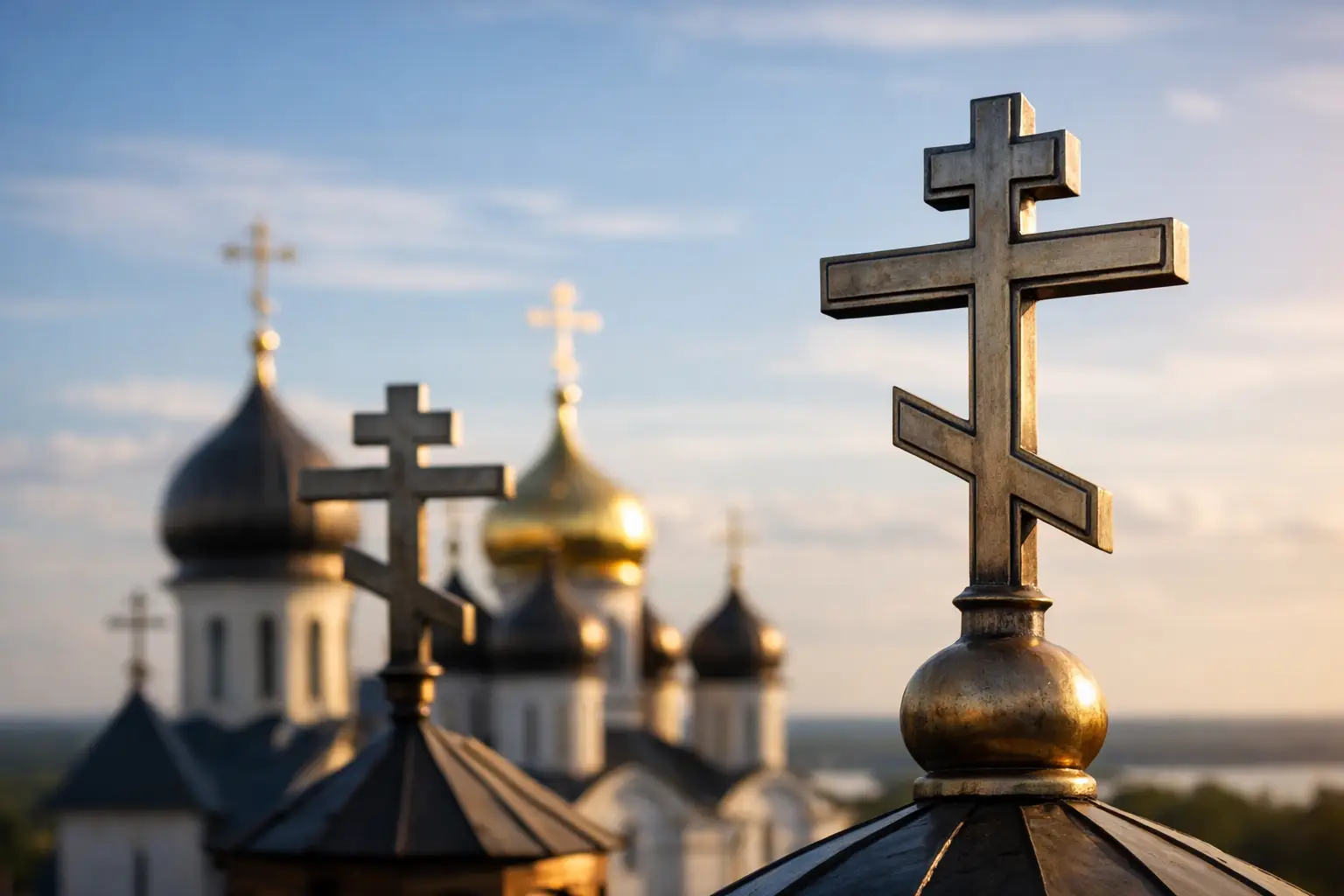
A Russian Orthodox cross is not simply a piece of religious jewelry or an ornament for the home. It is the sign of Christ’s victory over death, worn close to the heart, placed above the holy icons, and received with reverence at Baptism. Russian Orthodox crosses carry the theology of the Crucifixion in a form shaped by centuries of prayer, church art, and faithful daily use.
For Orthodox Christians, the Cross is holy because through it the Lord Jesus Christ offered Himself for the life of the world. When a believer kisses a cross, makes the sign of the cross, or wears a baptismal cross, the gesture is a confession of faith. The material may be silver, gold, wood, or another worthy substance, but its first purpose remains prayerful remembrance of Christ.
What Makes Russian Orthodox Crosses Distinct
The form most readily recognized as Russian is the eight-pointed Orthodox cross. It has a long central bar, a shorter upper bar, and a lower slanted footrest. This form is also seen throughout other Orthodox traditions, though it is especially associated with Russian sacred art, church domes, icons, and devotional jewelry.
The upper bar recalls the inscription placed above Christ’s head: “Jesus of Nazareth, the King of the Jews.” On many Orthodox crosses, this is represented by the Church Slavonic letters INЦI, a traditional rendering of the inscription. The central bar is the crossbeam on which the Savior’s hands were nailed. The lower bar represents the footrest.
The slant of the footrest is often understood in connection with the two thieves crucified beside Christ. Its raised end points toward the repentant thief, who entered Paradise through repentance, while the lowered end recalls the thief who rejected Christ. This image is not meant as a decorative puzzle. It proclaims that the Cross reveals both divine judgment and divine mercy.
Russian Orthodox crosses may also appear in six-pointed form, with the central bar and slanted footrest, or in a simpler four-pointed form. A cross may be plain and unadorned, or it may bear the crucified Savior, the Theotokos, saints, vines, prayerful inscriptions, or ornamental borders inspired by ancient Russian craftsmanship. The form should be chosen with reverence, not merely according to fashion.
Sacred Inscriptions on the Orthodox Cross
Many Russian Orthodox crosses include abbreviated inscriptions that hold a complete confession of the Church’s faith. Their presence gives a pectoral cross or wall cross a distinctly traditional character.
Common inscriptions include IC XC, the sacred monogram for Jesus Christ, and NIKA, meaning “conquers” or “is victorious.” Together, IC XC NIKA declares: Jesus Christ conquers. The letters ЦРЬ СЛАВЫ, meaning “King of Glory,” may appear above the Lord. Some crosses include the words “Save and Protect,” a beloved prayerful inscription often found on baptismal and pectoral crosses.
A cross may also show the skull of Adam at its base. According to ancient Christian tradition, Golgotha is associated with the burial place of Adam. Christ’s Blood, shed upon the Cross, is understood as reaching even Adam, the first man, and restoring fallen humanity. Such imagery may look solemn, yet its meaning is deeply hopeful: death has been overcome by the life-giving death of Christ.
Because inscriptions can vary by workshop, monastery tradition, or available space, a small cross will not always include every customary letter. What matters is that the image remains respectful, legible where possible, and faithful to Orthodox sacred tradition.
Wearing a Russian Orthodox Pectoral Cross
The pectoral cross received at Baptism is ordinarily worn beneath clothing, close to the body. It is not worn as an accessory for display. It is a personal sign of belonging to Christ and a quiet companion in prayer, work, travel, sorrow, and joy.
There is no single material required for every believer. A child may receive a small silver cross on a sturdy chain or cord. An adult may prefer handmade sterling silver, gold-accented silver, or a more substantial gold cross for a baptismal anniversary, wedding, name day, or feast-day gift. A fine silver 999 plated cross can offer a luminous, traditional finish, while a plain wooden cross may speak to someone seeking simplicity.
Size and comfort matter. A cross intended for constant wear should have smooth edges, a secure bail, and proportions appropriate for the person wearing it. A larger, richly detailed cross can be beautiful, but it may be better suited to special occasions or a prayer corner than daily wear. For children, parents and godparents should choose a safe, comfortable size and inspect the chain or cord regularly.
A cross should be treated with care. It should not be casually placed among ordinary objects, discarded when a chain breaks, or used as a superstition. If a cross is damaged, it can often be repaired. If it can no longer be worn, it should be kept respectfully with icons or brought to a priest for guidance.
Should a Cross Be Blessed?
A baptismal cross is normally blessed in the rite of Baptism. Other crosses may be blessed by a priest according to local parish practice. Many faithful seek a blessed cross as part of receiving it prayerfully, especially when it is given for Baptism, a name day, or another sacred occasion.
The blessing is not a magical guarantee against hardship. Rather, it sets the object apart for holy use and calls the wearer to live under the sign of Christ. When selecting a cross from a monastery, temple workshop, or established Orthodox source, its provenance may be especially meaningful, but the Christian life is always nourished by repentance, prayer, the Mysteries of the Church, and mercy toward others.
Choosing Russian Orthodox Crosses for a Gift
A cross is among the most enduring Orthodox gifts because it joins spiritual meaning with lifelong use. Godparents often choose one for Baptism. Parents may give one to a child on a birthday or baptismal anniversary. A carefully made cross in a gift case is also fitting for a spouse, grandchild, or loved one preparing for a feast day.
For a baptismal gift, simplicity is often wise. Choose a canonical Orthodox design, a comfortable size, and a durable chain or cord. For an adult, a detailed Crucifixion cross, an eight-pointed silver cross with traditional inscriptions, or a custom-made precious-metal piece may better reflect the occasion. Personalized work in silver, platinum, or multicolored gold can be especially meaningful when a family wishes to mark a sacrament or preserve a treasured design.
Do not assume that the most elaborate cross is automatically the most suitable. A humble cross, received with faith and worn faithfully, can become more precious than a richly ornamented piece kept only for appearance. The best choice depends on the recipient’s age, parish custom, way of life, and devotional needs.
The Cross in the Prayer Corner and Home
Russian Orthodox crosses also belong in the Christian home. Placed with icons of Christ, the Theotokos, the Guardian Angel, or beloved saints, a wall cross helps establish the prayer corner as a place set apart for God. It reminds the household that every prayer is offered through the saving work of Christ.
A wall cross may be carved wood, cast metal, silver plated, or made in a monastery workshop. In a small apartment, a modest cross above the icons may be all that is needed. In a family prayer corner, a larger cross can become the visual center, accompanied by beeswax candles, an icon lamp, prayer books, and icons received for Baptism, marriage, or family remembrance.
The Cross should be placed thoughtfully and kept clean. It is not a background decoration. Before it, Christians make the sign of the cross, ask forgiveness, give thanks, and entrust those they love to God’s mercy.
Andija offers Russian Orthodox crosses made for these sacred purposes, from traditional daily-wear pectoral crosses to refined gift-ready designs in silver and gold-accented finishes. Whether chosen for a child at Baptism, a loved one on a feast day, or a home’s prayer corner, the right cross should invite reverence rather than attention to itself.
When you hold a cross in your hands, let it call you beyond craftsmanship, metal, and ornament. “We worship Thy Cross, O Christ, and Thy holy Resurrection we glorify.”


