Choosing a Theotokos Icon for Your Prayer Corner
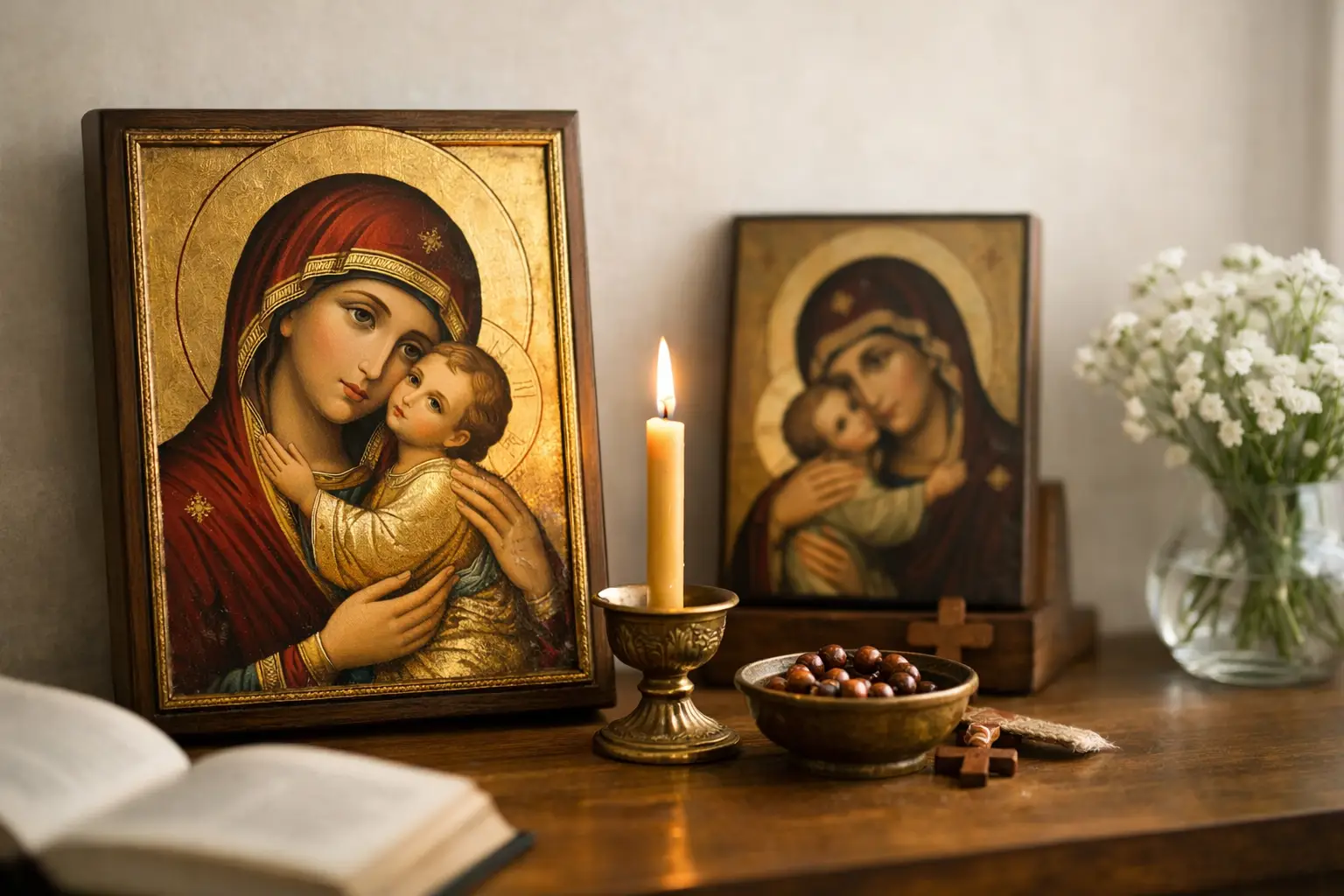
A Theotokos icon for prayer corner is not chosen merely to complete a beautiful arrangement in the home. It is received as a sacred image of the Mother of God, she who gave flesh to the Word and continually intercedes for the faithful before her Son. When a family stands before her icon with a candle, the sign of the cross, and humble prayer, the prayer corner becomes a small domestic church: a place set apart for repentance, thanksgiving, and peace.
Why the Theotokos Belongs in the Prayer Corner
In Orthodox life, the Theotokos holds a singular place of honor. The Church calls her more honorable than the cherubim and more glorious beyond compare than the seraphim, not as a goddess, but as the Mother of the incarnate Lord Jesus Christ. Her icons direct the heart to Christ. In nearly every canonical image, her hand, gaze, or posture reveals this truth: she leads us to her Son.
For this reason, many Orthodox prayer corners include an icon of Christ the Savior alongside an icon of the Most Holy Theotokos. Traditionally, Christ is placed to the right of the person praying and the Theotokos to the left. This recalls the arrangement familiar from the iconostasis, where the Savior and His Mother stand near the royal doors. The home does not become a church building, yet the arrangement gently teaches the order and prayerful memory of the Church.
A prayer corner may also include a cross, a prayer book, beeswax candles, a small lampada, and icons of the family’s patron saints. These objects serve prayer; they should not crowd it. A modest corner with two well-loved icons can be more fitting than a large collection kept only for display.
Choosing a Theotokos Icon for Prayer Corner
The first consideration is not size, finish, or frame. It is the iconographic image itself. Choose an image of the Mother of God that is canonical, reverently made, and spiritually meaningful to your household. A family may be especially drawn to an icon connected with a feast day, a place of pilgrimage, a family history, or a need carried in prayer.
The Hodegetria, meaning “She Who Shows the Way,” is among the most beloved forms. The Theotokos holds the Christ Child and gestures toward Him, teaching without words that He is the Way, the Truth, and the Life. This type is especially fitting for a family prayer corner because it visibly centers the home on Christ.
The Eleousa, often called the Icon of Tenderness, shows the affectionate closeness of Mother and Child. The Vladimir Mother of God is the best-known example. Such an icon brings to mind the mercy, compassion, and maternal intercession of the Theotokos. It may be particularly meaningful in homes where prayers are offered for children, reconciliation, illness, or comfort in sorrow.
Icons of the Theotokos of the Sign show the Virgin with her hands raised in prayer and Christ Emmanuel depicted within a medallion upon her breast. This image proclaims the mystery of the Incarnation. The Oranta image, with the Mother of God standing in prayer, is likewise a powerful reminder that she intercedes for the whole world.
There is no single icon type that every Orthodox household must select. A Theotokos icon for prayer corner should draw the family toward sincere prayer, remain faithful to Orthodox tradition, and be received with reverence. If an icon bears the name of a revered or miraculous image, it is good to learn its history and feast day, rather than treating the title as a decorative label.
Size, Materials, and Craftsmanship
A small icon can be entirely suitable for an apartment, dormitory, or a quiet shelf in a family room. A larger icon may be appropriate when the prayer corner is established in a dedicated place and can be seen clearly by all who pray there. Leave enough room to cense the icons, light a candle safely, and make the sign of the cross without rushing.
Material matters because it affects both durability and the character of the sacred image. A traditional color icon on wood offers warmth and a close resemblance to the icons familiar in Orthodox churches and homes. An icon with a fine silver 999 plated riza, or cover, gives a more solemn and gift-ready presentation while allowing the holy faces and hands to remain visible. Silver-plated icons are often chosen for weddings, baptisms, house blessings, and milestone anniversaries.
Fine workmanship is a worthy offering when it serves devotion rather than vanity. Look for clear canonical features, careful details, secure backing, and a presentation suited to the place where the icon will be kept. A handmade icon, a monastery-made image, or an icon prepared by Orthodox artisans can carry particular meaning for those seeking a visible connection to the living tradition of the Church.
Preparing a Place for Prayer
Orthodox Christians have often oriented prayer toward the east, the direction of the rising sun and a sign of Christ’s coming in glory. If an eastern wall is available, it is a beautiful custom to follow. Yet many homes have practical limitations. Windows, doors, apartment layouts, and family needs may make another location more sensible. Choose a clean, peaceful, and visible place where the household can gather without distraction.
Avoid placing icons where they may be treated casually, exposed to moisture or grease, or surrounded by objects that compete for attention. A kitchen can be a place of heartfelt prayer, but it may not be the best place for a precious icon near heat and steam. Bedrooms are often appropriate, especially for personal morning and evening prayers. A central family room can also be fitting when the goal is to establish a shared rule of prayer.
The icons may be hung on the wall or placed on a stable shelf or icon stand. Keep them upright and protected from direct sunlight, which can affect color over time. If candles are used, never leave them unattended and keep flame well away from wood, fabric, paper, and the icon itself. A small candleholder and a careful routine preserve both reverence and safety.
Some families add a small cloth beneath the icons, a hanging lampada, or a vase of flowers on feast days. These are beautiful customs when kept simple. The most precious adornment of the prayer corner is not silver, flowers, or polished wood, but the prayer offered there with attention.
Receiving and Venerating the Icon
When bringing a new icon into the home, many faithful ask their priest to bless it, particularly if it has not already been blessed according to local practice. Customs vary among parishes and jurisdictions, so it is wise to follow the guidance of one’s priest. An icon does not function as a charm or a religious ornament. Its honor belongs to the person depicted, and its purpose is communion in prayer.
Before the icon of the Theotokos, one may begin simply: make the sign of the cross, bow, and say, “Most Holy Theotokos, save us,” or pray the familiar hymn, “It is truly meet to bless thee, O Theotokos.” Parents may teach children to greet the icons quietly in the morning and before sleep. Such small acts form a faithful rhythm over many years.
Theotokos icons are also natural places for intercession. Bring before the Mother of God the names of children, spouses, parents, the sick, those traveling, and those who have fallen away from peace. Ask not for a life without hardship, but for mercy, courage, healing, and steadfastness in Christ. Her maternal compassion does not replace prayer to the Lord; it strengthens the faithful heart to turn to Him.
A Sacred Gift for a New Home or Family
An icon of the Mother of God is a deeply fitting gift for a baptism, wedding, housewarming, birthday, or name day. For a young couple, it may become the first icon in the home they are building together. For godchildren, it can remain a lifelong companion and a quiet witness to the prayers offered for them by parents and godparents.
When selecting an icon as a gift, consider the recipient’s space and devotional life. A compact color icon may suit a student or someone beginning a prayer corner. A larger silver-plated icon in a gift case may be appropriate for a wedding or an important family anniversary. At Andija, carefully made Orthodox icons and gift presentations allow families to choose an offering that is both worthy of the occasion and ready to be treasured.
Place the icon with gratitude, light a candle when you can, and return to it in both joy and trial. Before the face of the Mother who points always to Christ, let the prayer corner become a place where the heart learns again to say, “Thy will be done.”


