Submit a prayer note
Anyone shopping for a pectoral cross soon runs into the question of the Orthodox cross vs the crucifix. Should the cross carry the figure of Christ, or is a plain one just as Orthodox? Can a cross without the Crucifixion be blessed? And why does an Orthodox crucifix look so different from the one in a Catholic church?
This article answers those questions. It does not go into size, metal, chain or cord: those are covered on our page on how to choose a pectoral cross.
Two words, one sign
A cross is the sign of Christ's death and Resurrection: an instrument of execution that became the instrument of our salvation. It can be completely plain, patterned, engraved with letters, or carry a prayer on the back.
A crucifix is a cross that bears the image of the crucified Lord. In Orthodox usage people often say "a cross with the Crucifixion" rather than "crucifix", and the word Crucifixion also names the event at Golgotha and the icon of that event.
Both point to the same thing. A plain cross speaks first of victory: death has been defeated, and the empty Cross is the sign of that triumph. A crucifix places us directly before the Lord's suffering and calls us to repentance and gratitude. Orthodox hymns join the two. On the feast of the Exaltation of the Cross and on the Sunday of the Cross in Lent, a cross is laid in the middle of the church and the faithful sing: "Before Thy Cross we bow down in worship, O Master, and Thy holy Resurrection we glorify."
Is a plain cross Orthodox?
Yes. For several centuries Christians did not depict Christ on the Cross at all. They used a plain cross, or the monogram of Christ's name. Images of the Crucifixion spread from around the 5th and 6th centuries, and at the end of the 7th century the Council in Trullo directed that Christ be shown in His human form rather than through symbols such as the lamb. The crucifix then became central to church art, but the plain cross never went out of use.
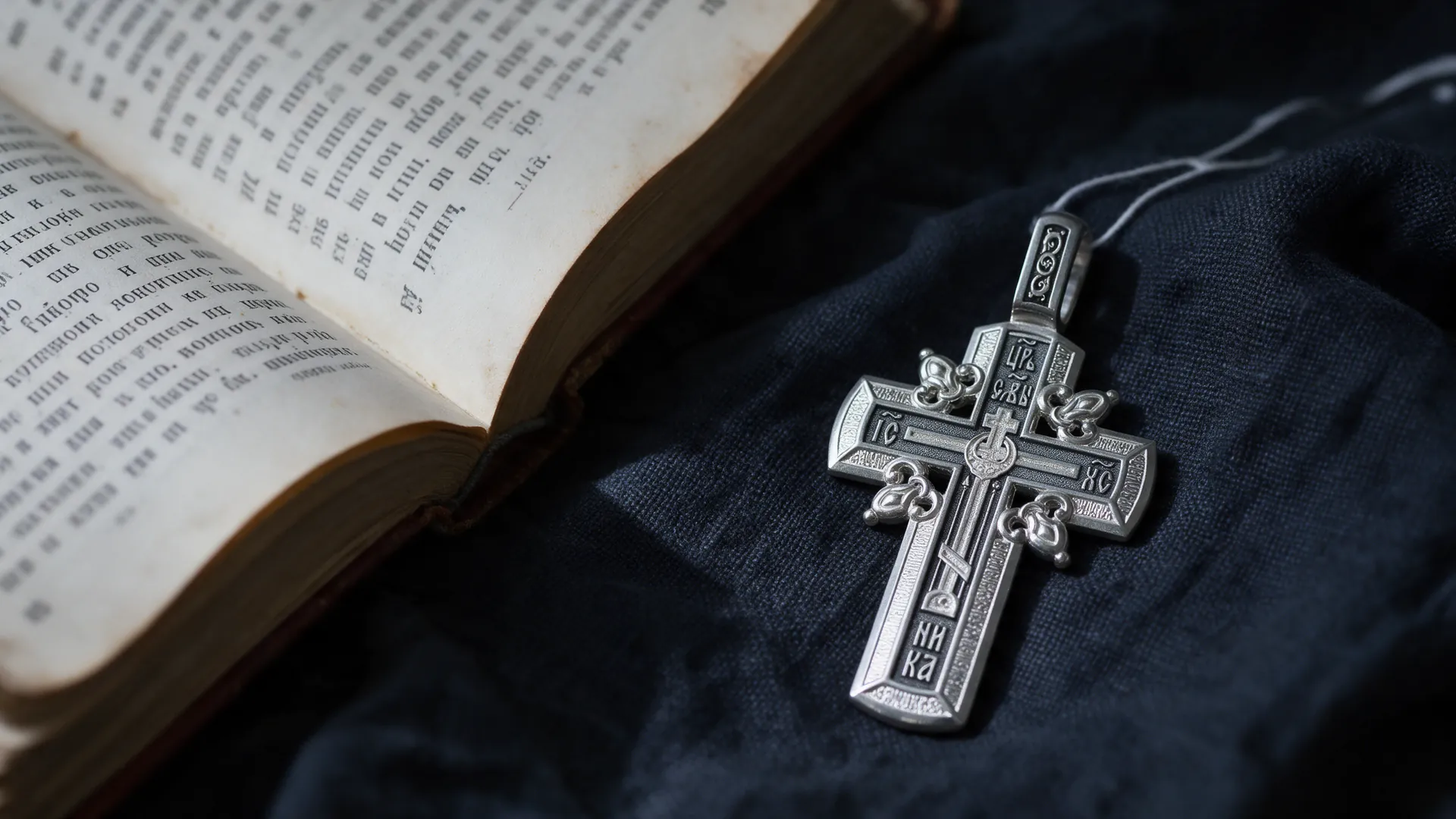
In Orthodox practice a plain pectoral cross is a full Christian cross. It often bears the letters IC XC, the word NIKA ("conquers"), the prayer "Save and protect", or a pattern of vines and leaves. Generations of Orthodox Christians have worn crosses like this.
People often ask whether a cross without the figure of Christ can be blessed. The rite of blessing a cross does not require the Crucifixion to be shown on it. A priest may decline to bless an object that only resembles a cross, such as a fashion pendant in an odd shape or one with signs foreign to the faith. An ordinary Christian cross without the Crucifixion is blessed in the same way as one with it.
Reading an Orthodox crucifix
The most common Orthodox cross is eight-pointed. Above the main crossbar there is a short bar for the inscription, and below there is a slanted footrest. Its raised end points to the thief who repented on the cross beside Christ, the lowered end to the one who mocked Him.
On an Orthodox crucifix pendant you will usually see:
- the body of Christ calm and upright, the head bowed, the arms stretched straight out;
- four nails, with each foot fixed separately and resting on the footrest;
- the title above His head, either the initials of "Jesus of Nazareth, King of the Jews" in Slavonic or Greek, or the words "King of Glory";
- the letters IC XC, short for Jesus Christ, and often NIKA;
- Greek letters in the halo meaning "He Who Is";
- sometimes the hill of Golgotha below, with the skull of Adam, whom Christ came to raise.
Many crosses carry "Save and protect" on the back. Four-pointed and six-pointed Orthodox crosses also exist, as do crosses with trefoil ends. The outline alone tells you little; the image and the inscriptions tell you more.
How a Western crucifix differs
Later Western crucifixes often show the suffering in close detail. The body sags under its own weight, the head wears the crown of thorns, and the face shows agony. Christ's feet are usually crossed and pierced with a single nail, so there are three nails rather than four. The plaque above His head reads INRI, the Latin initials of the title, and the cross is usually four-pointed without a footrest.
Orthodox iconography keeps a stillness. Christ truly suffers and dies, but His Passion is voluntary, and victory can already be seen in it. That is why His face is peaceful and His body is not twisted.
These differences grew over many centuries and are not absolute. Some early Western crosses show Christ crowned and serene, and some Eastern ones are quite detailed. The shape of someone's cross is no measure of their faith. If you are buying for yourself or for an Orthodox friend, choose a cross made to the Orthodox pattern: with a footrest, four nails, and Slavonic or Greek inscriptions.
Which to choose for daily wear
There is no rule that settles the question. Some things worth weighing:
- Family and parish custom. In many families children are given a cross with the Crucifixion, like their parents'. In others the plain form is the habit.
- Daily wear. A pectoral cross is worn on the body, under clothing, and many people never take it off. A plain cross with no raised figure catches less on clothes and keeps its look longer.
- Personal devotion. Some people need the crucified Lord before their eyes; for others the Cross as a sign of victory speaks more strongly.
- Gifts. If the cross is a present, find out beforehand which form is customary in the recipient's tradition.
A wall cross for the icon corner is a different matter. It hangs in front of you at prayer and does not have to be worn, so a detailed Crucifixion with the Mother of God and St John standing by fits well there.
When in doubt, ask your parish priest. For the particular case of a child's first cross, see our article on the Orthodox baptism cross.
Where our crosses are blessed
Every silver cross and pendant in our shop is consecrated on particles of the relics of St George the Victorious. This applies to every silver cross, whatever its form, and the product page of each item states where it was consecrated.
Our sterling silver crosses are collected in the Orthodox pectoral crosses section. If you have any doubts about how to wear and keep a consecrated cross, ask the priest of your parish.