Submit a prayer note
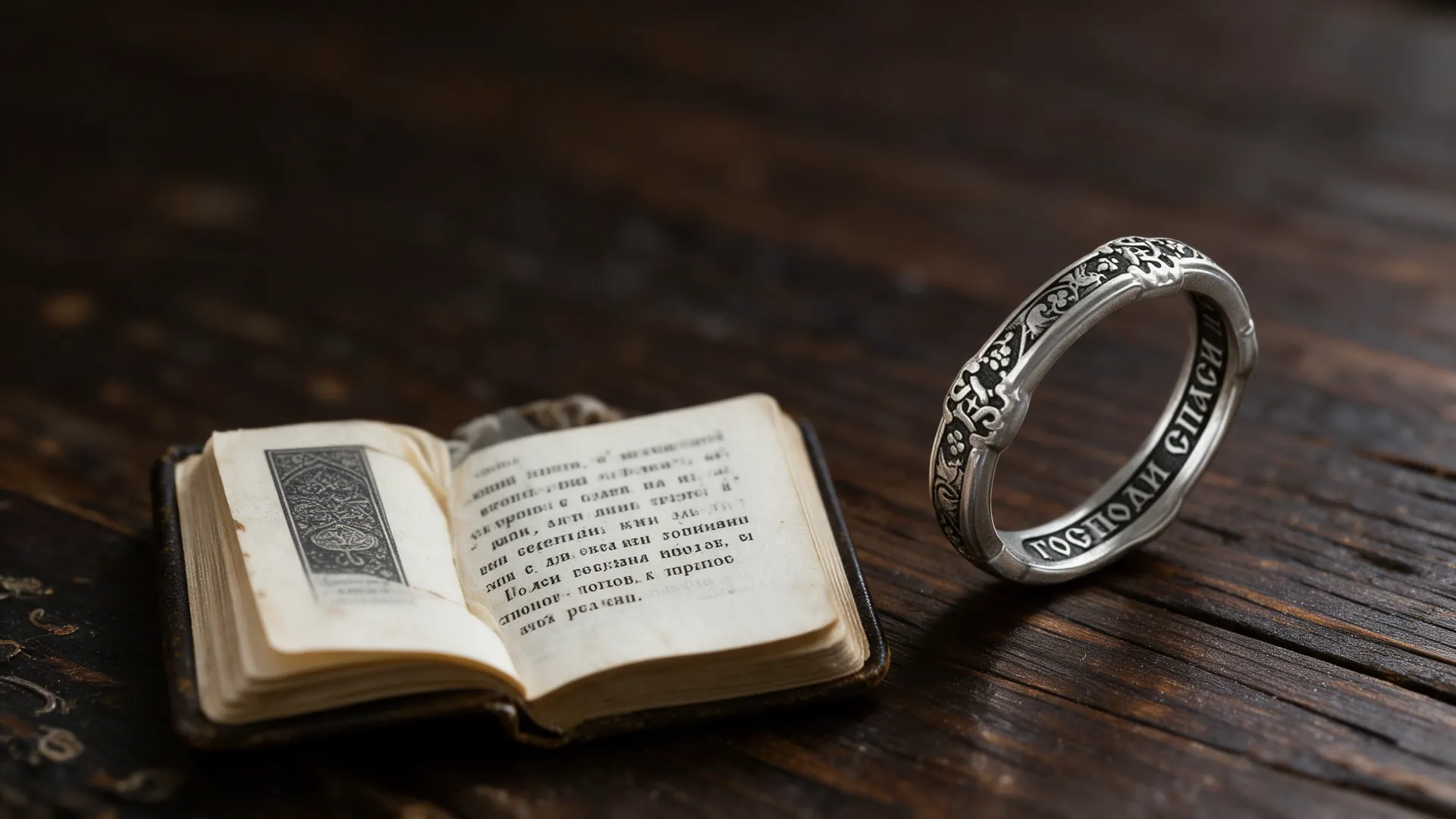
An Orthodox prayer ring is a plain band of silver with a short prayer engraved on it. You see them on the hands of Orthodox Christians from Athens to Tallinn: some carry the Jesus Prayer in Greek, others the words "Lord, save and protect" in Cyrillic letters. People wear them for the same reason they keep an icon on the desk. The ring is there to bring prayer back to mind during an ordinary day.
Because the ring is personal, it raises practical questions. Which finger? Can it go next to a wedding ring? Does it need blessing? And what about the stories people tell when one cracks or goes dark? The answers below follow ordinary Orthodox practice. Where the Church has no rule, we say so.
What the words on the ring mean
The most common inscription on rings from the Slavic tradition is "Spasi i sokhrani", "Save and protect". It is a shortened form of a very old prayer, "Lord, save and protect me", said in a moment of worry, before a long drive or a hard conversation, or for someone you love. Some rings carry the full phrase, some add a small cross or an angel.
Greek rings more often carry the Jesus Prayer, "Lord Jesus Christ, Son of God, have mercy on me", or simply "IC XC NIKA", "Jesus Christ conquers". That is why English speakers often call any of these a Jesus prayer ring.
On most rings the words run round the outside, where the wearer sees them. Others are engraved inside the band, against the skin. Such a ring looks like a plain wedding band, and only its owner knows the prayer is there.
Why wear an Orthodox prayer ring
The Fathers of the Church taught that prayer is not kept for morning and evening only. A short prayer repeated through the day, at work, in the car, in a queue, keeps the heart turned to God. A prayer rope serves this purpose at home and in church. The ring does something similar in the middle of daily life: your hand is in front of you dozens of times an hour, and each glance can become a few words of prayer.
That is the whole meaning of the ring. It belongs with other reminders of faith, such as the cross worn from baptism or the icon in the car. It does not replace the pectoral cross, which an Orthodox Christian wears always. If you do not have a cross yet, our pectoral crosses section is the place to begin.
Which finger and which hand
The Church has no rule here. Neither the canons nor the service books say anything about where a prayer ring should be worn, so any finger is acceptable. Customs vary from family to family:
- The ring finger of the right hand. Unmarried people often wear it there. In Orthodox practice the wedding ring is worn on the right hand, so married people usually choose another finger.
- The middle or index finger. Many men prefer the middle finger, where a wide band sits comfortably.
- The left hand. Some wear the ring on the left so that it is less in the way at work.
You may hear that the ring belongs on the right hand because that is the hand we cross ourselves with. It is a pious habit, not a requirement. If the ring rubs, catches on gloves or gets in the way, move it. Comfort matters more than custom here.
Wearing a prayer ring with a wedding ring
There is no conflict between the two. People combine them in several ways:
- on the same finger, with the wedding ring nearer the palm and the prayer ring above it;
- on neighbouring fingers of the same hand;
- on different hands, the wedding ring on the right and the prayer ring on the left.
Some couples choose matching "save and protect" rings as their wedding rings. At an Orthodox wedding the priest blesses the rings during the service, whatever their design, so these are brought to church like any others. Ask your priest beforehand how he prefers to receive them.
A reminder, not a charm
The ring does not protect anyone by itself. God protects, and the ring carries a prayer addressed to Him. Treating the silver and the engraving as a lucky charm misses the point entirely, and the Church has always warned against it.
For the same reason, the stories that circulate about prayer rings have nothing to do with faith. A ring that darkens, cracks or goes missing is not a sign of misfortune and does not mean protection has been "taken away". Sterling silver darkens with time, moisture and household chemicals; that is how the metal behaves. A thin band can crack after a knock. A lost ring can simply be replaced.
Any baptised Orthodox Christian, man or woman, can wear one. If you give a prayer ring to someone who is not a churchgoer, tell them what the words mean, so that they wear it with respect.
Should a prayer ring be blessed?
Yes, it is usual to have it blessed, just as you would a new cross. Any Orthodox priest can do it: he reads a short prayer and sprinkles the ring with holy water. You can bring it together with a cross, a medallion or a chain.
Every item in our catalogue states where it was consecrated. All silver crosses, pendants and rings are consecrated on particles of the relics of St George the Victorious, and the documents confirming where our items are blessed are collected on the consecration page. If a ring's card does not name a place of consecration, take it to your parish priest before you start wearing it.
Choosing a ring: size, silver and care
Our prayer rings are made of sterling silver 925, in men's and women's styles. When choosing, look at:
- The width. A broad band with large lettering suits a man's hand; a slim one is easier to wear every day on the ring finger.
- Where the words are. Outside, they remind you at every glance. Inside, the prayer stays private.
- The size. Measure the inner diameter of a ring that already fits you: the number of millimetres is the size. Our article on ring size and silver care explains what to do if you fall between two sizes.
To keep the silver looking good, take the ring off before a shower, the pool or cleaning with household products, and polish it with a soft cloth rather than toothpaste. The full routine is on our silver care page.
If the size, metal or inscription you want is not in the catalogue, the ring can be made to order: we reply within two working days with the price and the lead time. Orders ship from Tallinn by registered post with a tracking number within 1-3 working days of payment.