Submit a prayer note
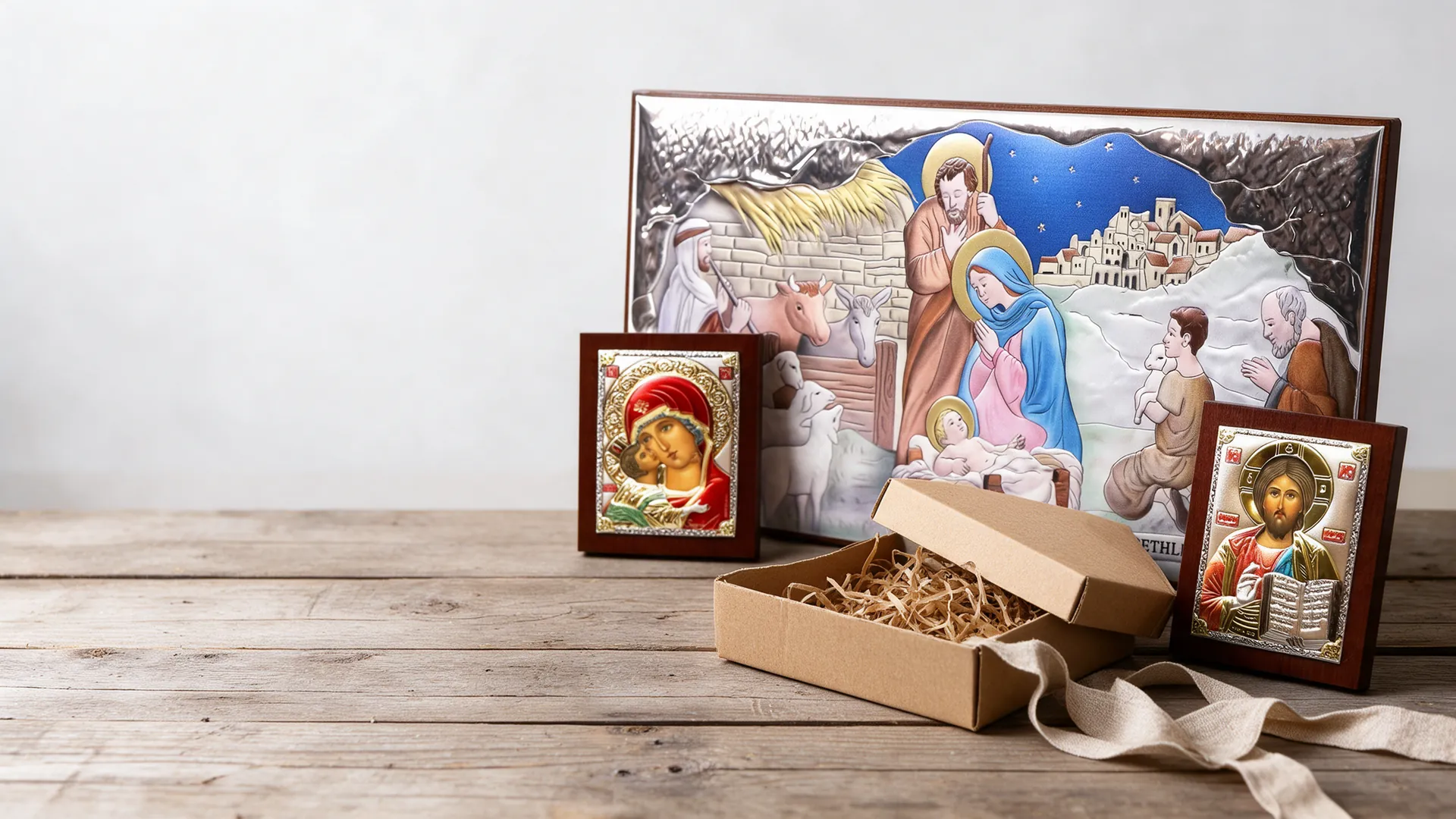
An Orthodox icon gift is one of the oldest Christian presents there is. Parents bless their children with icons on the wedding day, godparents give a godchild the image of their saint, pilgrims bring icons home for the people they prayed for. The question is rarely whether to give an icon. It is which one, and for whom.
Two things decide it: the person and the occasion. This guide goes through the usual occasions, from a wedding to a housewarming, and the few checks worth making before you buy. If you need ideas beyond icons, we have separate articles on Orthodox baptism gifts and wedding gifts, linked in the sections below.
Is an icon a good gift?
For an Orthodox Christian, almost always. An icon is made for prayer, and a new one usually finds its place in the family's icon corner within a day. It also lasts: people keep icons for decades and pass them on to their children.
The one thing to weigh is the person receiving it. Someone who prays will treasure it. A friend who is not a churchgoer may still be glad of a small icon given with love, and some people say such a gift was where their own prayer began. For someone of another faith, an icon is usually not the right present, out of respect for what they believe.
If you are unsure, ask the family quietly whether the person already has icons at home and which saints they are close to. It saves both of you from a duplicate.
Choosing the saint: the person first
The safest choice for almost any occasion is the icon of the person's patron saint, the saint whose name they received at baptism. It is personal, it suits every age, and it can never be "the wrong icon". Our article on choosing a patron saint icon explains how to find the right saint when a name has several.
Before buying, check:
- the baptismal name. It may differ from the everyday one: a Svetlana may be Photini in church, a convert may have taken a saint's name at chrismation;
- the inscription. An Orthodox icon carries the name of the saint or the feast. Without it, the image is a picture;
- the size. A small icon that fits on a shelf beside the others is more use than a large one with no wall to hang on;
- the blessing. An icon bought in an ordinary shop is usually taken to church to be blessed. Icons from monastery workshops arrive already consecrated in the monastery where they were made.
Things to avoid: decorative "icons" printed on magnets, calendars and key rings, images chosen to match the colour of a room, and anything without a proper inscription.
Icons for a wedding
At an Orthodox wedding the key icons are the wedding pair: Christ for the groom and the Mother of God for the bride. Parents traditionally give them, sometimes godparents, so a guest should ask before buying one.
Other guests have a wider choice: the patron saints of the bride and groom as a matching pair, an icon of saints honoured as protectors of marriage, or a single icon of the Mother of God for the couple's new home. Greek sponsors, the koumbaroi, often give the couple an icon as well. Our article on Orthodox wedding gifts goes into the customs in detail.
Icons for a baptism
For a baptism, the usual icons are the child's patron saint and the Guardian Angel. Godparents or grandparents tend to give them, and the parents generally know who is buying what. Ask for the baptismal name before you order: it is sometimes different from the name on the birth certificate.
An adult convert will often value their own saint's icon together with a Gospel or prayer book. For crosses, christening clothes and other presents, see Orthodox baptism gifts.
Icons for a birthday, a name day or a new home
Birthdays and name days. In Greek and Slavic families alike, the name day often matters more than the birthday, and the patron saint's icon is the natural gift for it. If the person already has one, choose an icon of the Mother of God that their family loves, or a saint they turn to often. Some people also give the icon of the saint commemorated on the day the person was born.
For parents or grandparents. An icon of saints honoured as protectors of the family, or a larger icon of Christ or the Mother of God for the centre of their icon corner.
For a colleague or someone you know less well. A small icon of Christ or the Mother of God is always appropriate.
For a new home. If the household has no icons yet, give a pair of Christ and the Mother of God, the beginning of any icon corner. If they do, the Protection of the Mother of God or the Holy Trinity are traditional choices for a house. Many Orthodox families ask a priest to bless a new home, and a gift icon is welcome that day.
How to present an icon
There is no set formula. Give it simply, in your own words: "May your saint keep you", "We pray for your home", "Many years". A parent or godparent may bless the person by making the sign of the cross with the icon, as families have long done.
Add a card with the date and the occasion. Years later it tells the family who gave the icon and when. If the icon was consecrated at a particular shrine, say so: that history makes the gift dearer.
Icons and Orthodox gifts from our catalogue
Our icons section has icons from the workshops of the Pskov-Caves and Danilov monasteries, consecrated in those monasteries, with the workshop certificate on the back. There are also icons from the St Gabriel series with a particle of cloth from the saint's relics, consecrated in Samtavro monastery in Mtskheta, most of them at the relics of the saint, as well as silver-plated icons.
Every item card states where it was consecrated. For ready-made Orthodox gifts, including icons, books and things for prayer at home, see our gifts section. We ship from Tallinn by registered post with a tracking number within 1-3 working days of payment, so order early if the icon is for a set date.