Submit a prayer note
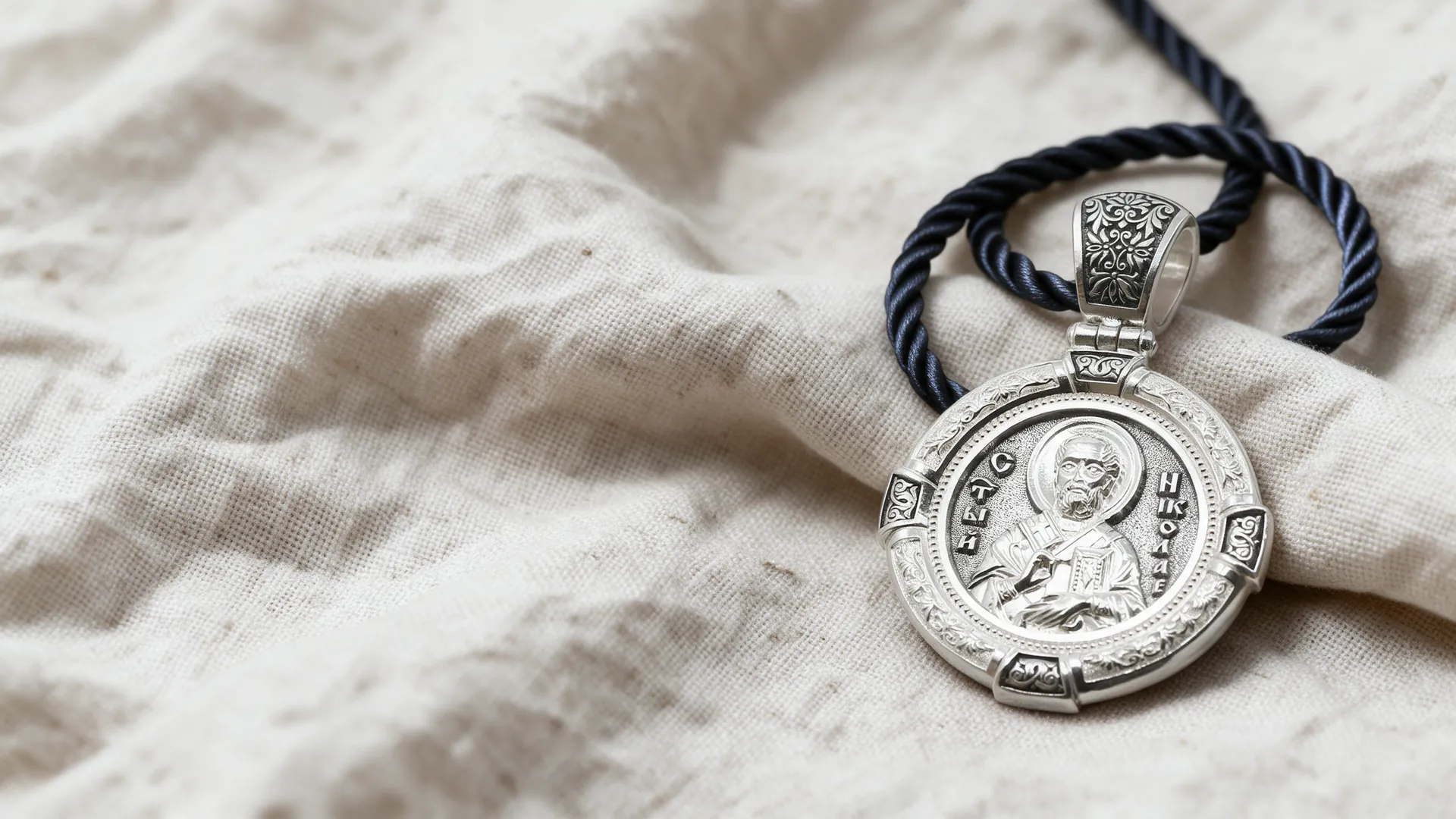
An Orthodox saint medallion is a small icon made to be worn on the body. It shows Christ, the Mother of God, an angel or a saint, carries an inscription with their name, and hangs on a chain or cord on the chest. Many Orthodox Christians wear one beside their cross: the icon of their patron saint, a favourite image of the Theotokos, or the Guardian Angel given to them as children.
It is a simple thing, but it raises a few questions. How is it different from the little pouches some families pin to a baby's clothes? Can it be worn on the same chain as the cross? Does it need to be blessed? Here are the answers.
What an Orthodox medallion is
A medallion is an icon in miniature. It follows the same rules as any icon: the figure is shown according to tradition, and the name is written so there is no doubt who is depicted. It is usually made of silver or gold, sometimes with enamel.
Because it is an icon, it is treated as one. People pray before it in a few words, touch it in a difficult moment, cross themselves. It is worn under clothing, close to the skin, the same way as the cross. Wearing it on top of a jumper as an accessory misses the point.
The most common choices are:
- the patron saint whose name you received at baptism;
- the Mother of God, often in the form most loved in the family;
- the Guardian Angel, a frequent gift for children;
- a saint you turn to in a particular need, such as St Nicholas or St George the Victorious. A St George pendant is a popular choice for men.
If you are unsure who your patron saint is, our article on choosing a patron saint icon explains how to find out.
Medallion, phylakto and ladanka
In Greek-speaking parishes there is the phylakto, and in Slavonic usage the ladanka. Both began as a small pouch or case worn on the chest. Inside there might be a grain of incense (the word ladanka comes from the Slavonic for incense), a little earth or oil from a holy place, a piece of cloth that touched relics, or a written prayer. Such a pouch was pinned to clothing or hung on a cord, and families often pinned one to a baby's clothes or hung it by the cot.
Later the same words came to be used for small hinged metal cases and for flat medallions with an image. That is where the confusion comes from.
The difference, put simply:
- A phylakto or ladanka is a container. What matters is what is inside.
- A medallion is itself an icon. What matters is the image you pray before.
Neither one replaces the cross.
Can you wear a saint medallion with your cross?
Yes, and that is how it is meant to be worn. The cross is put on at baptism and worn for life; every Orthodox Christian has one. A medallion is an addition to it. Wearing a medallion instead of a cross is a mistake, however beautiful the medallion.
The Church has no fixed rule about one chain or two. Many people hang the cross and the medallion together; others prefer a separate cord for the icon. The usual practice is simply to keep the cross first: the medallion hangs beside it and does not cover it. If both share a chain, choose a medallion no larger than the cross, so the two do not knock against each other and catch.
When in doubt, ask your parish priest. The answer is usually short.
Not a lucky charm
Some people treat a medallion as protection in itself, something that keeps away bad luck. The Orthodox Church sees it differently. A medallion does nothing on its own. It reminds the wearer of God and of the saint they pray to, and any help comes by God's mercy through the prayers of the saints. Worn in that spirit, it is a good companion. Treated as an amulet, it becomes superstition.
Blessing a medallion
A medallion is blessed in the same way as a cross or an icon. One bought from a church shop usually already is. One from a jeweller should be taken to a priest.
Every item card in our shop states where the item was consecrated. All our silver crosses, pendants and rings are consecrated on particles of the relics of St George the Victorious. Our page on consecration shows how and where our icons and silver are blessed, with the documents that confirm it.
Everyday wear and care
A few practical points:
- there is no need to take a medallion off at night, but remove silver chains before swimming, a sauna or cleaning with household chemicals;
- if a medallion bends or wears smooth, it is not thrown away; keep it at home with your icons;
- if it is lost, buy another and have it blessed if it is not already;
- sterling silver 925 darkens with time, which is a property of the metal; clean it with a soft cloth and no toothpaste or abrasives.
Men often choose a slightly larger, plainer medallion, women and children something smaller and finer. That is a matter of taste, not of rule.
Choosing a silver Orthodox pendant
Our silver medallions are in the pendants section. Before you choose, think about:
- Whose image. For a gift, ask for the baptismal name first.
- Size. If it will share a chain with a cross, keep it smaller than the cross.
- The inscription. It should be clear who is shown.
- What it hangs on. A separate chain or cord can be chosen from cords and chains.
We ship from Tallinn by registered post with a tracking number within 1-3 working days of payment.