Submit a prayer note
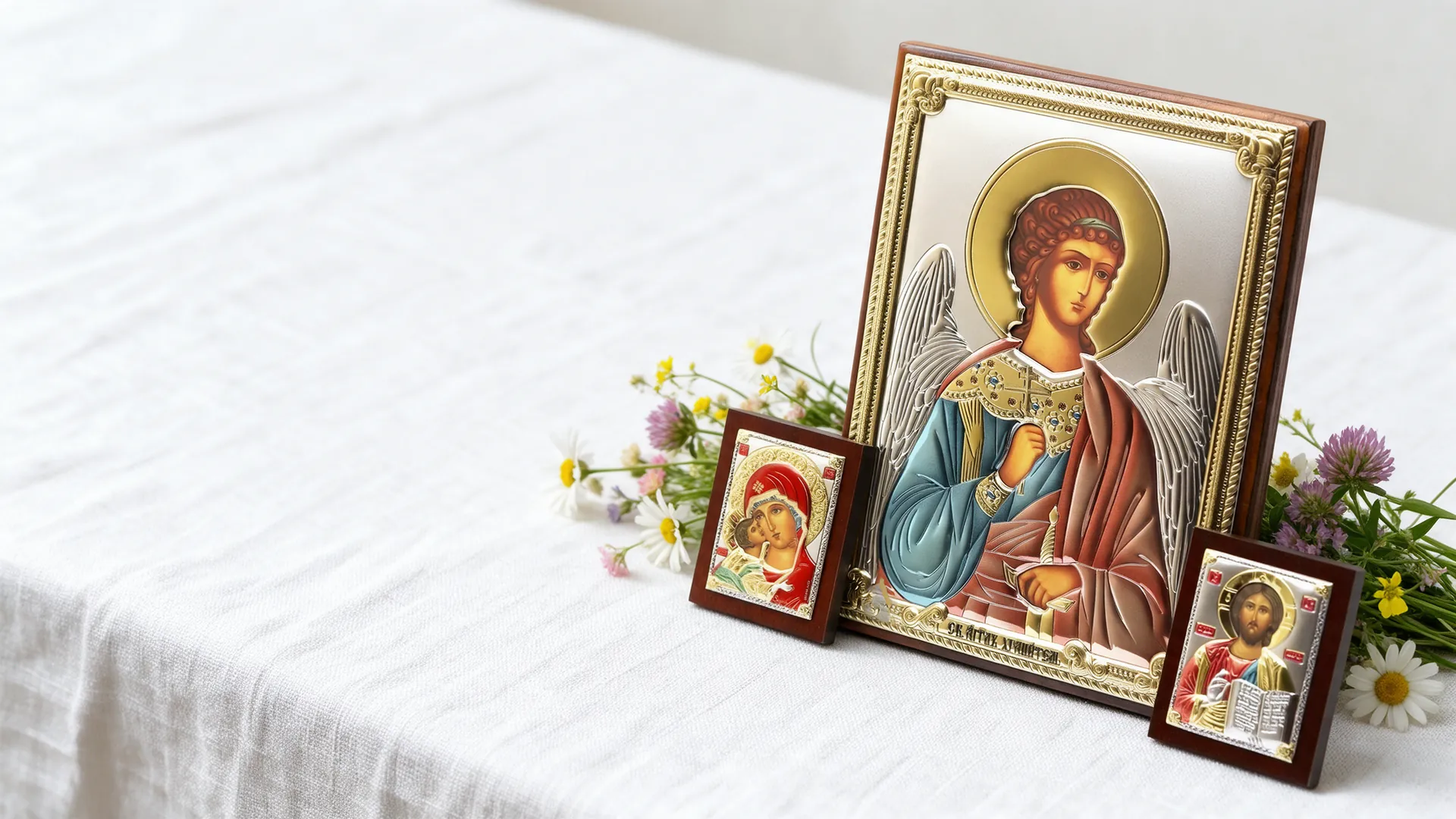
A patron saint icon shows the saint whose name a person received at baptism. For an Orthodox Christian this saint is a lifelong friend in prayer: someone who has lived a human life before God and now prays for the one who bears their name. Most Orthodox homes have at least one such icon, and many families keep one for every member.
Choosing it is easy when you know exactly who your saint is. It gets harder when a name is shared by several saints, when the name you use every day differs from your baptismal name, or when your name does not appear in the Church calendar at all. This guide walks through each case.
What a patron saint icon is
In the Orthodox Church every person is baptised with the name of a saint. That saint becomes their heavenly patron, and the day of the saint's commemoration becomes their name day. The icon of that saint is called a name icon or patron saint icon.
Like every Orthodox icon, it carries an inscription with the saint's name, and the image follows established patterns. A martyr usually holds a cross, a bishop wears vestments and holds the Gospel, a monastic saint appears in a monk's or nun's habit. The inscription and the clothing tell you which saint is shown, which matters when several saints share a name.
The icon usually stands in the icon corner beside Christ and the Mother of God. In a family where everyone has their own patron, the icons often stand together, so that each person can pray for the others by name.
Finding your patron saint
The rule is simple: your patron saint icon is the icon of the particular saint whose name you were given at baptism. Several saints often share one name, so it helps to know which of them is yours.
If you are not sure who that is:
- ask your parents or godparents, who may remember why the name was chosen;
- check your baptismal certificate, which in some parishes names the saint and the feast day;
- ask the parish where you were baptised, as many keep records.
When nobody knows, a common custom is to take the saint of that name whose feast falls nearest after your birthday. Another is simply to choose, among the saints of your name, the one whose life speaks to you, and to keep that saint from then on. Talk it over with your priest. There are, for example, many saints called John, among them the Forerunner and the Apostle and Evangelist. Mary may be Mary Magdalene, St Mary of Egypt or Mary the sister of Lazarus.
Many Orthodox calendars list saints day by day, and a priest can help you read them. For which saints are asked for help with particular needs, see which saint to pray to.
When your name is not in the calendar
Some names have no saint in the Orthodox calendar. Then a person is baptised with a saint's name that is close in sound or meaning, or with the older form from which their everyday name comes. Some familiar examples:
- Svetlana is usually baptised Photini, since both names speak of light;
- Yuri and Yegor are forms of George;
- Oksana is a form of Xenia, and Polina comes from Apollinaria.
In such cases the patron saint icon is an icon of St Photini, St George or St Xenia: the saint whose name was given at baptism.
Adult converts are usually received with the name of a saint, often one they have come to love while preparing. In English-speaking parishes many converts keep their own name if a saint bears it, and take a new one if not. Either way, the choice is made with the priest's blessing.
Icons for children and the measure icon
The usual baptism gift for a child is a small icon of their patron saint. Godparents or grandparents often give it, and it stays in the child's room or the family icon corner. Ask for the baptismal name before you buy: it is not always the name on the birth certificate.
There is also an old custom of the measure icon. At a child's birth, an icon of their patron saint is painted on a board exactly as long as the newborn. It is a rare and personal gift, usually commissioned from an icon painter well ahead of the baptism.
For those who want to carry their saint with them, there is the small medallion worn on a chain next to the cross, never instead of it. Our silver medallions are in the pendants section.
Praying before your patron saint icon
There is no fixed rule. People turn to their saint in morning and evening prayers, in difficult moments and above all on the name day, when they try to be at the Liturgy. A short prayer to the patron saint is widely used: "Pray to God for me, holy saint of God (name), for I fervently turn to you, the quick helper and intercessor for my soul."
Reading the life of your saint helps more than anything else. It is much easier to pray to someone whose story you know.
Having your own patron does not stop you praying to other saints. Your icon corner may also hold St Nicholas, the Mother of God and saints your family has long loved. The patron's icon simply keeps a special place among them.
A patron saint icon as a gift
A patron saint icon suits almost any occasion: a baptism, a birthday, a name day. Our guide to Orthodox icon gifts covers the usual occasions, and our article on Orthodox name day gifts explains name day customs.
Our icons section has icons from the workshops of the Pskov-Caves and Danilov monasteries, consecrated in those monasteries, with the workshop certificate on the back. There are also icons of the St Gabriel series with a particle of cloth from the relics of St Gabriel of Samtavro. They are consecrated in Samtavro monastery in Mtskheta, most of them at the relics of the saint. Every item card states where it was consecrated.
Before you order, check the inscription to make sure the icon shows your saint and not a namesake. We ship from Tallinn by registered post with a tracking number within 1-3 working days of payment.