Submit a prayer note
People often ask which saint to pray to when something specific weighs on them: a job interview next week, a child who is ill, a house that will not sell, a wedding ring that has gone missing. Orthodox tradition does have answers, built up over many centuries of prayer. But the answers make most sense once you see the principle behind them.
The saints are alive in God and pray for us. Whatever help comes, comes from God, by His mercy and through their prayers. That is why an Orthodox Christian may turn to any saint at all. Over time, though, the faithful began to ask particular saints for help in particular needs, usually because of something in the saint's own life: a physician saint for the sick, a shepherd bishop for daily bread, parents who waited years for a child for couples hoping to conceive.
This guide gathers the saints most often asked for prayers in different situations. Treat it as a starting point.
Can Orthodox Christians pray to any saint?
Yes. There is no rule that work belongs to one saint and children to another. All the saints share the same love for people, and any of them can become your intercessor. Many believers keep turning to one saint for years, with every worry, small or large.
It helps to keep the order of prayer in mind. We pray first to God, the Father, Son and Holy Spirit, and to the Mother of God. Prayer to a saint is asking a friend of God to pray with us and for us. A list of "the right saint for every problem" can slide into treating the saints like departments in an office, and the Church has always warned against that. A saint looks for faith, repentance and a changed life, and the request itself belongs inside that relationship.
Start with your patron saint
Every Orthodox Christian receives the name of a saint at baptism. That saint is your heavenly patron, and the most natural person to ask before anyone else. Many families keep an icon of each member's patron in the icon corner and read a short prayer to them daily. If you are not sure who your patron is, or would like an icon of them, see our guide to choosing a patron saint icon.
After your own patron, it is natural to turn to the saints of your parish, the saints whose relics you have venerated, and those your family has always loved.
Which saint to pray to for healing
In illness the first prayer is to Christ, the Physician of souls and bodies, and to the Theotokos. Among the saints, Orthodox Christians most often ask:
- St Panteleimon the Great Martyr and Healer, a young physician who treated the poor without payment;
- Sts Cosmas and Damian, the Unmercenary physicians, brothers who also healed without taking money;
- St Luke of Simferopol, a surgeon and archbishop who kept operating while serving as a bishop;
- St Gabriel of Samtavro, whose relics in Mtskheta draw many people praying for sick relatives;
- St Nektarios of Aegina, much loved in the Greek tradition by those facing serious illness.
Prayer and medical treatment go together. The Church has never asked the sick to choose between the doctor and the icon corner. There is more on praying for someone who is unwell, at home and in church, in our article on Orthodox prayer for the sick.
Which saint to pray to for a job, a home and daily needs
For work, money and housing, two fourth-century bishops are asked more than anyone.
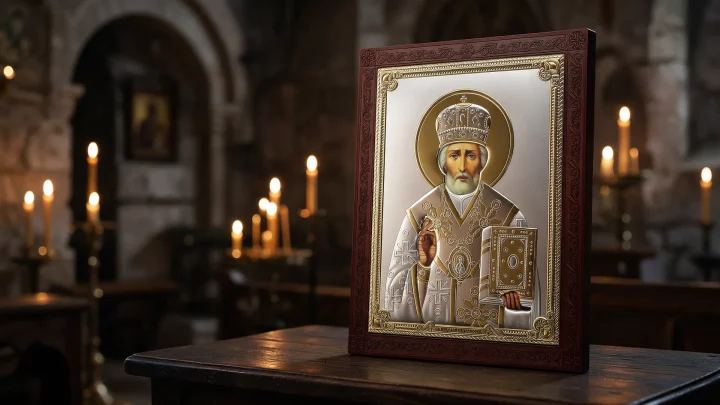
St Nicholas of Myra helped the poor in secret, defended people wrongly condemned, and is called upon by travellers, by those looking for work and by anyone in material need. His life and icons are described in our article on the St Nicholas icon.
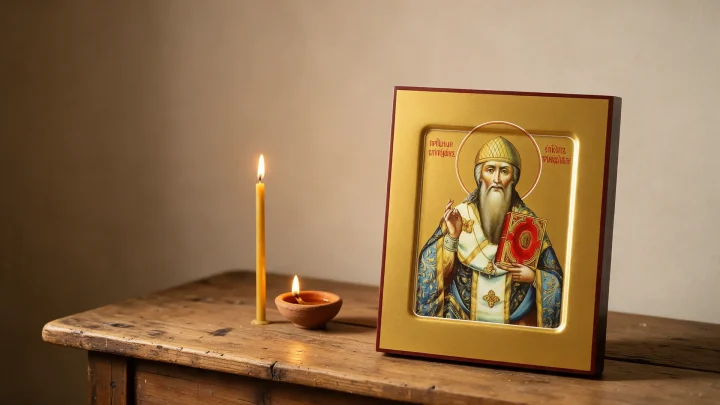
St Spyridon of Trimythous was a shepherd who stayed one even as a bishop. Orthodox Christians ask his prayers when looking for a new job, when buying or selling a house, and when weighed down by debt. You can read his life and miracles in the article on the St Spyridon icon.
For things that are lost or stolen, two saints are traditional:
- St Phanourios, loved in Greece and Cyprus; when something lost is found, many families bake a simple cake, the phanouropita, and share it in his memory;
- St John the Warrior, asked for help when something has been stolen and for those who have wronged us.
Saints for pregnancy, children and study
Couples hoping for a child pray to the Righteous Joachim and Anna, the parents of the Mother of God, and to Zachariah and Elizabeth, the parents of St John the Baptist. Both couples waited many years, and God gave them a child in old age. Husbands and wives often read the prayer to them together.
For children who are already born, parents turn to the Theotokos and to each child's own patron saint. Mothers also ask the prayers of the martyrs Faith, Hope and Love and their mother Sophia.
For students and exams, the Greek tradition looks to the Three Holy Hierarchs, St Basil the Great, St Gregory the Theologian and St John Chrysostom, honoured as patrons of learning. Pray with the child before a test, and remember to say thank you afterwards whatever the result.
Saints for marriage, family and those far from home
For a peaceful marriage, and for those hoping to find a husband or wife, Orthodox Christians pray to Sts Joachim and Anna, to Sts Peter and Fevronia of Murom, a prince and his wife who lived in love until they died on the same day, and to their own patrons.
For family members in the armed forces, the traditional intercessor is St George the Great Martyr, himself a soldier. For those travelling, by long custom, St Nicholas. When a family struggles with drinking, many pray to the martyr Boniface.
The list could go on for pages. The Church has glorified thousands of saints, and among them each person can find someone close to their own life.
How to ask a saint for prayers
Prayer to a saint can be very short. "Holy (name), pray to God for us" can be said at any moment of the day. When there is time, read the saint's troparion, an akathist, or simply their life, so you know whom you are speaking to. And when a difficulty passes, give thanks to God and to the saint.
An icon helps you gather your attention, which is why many people keep an image of the saint they pray to beside the icons of Christ and the Mother of God. You can find one in our icons section.
Many Orthodox Christians also send the names of their loved ones to the relics of a saint. Through our site, prayer notes for the living and the departed go to Samtavro monastery, at the relics of St Gabriel, and to the Monastery of the Nativity of the Most Holy Theotokos in Borjomi. A note with up to five names can be sent from the prayer notes page, and the names are commemorated at the divine service. The help we ask for always comes from God, by His mercy and through the prayers of His saints.