Submit a prayer note
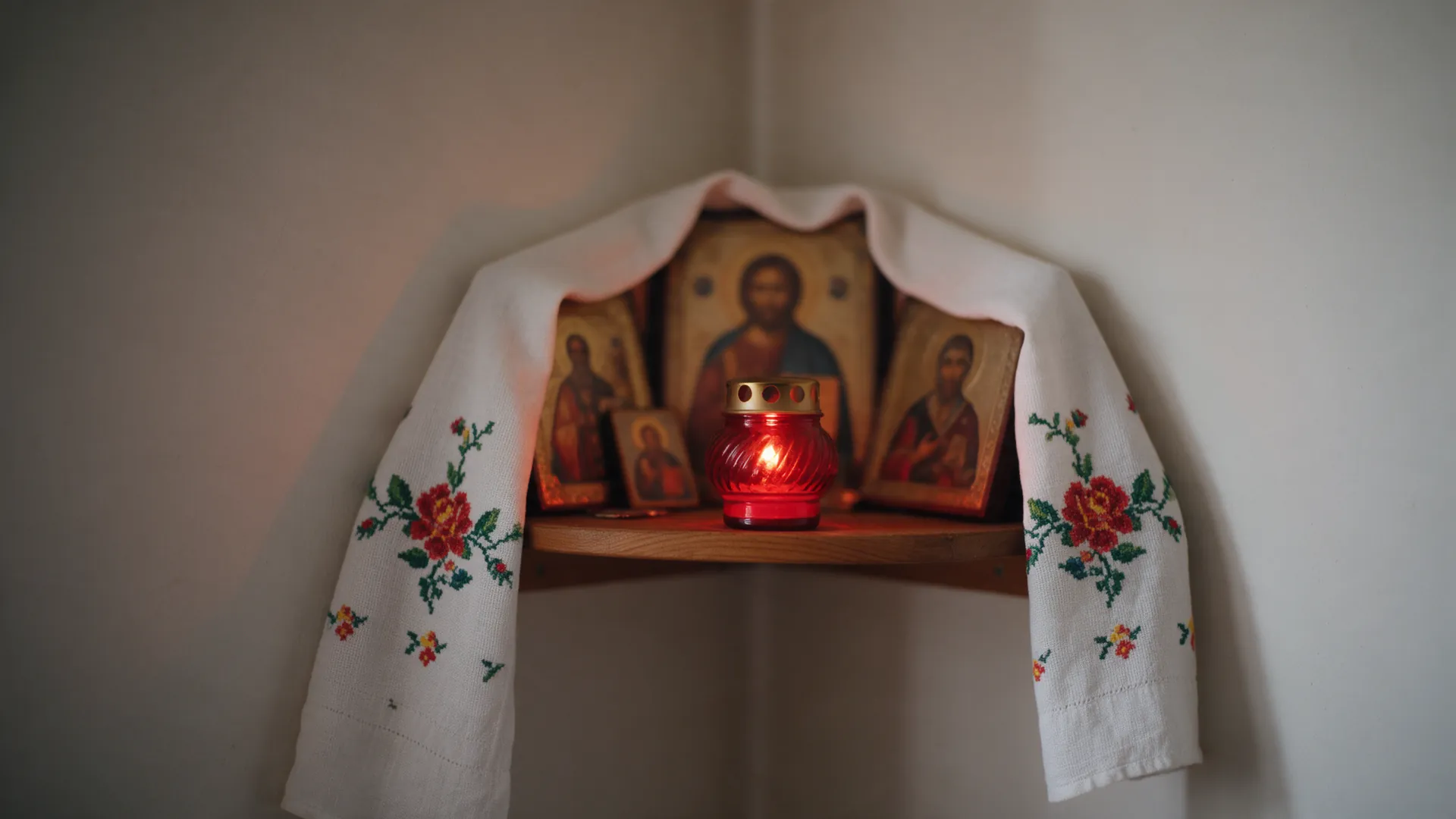
An Orthodox icon corner is the place in a home where the family prays. It can be a single shelf with two icons in a flat, or a carved wooden case filling the corner of a room. Morning and evening prayers are read there, the lamp is lit on Sundays, and the names of relatives are remembered before God.
The rules for an icon corner are few and simple. Most of what follows is custom that grew out of church practice, and every household adapts it to the space it has. If you are setting up your first prayer corner, read this as a set of practical steps, then ask your parish priest about anything that is still unclear.
Which wall to choose
Orthodox churches face east, and the faithful pray towards the altar. At home the same direction is kept when possible: the icons go on an eastern wall, so that the family stands facing east as it does in church. East is linked in Christian tradition with Christ, the Light who will come again.
In many homes the eastern wall is taken up by a window, a door or a wardrobe. In that case choose the quietest place where you can stand, make the sign of the Cross and bow without bumping into furniture. The Church does not ask anyone to measure with a compass.
A few places work badly:
- above or beside the television or computer screen;
- on a shelf shared with photographs, ornaments or souvenirs;
- next to the cooker, where grease settles, or above a radiator, which dries out wood;
- a narrow passage where the icons can be knocked by a bag or a shoulder.
Small icons can also stand in other rooms: in the kitchen for grace before meals, by a child's bed, at a desk. The main prayer corner, though, is one place.
Shelf, table or corner case
The simplest option is a solid wooden icon corner shelf fixed to the wall. It holds two or three icons, a lamp and a prayer book, and in a small flat that is often all you need for years.
A corner case follows the shape of the old prayer corner: two panels meet in the angle of the room, with shelves in tiers. It holds more icons and takes up little floor space. A flat case fixed to a straight wall works where there is no free corner. An icon corner table, a small stand with a top for books and candles, suits renters who cannot drill into walls.
Many families cover the shelf with a clean linen cloth, sometimes embroidered, and drape a long cloth over the top of the main icon. This orthodox icon corner cloth is an old custom and entirely optional. Whatever you choose, make sure heavy icons in metal covers are fixed securely before you start cleaning around them.
The first icons: Christ and the Mother of God
Every icon corner begins with two images: Christ and the Mother of God. For Christ most families choose the Christ Pantocrator icon, where the Lord holds the Gospel and blesses with His right hand. For the Theotokos there are many venerated types, and choosing among them is covered in our guide to an icon of the Mother of God for your home.
With these two icons the corner is ready for prayer. Other icons are added over time as life brings them:
- the patron saints of each member of the family;
- a pair of wedding icons, if the couple was married in church;
- St Nicholas, kept in a great many Orthodox homes;
- a saint linked to your family by a place, a pilgrimage or a story;
- a feast icon, if there is room for one.
Choose icons that follow the tradition of the Church and carry the name of the saint. Fewer icons of good quality are better than a crowded wall. Our catalogue includes icons from the workshops of the Pskov-Caves and Danilov monasteries, each with a workshop certificate on the back.
How to arrange the icons
The arrangement copies the iconostasis in church. Standing in front of the corner, place Christ on the right and the Mother of God on the left, just as they stand on either side of the Royal Doors.
Above them, on the top tier, families usually put the icon of the Holy Trinity or a cross. Icons of the saints go below or beside Christ and the Theotokos, never above them. A practical summary of the orthodox icon corner rules:
- Christ and the Theotokos are in the middle and usually the largest.
- The Trinity, a cross or a feast icon goes on top, if there is a top tier.
- Saints come lower down and to the sides.
- Icons stand straight and steady, and none hides another.
- Everything can be seen clearly from the place where you pray.
Beyond this there is no fixed plan for every home. If you are unsure where a particular icon belongs, your priest will be glad to advise.
Lamp, candles and other icon corner supplies
The lampada is a small oil lamp with a floating wick that hangs or stands before the icons. Families light it during prayer and on Sundays and feasts; in some homes it burns all the time. Keep the flame well away from the shelf, curtains and wallpaper, and never leave it burning in an empty room.
Church candles are used in the same way: during prayer, on feast days and on the anniversaries of those who have died. In homes with small children or pets, an electric lamp is a sensible choice.
Other things that belong near the icons:
- a prayer book, the Gospel and the Psalter;
- holy water and blessed bread brought from church;
- palm or willow branches from Palm Sunday;
- a written list of the living and departed for whom the family prays.
Bills, keys, medicines and glasses of water do not belong on the icon shelf. Clear them away as soon as they appear.
Keeping the corner in daily use
Dust the icons with a soft, dry cloth. Do not use household sprays, wet wipes or metal polish, especially on icons with a silver or gilded cover. Wash the shelf cloth whenever it starts to look tired.
If an old icon is damaged or darkened, it is never thrown away. Take it to church and ask the priest what to do: it can be restored, or left in the church's care. The same applies to inherited icons whose history you do not know.
Most of all, use the corner. A short rule kept every day, such as the Trisagion prayers, the Lord's Prayer and a psalm, does more than a long one abandoned after a week. Teach children to cross themselves in front of the icons and to name the people they pray for.
Where to begin
Start small: a shelf, an icon of Christ, an icon of the Mother of God and a prayer book. The rest will come with baptisms, weddings and visits to holy places.
A new icon bought from an ordinary shop is usually taken to church to be blessed. Icons in our catalogue state on the product page where they were consecrated: icons from the Pskov-Caves and Danilov workshops are consecrated in the monasteries where they are made. The documents are collected on the consecration page.