Submit a prayer note
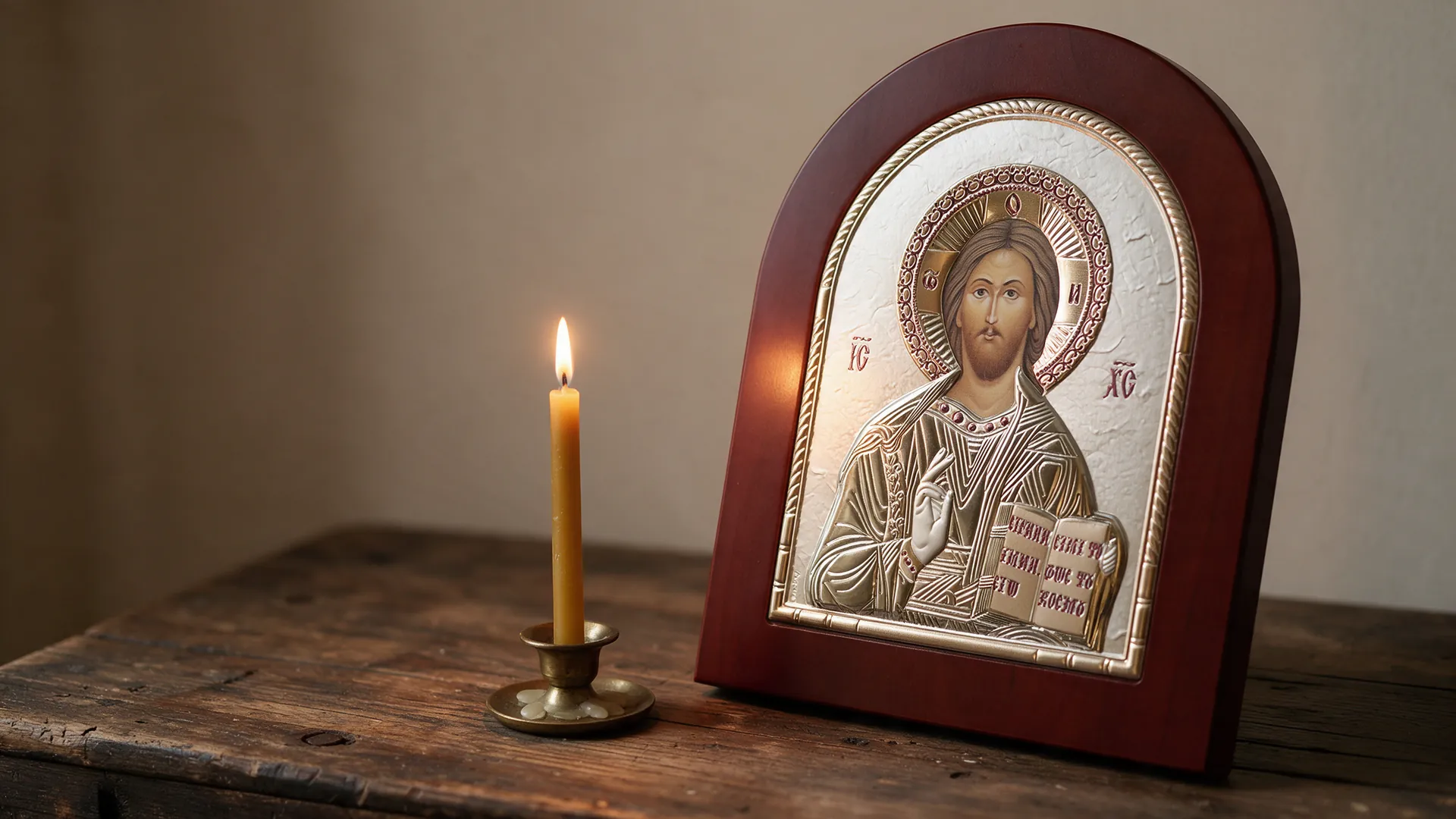
The Christ Pantocrator icon shows the Lord from the waist up, facing the person who prays. His right hand is raised in blessing and His left holds the Book of the Gospels. It is the image of Christ found in the domes of Byzantine churches, at the centre of the Deesis row on the iconostasis and in countless home prayer corners.
To understand the Christ Pantocrator icon meaning, it helps to take the image apart slowly: the name, the hands, the book, the halo, the face. Then it becomes clear why Orthodox Christians have placed this icon at the heart of their worship for some fifteen centuries, and why so many families choose it as the first icon in the house.
What "Pantocrator" means
Pantocrator is a Greek word usually rendered "Almighty" or "Ruler of All". Greek translations of the Old Testament use it as a name of God, and the Book of Revelation puts it in the mouth of the Lord Himself: "I am the Alpha and the Omega, the Beginning and the End, who is and who was and who is to come, the Almighty" (Revelation 1:8).
By painting Christ under this title, the Church confesses that the man who walked in Galilee, taught, healed and was crucified is the eternal Son of God, Creator and Judge of the world. The icon holds together the Teacher of the Gospel and the King who will come again in glory.
Reading the icon detail by detail
Every element of the image belongs to a confession of faith. For the wider language of icons see our guide to Orthodox icon symbolism; here are the features that matter most for the Pantocrator.
The right hand
Christ blesses with His right hand. In the common Greek form the fingers spell out IC XC: the index finger straight, the middle finger bent, the thumb crossed over the ring finger, the little finger curved. Some early icons show a two-finger blessing, often explained as a sign of Christ's two natures. Either way, the blessing comes from God Himself.
The Gospel book
In His left hand Christ holds the Gospels. A closed book, often set in a jewelled cover, speaks of divine wisdom and of the Last Judgement. An open book carries a verse, most often Matthew 11:28: "Come to Me, all you who labour and are heavy laden, and I will give you rest." Other favourite texts are "I am the light of the world" (John 8:12) and "A new commandment I give to you, that you love one another" (John 13:34).
The halo and the letters
Only Christ's halo contains a cross. On its arms are three Greek letters, ὁ ὤν, "He Who Is", the name God revealed to Moses at the burning bush. Beside His head stand the letters IC XC. Together they state plainly that Jesus Christ is God.
Robes and face
Christ usually wears a red or crimson tunic beneath a blue outer garment. A common reading takes the red as His divinity and royal dignity and the blue as the human nature He took on. A gold band on the shoulder of the tunic marks His rank.
The face is calm, direct and attentive, and the eyes meet yours wherever you stand. Many people say it is hard to make excuses before that gaze. Yet the Judge shown here is the same Lord who went to the Cross, so the look holds mercy as well as truth.
The Sinai Pantocrator and Hagia Sophia
The best known early image is the Christ Pantocrator icon at Saint Catherine's Monastery on Mount Sinai, painted in the sixth century in hot wax. The two halves of the face are noticeably different: one side gentle, the other stern. Many see in it the merciful Saviour and the righteous Judge in one person. This feature belongs to the Sinai icon and is not expected of every Pantocrator.
In Constantinople the great Deesis mosaic in the gallery of Hagia Sophia shows Christ as Pantocrator with His Mother and St John the Baptist turned towards Him in prayer. The same arrangement is repeated at the centre of the Deesis row on any iconostasis. In middle Byzantine churches the Pantocrator filled the central dome, looking down on the whole congregation, with prophets, apostles and feasts arranged below. The building itself shows a world held together by Christ.
How the Pantocrator differs from other images of Christ
The Pantocrator has several forms: head and shoulders, half-length, full-length, and Christ enthroned. Two other common images are easy to confuse with it:
- The Mandylion, or Image Not Made by Hands: only the face of Christ, on a cloth, with no hands or book.
- Christ Emmanuel: Christ as a boy or young man, recalling the prophecy of Isaiah.
There is also Christ in Glory, enthroned and surrounded by the heavenly powers, which develops the Pantocrator theme for the Last Judgement.
Where to place the icon at home
In a home prayer corner the icon of Christ follows the order of the church iconostasis. Standing in front of the corner, Christ goes on the right and the Mother of God on the left. A cross or the Holy Trinity can go above them, and icons of saints below or to the sides. Our guide to setting up an Orthodox icon corner explains the arrangement step by step.
If a household has only one icon, let it be Christ. The half-length Pantocrator suits any rule of prayer, from a short morning prayer to a full evening service read at home.
Praying before the Christ Pantocrator icon
People bring everything to this icon: thanksgiving, repentance, worry about a sick relative, a hard decision at work, grief. Almost every prayer of the Church is addressed to Christ, so there is no special subject for this image.
No elaborate words are needed. A simple pattern many people use:
- Make the sign of the Cross and bow.
- Say the Lord's Prayer, which Christ Himself gave.
- Repeat the Jesus Prayer: "Lord Jesus Christ, Son of God, have mercy on me, a sinner."
- Name in your own words what weighs on you and the people you are praying for.
For longer prayer, Orthodox prayer books include the Canon of Repentance to our Lord Jesus Christ and the Akathist to the Most Sweet Jesus. A few minutes each day before the same icon will do more than a long rule kept for a week and dropped.
Choosing a Pantocrator icon
For a prayer corner, choose a half-length icon large enough for the face to be clearly visible from where you stand. A small icon is useful for travel or a desk. Check for the letters IC XC, the cross in the halo and, if the book is open, a legible verse.
Our catalogue includes icons from the workshops of the Pskov-Caves and Danilov monasteries, made and consecrated in those monasteries, with the workshop certificate on the back. An icon bought from an ordinary shop is usually taken to church to be blessed; our article on how to bless an icon explains what to ask the priest.