Submit a prayer note
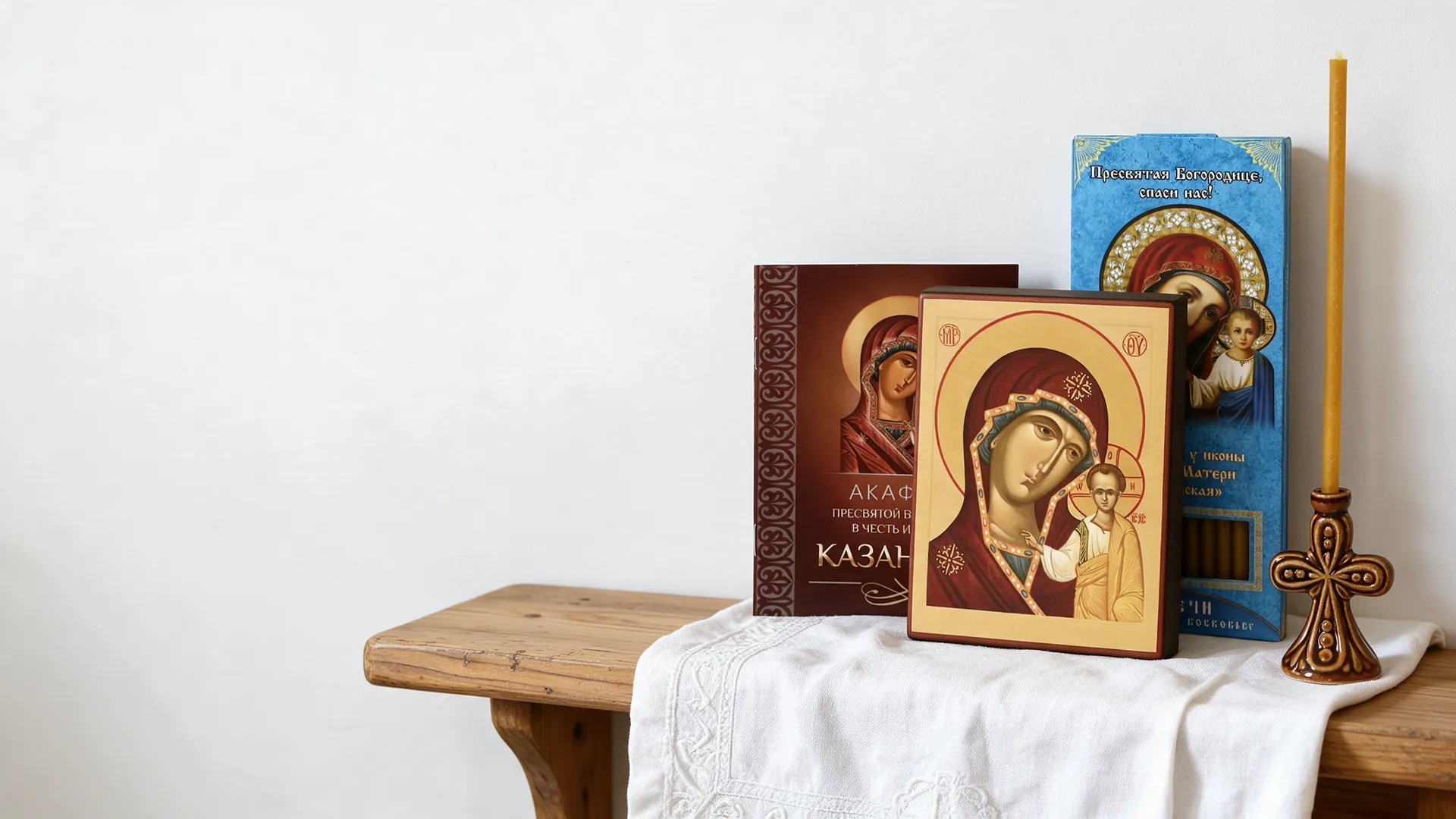
A Theotokos icon for home is usually the second icon a family brings into the house, placed beside the icon of Christ. Together the two images form the core of almost every Orthodox prayer corner, from a single shelf in a student flat to a full wooden case in a family house.
Choosing can feel daunting. There are hundreds of venerated icons of the Mother of God, each with its own name, history and feast day. In practice most of them belong to a handful of types, and once you can recognise those types the choice becomes much simpler. The rest is guided by family memory, your parish and the holy places that matter to you.
Why the Theotokos stands beside Christ
Theotokos is Greek for "God-bearer". The Church gives the Virgin Mary this title because the One she bore is God. Her icons almost always point to Him: on most of them she holds the Christ Child or gestures towards Him, and prayer to her is a request for her intercession before her Son.
On every iconostasis the icon of the Mother of God stands to the left of the Royal Doors and the icon of Christ to the right. Orthodox homes follow the same order. If you already have an icon of Christ, the Theotokos is the natural next icon to add.
Three families of Marian icons
Most icons of the Mother of God can be placed in one of three groups, recognised by the position of the Child and of His Mother's hands.
Hodegetria: She Who Shows the Way
The Mother of God holds the Child on one arm and points to Him with her other hand. The Child sits upright and blesses. The meaning is direct: the way to salvation is Christ. The Kazan, Smolensk, Iveron and Tikhvin icons are all of this type. It is clear and dignified, and many families choose it as their first Marian icon.
Eleousa: Tender Mercy
The Child presses His cheek against His Mother's and embraces her. The tenderness carries sorrow too, because she already knows about the Cross. The Vladimir icon is the best known example, and many other venerated icons, such as the Pochaev icon, are close to this type.
The Sign, or Platytera
The Theotokos is shown with her arms raised in prayer, and on her breast, within a circle, is Christ Emmanuel. This type speaks of the Incarnation: God contained within the Virgin. In many churches it fills the apse above the altar, where it is called the Platytera, "wider than the heavens".
Other forms include the Mother of God enthroned, the Protection, where she spreads her veil over the faithful, and the icon with seven swords piercing her heart. The last has its own article: the Seven Swords icon.
How families choose a Theotokos icon
There is no rule about which icon of the Mother of God a home must have. More often life makes the choice:
- an icon before which parents or grandparents prayed;
- the icon venerated in your parish, or the one it is dedicated to;
- an icon whose feast falls near a birthday, a baptism or a wedding;
- an icon from a monastery or shrine you have visited;
- the icon before which you first truly prayed.
If you are still unsure, start with a Hodegetria or an Eleousa. Both sit naturally beside a half-length icon of Christ, and both are among the most widely kept icons in Orthodox homes. The Kazan icon is traditionally paired with Christ for weddings; the Vladimir icon is loved by many as an image of a mother's tenderness.
People pray before icons of the Mother of God about children and family, the health of those close to them, peace at home and comfort in grief. Some icons have their own customs of prayer, yet any need can be brought to her before any of her icons. The shortest prayer is one most Orthodox children learn early: "Most Holy Theotokos, save us."
What to check before you buy
Whether you buy in a church shop or online, a few points are worth checking.
- The inscription. Look for ΜΡ ΘΥ, "Mother of God", and usually the name of the icon type. An icon without a name is incomplete.
- The type. The hands, the face and the position of the Child should match the type named. Our guide to Orthodox icon symbolism explains what to look for.
- The stars. Three stars on her veil, on the forehead and shoulders, confess her virginity.
- The size. The icon of the Theotokos is usually the same size as the icon of Christ beside it, or slightly smaller. Measure the shelf first.
- Where it was blessed. Ask whether the icon has been consecrated, and where.
Our catalogue includes icons from the workshops of the Pskov-Caves and Danilov monasteries. The monasteries craft and consecrate them in their own workshops, and each carries the workshop certificate on the back. An icon bought from an ordinary shop is usually taken to church to be blessed. We also have a separate section of silver-plated icons with images of the Mother of God and of Christ in a metal cover.
Where to place the icon
Standing in front of the corner, the Mother of God goes on the left and Christ on the right, just as on the iconostasis. Both stay at the centre, with saints below or to the sides. An eastern wall is traditional, though any quiet place where you can stand and pray will do. Our guide to the Orthodox icon corner covers the whole arrangement, including lamps and candles.
Keep the icon away from the television, from shelves of photographs and souvenirs, from the cooker and from radiators. A small icon of the Theotokos can also stand in a child's room or by a bed, while the main place of prayer remains one.
Caring for the icon
Dust it with a soft, dry cloth. Avoid household sprays, water and metal polish, especially on icons with a metal cover, where cleaners can damage the surface and fine detail. A damaged icon is never thrown away: take it to church and ask the priest what to do.
Begin with one icon you are glad to see every day. Set it beside Christ, light a candle and say even a short prayer. Other icons will come later, with feasts, pilgrimages and the events of family life.