Submit a prayer note
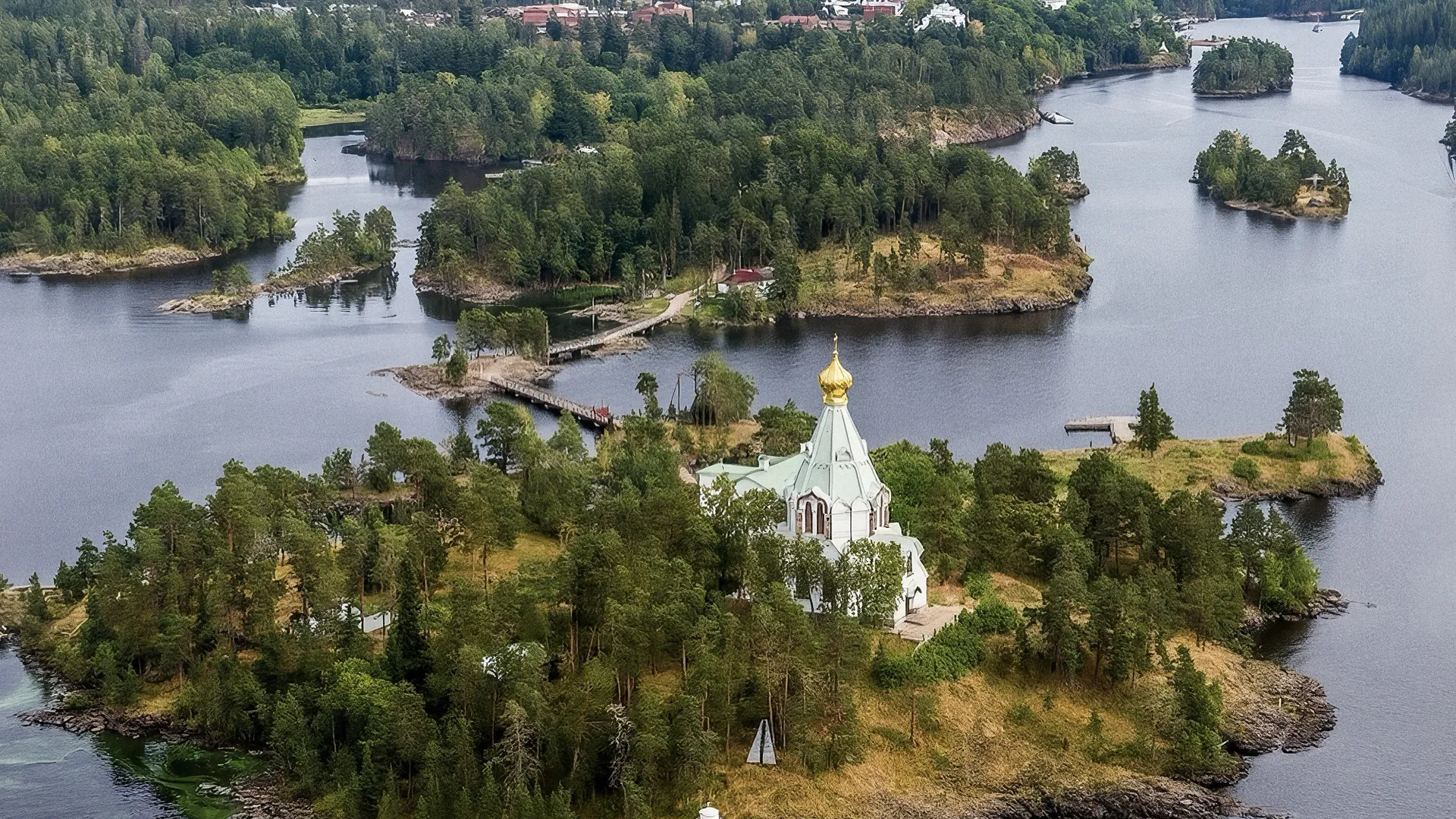
Valaam monastery, the Transfiguration monastery of Valaam, stands on the island of Valaam in the northern part of Lake Ladoga, the largest lake in Europe. Around the main island lie dozens of smaller ones, and the monastery has sketes scattered across the archipelago. The only way there is by water, and once the lake freezes the island is hard to reach.
People often call Valaam the Northern Athos. The name became fixed in the 19th century, when it was one of the largest and strictest monasteries of the north. Our centre took a group of pilgrims there, and you will find a note about that trip at the end.
Sts Sergius and Herman, the founders
According to tradition, the monastery was founded by Sts Sergius and Herman of Valaam. The monastic tradition places them very early, soon after Christianity reached these lands, while historians disagree about the date and many point to the 14th century. What is certain is that by the 15th and 16th centuries Valaam was already widely known.
Several saints began their monastic life on the island before founding monasteries of their own: St Alexander of Svir, St Arsenius of Konevets and St Sabbatius of Solovki. In this way Valaam became a mother house for a whole family of northern monasteries. Later, at the end of the 18th century, St Herman of Alaska left Valaam for the mission to Alaska.
The Church keeps the memory of Sts Sergius and Herman on 11 July and 24 September, and the monastery services on those days are especially solemn.
How Valaam became the Northern Athos
War reached the island more than once, and at the start of the 17th century the monastery was destroyed completely. It was rebuilt in the 18th century, and Abbot Nazarius brought in the strict rule of the Sarov hermitage.
The great builder of Valaam was Abbot Damascene, who led the brethren for more than forty years in the 19th century. Under him new sketes and chapels went up across the islands, and the monastery fed itself: the monks fished, kept gardens and orchards, baked bread and ran their own workshops.
This was also when the Valaam chant took shape, slow and plain in its melody. It is still sung in the monastery services and has become known well beyond the island. Painters and writers came too, among them Arkhip Kuindzhi, Nicholas Roerich, Nikolai Leskov and Boris Zaitsev.
New Valaam and the revival of 1989
After 1917 the islands belonged to independent Finland, and monastic life went on. In 1940, when the border moved, the brethren left for the interior of Finland. They took icons and some of their shrines with them and founded the New Valaam monastery, which is still active today.
Among the icons they carried away was the Valaam icon of the Mother of God. It was painted on the island in the 19th century and became known for miracles after the brethren had left. The original stayed at New Valaam, and in the revived monastery people pray before a venerated copy.
For decades the island had no monks. In 1989 the first brethren returned and monastic life was revived. Since then the main cathedral and many of the sketes have been restored, and the monastery again welcomes pilgrims from all over the world.
Shrines of Valaam monastery
The main church is the cathedral of the Transfiguration of the Saviour. In its lower church the relics of the founders, Sts Sergius and Herman, rest hidden beneath the floor. Other shrines pilgrims come to:
- a venerated copy of the Valaam icon of the Mother of God;
- the relics of St Antipas of Valaam;
- the church of the Dormition and the church of the Life-giving Spring icon of the Mother of God;
- the sketes on the islands, among them All Saints, St Nicholas, Resurrection, Gethsemane, Konevets and St John the Baptist.
Give the sketes time. The paths between them run through forest and along the shore, and walking them slowly explains why monks have looked for silence here for centuries.
Visiting Valaam as a pilgrim
Valaam is a working monastery and pilgrims are its guests. Women wear a skirt and a headscarf in church, men go bareheaded. Ask before taking photographs or filming inside the churches.
Boats run to the island during the navigation season, roughly from late spring to autumn. In winter the crossing depends on the ice and the weather, so plan ahead. Allow at least two days on the island: enough to attend a service in the cathedral, venerate the shrines and walk out to the more distant sketes.
In 2019 our centre took a group of pilgrims from Tallinn to Valaam, accompanied by one of our coordinators. You can read how that trip went in our article on the Valaam trip. A short profile of the monastery is on the Valaam monastery page, and our upcoming trips are listed in the pilgrimage section.