Submit a prayer note
Orthodox icon symbolism is a visual grammar. An iconographer chooses a gold background, folds a garment in a certain way, arranges the fingers of a hand and writes a few letters beside a face, and each of these choices says something about the person shown. The grammar grew over many centuries from Scripture, the hymns of the Church and the lives of the saints.
Nobody needs to master it before praying, but once you know why the Mother of God wears three stars, or why a martyr holds a small cross, the icon in your corner becomes easier to read and harder to pass by. This guide goes through the main elements in turn.
A caution first. Very few colours or gestures have one fixed meaning. The same red may carry different weight in two schools of painting, and sometimes a shade was chosen simply for balance. Begin with who is depicted and read the details in the light of that person.
Why an icon looks the way it does
The Church venerates icons as a witness to the Incarnation: God became man, and so He can be depicted. The Seventh Ecumenical Council in 787 taught that the honour given to an image passes to its prototype. The believer prays to Christ, to the Theotokos or to a saint; wood and pigment help to hold the attention.
A painter shows the world as the eye sees it, with shadows, volume and distance. An iconographer shows the world transfigured, as it will be in the Kingdom of God. That is why an icon has no single light source, no cast shadows and no landscape receding into haze. The flatness is deliberate and was achieved by highly skilled masters.
Light: gold, halos and highlights
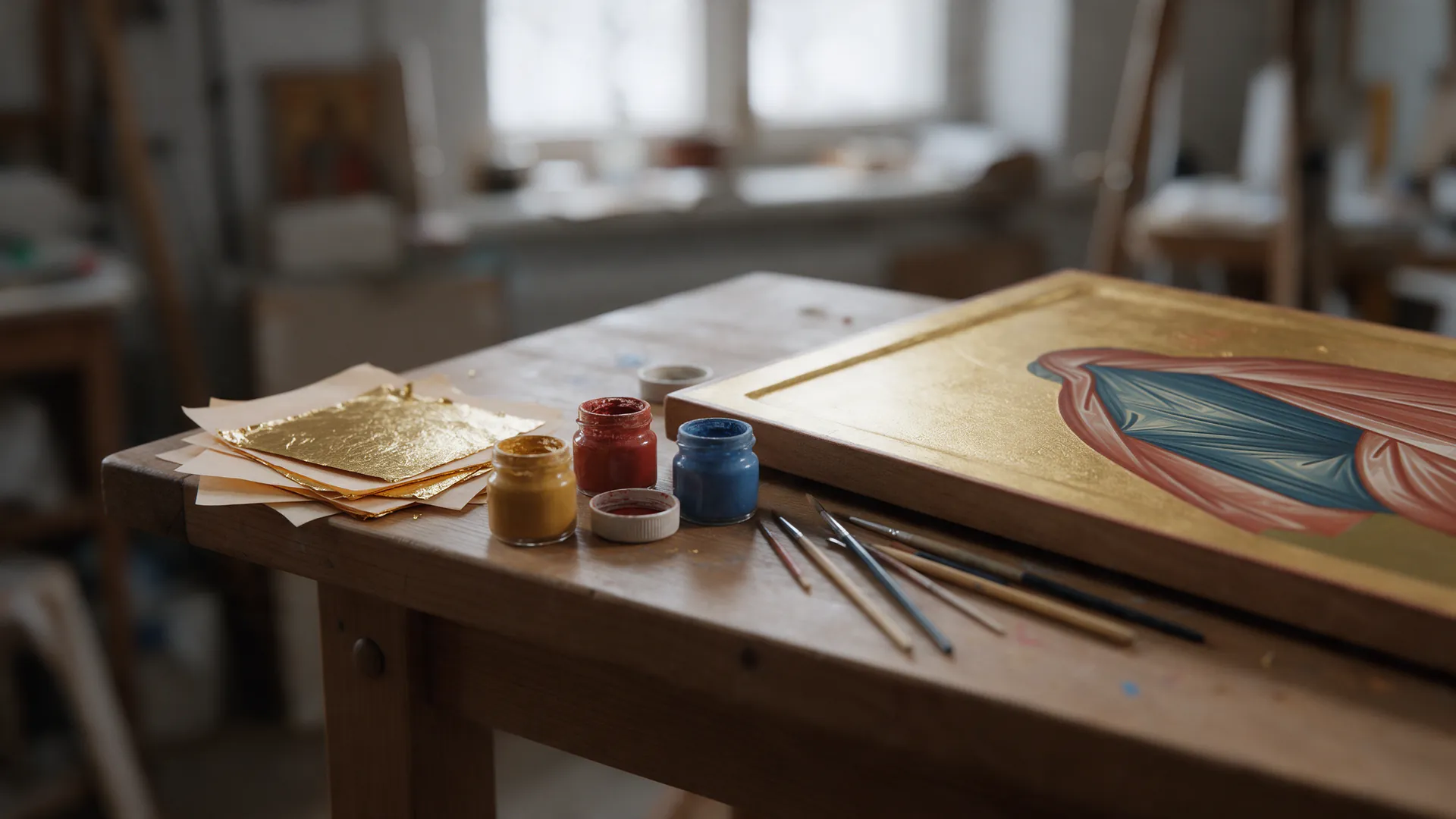
Iconographers call the gold ground "light". It stands for the uncreated light of God in which the saints now live. Because the saint is shown outside ordinary time, there is no room or view behind them, only radiance.
The halo carries the same meaning: holiness, a human being filled with grace. Christ's halo is different from all others. A cross is set within it, and on the arms of the cross are the Greek letters ὁ ὤν, "He Who Is", the name God gave Himself when He spoke to Moses from the burning bush. Even on an icon of the infant Christ, these letters declare that the Child is God.
Light in an icon comes from within. Faces are built up from dark to light: a dark base, then ever paler layers, and finally small white highlights. The result is a face that seems to shine of itself.
Colour symbolism in Orthodox icons
The iconographer's palette is small, and most colours have recognised associations:
- White: divine glory, purity and resurrection. Christ at the Transfiguration and the angel at the empty tomb are dressed in white.
- Red and purple: royal dignity, sacrifice, the blood of the martyrs and burning love. Purple was the colour of the Byzantine emperors.
- Blue: heaven, mystery and the life of the age to come.
- Green: life, growth and renewal, often linked with the Holy Spirit.
- Brown and ochre: the earth and humility. Monks and ascetics are usually shown in dark, earthy robes.
- Black: darkness and death, such as the black cave in the Nativity icon or the abyss beneath Christ's feet in the icon of the Resurrection.
The clothing of Christ and of His Mother is best read as a pair. Christ often wears a red or crimson tunic under a blue outer robe: divinity clothed in human nature. The Theotokos usually reverses the order, with a deep blue dress beneath a crimson veil, the maphorion: a human being who received God into herself. This reading is widespread, though not universal, and shades vary from one school to another.
Faces and hand gestures
The face in an icon is not a portrait. The eyes are large and attentive, the nose long and fine, the mouth small and closed, and the ears are often visible. The saint is not speaking or eating but listening to God, and the stillness of the features shows passions brought to rest.
Saints face the viewer or turn three-quarters towards them. Profile is generally kept for those whose gaze the believer should not meet, such as Judas at the Last Supper or demons.
Hands speak as clearly as faces:
- Christ and the bishops bless with the right hand, the fingers shaped into the letters IC XC, the name of Christ.
- Both hands raised, palms open, mean prayer. This is the Theotokos of the Sign, also called the Orans.
- A hand pointing to the Child belongs to the Hodegetria, "She Who Shows the Way": the way is Christ.
- An open palm turned outwards, common on martyrs, is a confession of faith.
- A hand laid on the breast expresses humility and consent to God's will.
Attributes: what the saints hold
Often you can name a saint from what they carry before you read a single letter:
- a Gospel book: Christ, bishops and teachers of the Church;
- a scroll: prophets and monastic saints, frequently with a line of their prophecy or teaching;
- a small cross: martyrs who died for Christ;
- spear, sword and armour: soldier martyrs such as St George the Victorious;
- a medicine box and spoon: the unmercenary physicians, among them St Panteleimon;
- a model of a church: founders of monasteries and builders of churches.
Inscriptions and the three stars
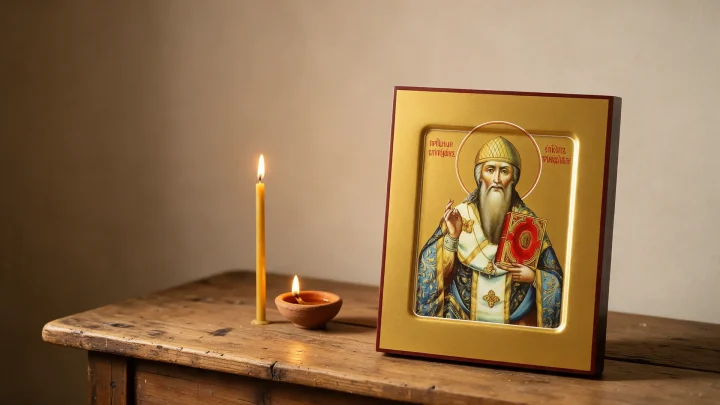
The inscription belongs to the icon itself. Without a name the image is unfinished, because the name tells us who is present.
The abbreviations you will meet most often:
- IC XC: Jesus Christ, the first and last letters of each word in Greek.
- MP ΘΥ: Mother of God, again abbreviated from the Greek.
- ὁ ὤν within Christ's halo: "He Who Is".
- Saints' names, in Greek or Church Slavonic, usually with a title such as martyr, bishop or venerable.
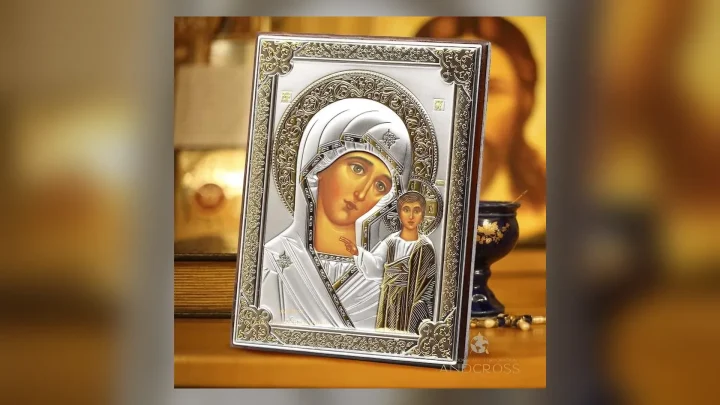
The stars on the Theotokos's veil are read like a text. There are three, on the forehead and on each shoulder, confessing that she remained a virgin before, during and after the birth of Christ.
When you choose an icon, look for the name. Many saints wear similar vestments, and the inscription is the surest guide.
Reverse perspective and sacred time
In a painting, lines run back to a vanishing point on the horizon. In an icon they frequently run the other way: tables, thrones and buildings widen towards the viewer, as if the vanishing point were in front of the icon, where the believer stands. This is called reverse perspective, and it makes the image open outwards to meet the person praying.
Mountains rise in stepped ledges, trees are drawn as signs, and buildings stand with their walls open. A red cloth slung between two buildings tells you the scene happens indoors. The most important figures are the largest, because size here shows significance, not distance.
Time is gathered in the same way. The Nativity icon shows the Child in the manger, the Magi on the road, the washing of the newborn and a troubled Joseph all at once. A feast icon presents the whole event as the Church sings it in the services. For a masterpiece where colour and composition carry a whole theology, see our article on the Holy Trinity icon.
Reading an icon in your own home
Try these steps with any icon in your prayer corner:
- Read the inscription and find out who is shown.
- Look at the hands and at anything they hold.
- Notice the colours of the clothing and the background.
- Find the feast or the life connected with the image, and read its troparion.
The two icons that come first in any home are the best place to start. Our guide to the Christ Pantocrator icon explains the image of the Saviour, and the article on choosing an icon of the Mother of God covers her most loved types.
If you are looking for a new icon, our catalogue includes icons from the workshops of the Pskov-Caves and Danilov monasteries. They are made and consecrated in those monasteries, and each carries the workshop certificate on the back. Check the inscription and the main details in the photographs before you choose.