Submit a prayer note
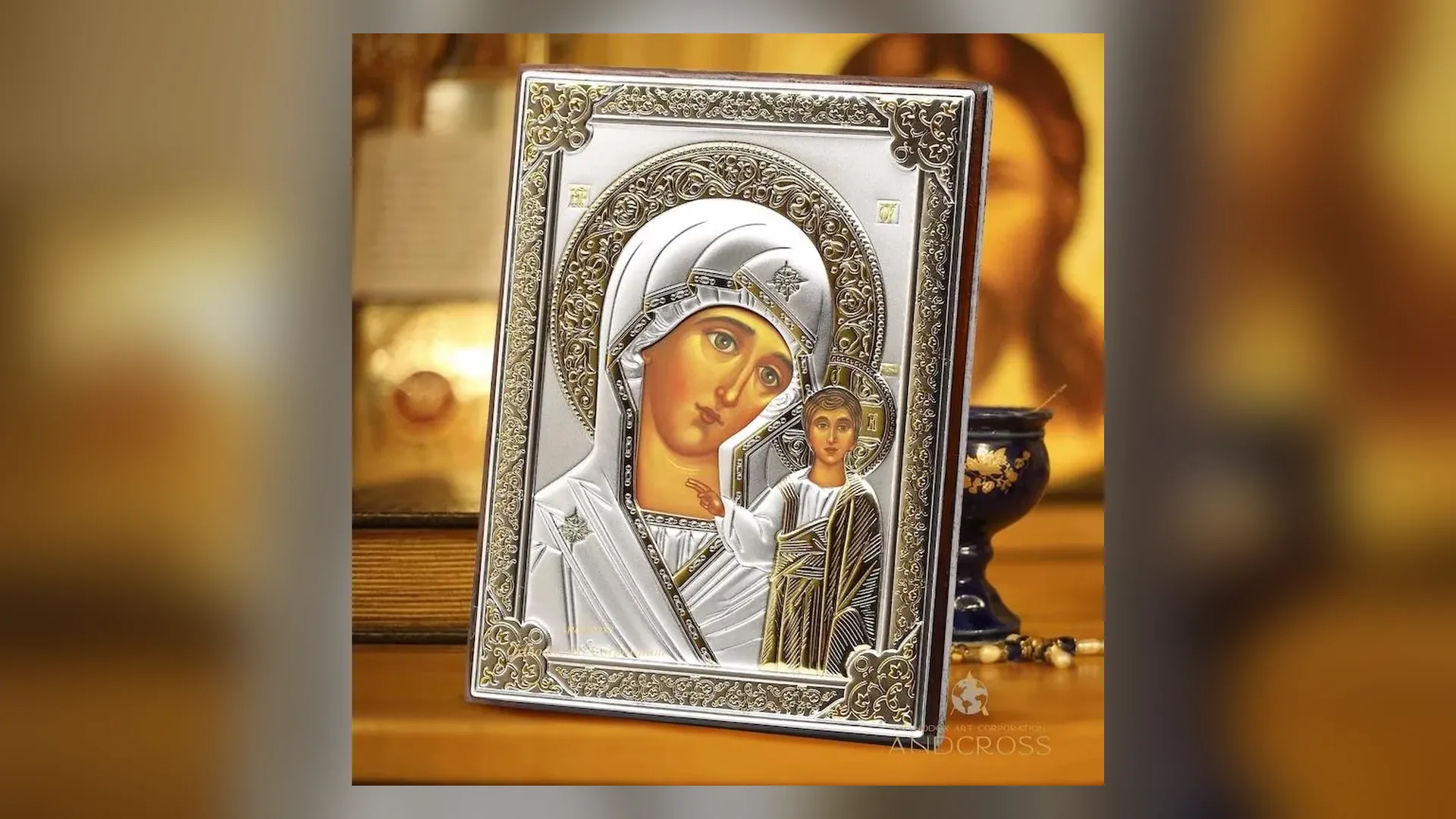
A silver-plated Orthodox icon catches the eye at once: bright metal, fine relief ornament, and in the middle the face of Christ, the Mother of God or a saint painted in colour. Some people are drawn to the beauty of it. Others wonder whether so much shine belongs in a prayer corner at all.
The answer starts with what an icon is for, and with a custom that goes back to the early centuries of the Church: people have always given their best to the holy images. Below we look at that custom, at how the silver-plated icons in our catalogue are made, and at how to keep one at home.
What an Orthodox icon is
An icon is a holy image through which a person turns in prayer to the Lord, the Most Holy Mother of God and the saints. It is a window for prayer rather than a painting on a religious theme or a piece of decoration. In front of it people light a candle, ask for help for their family, give thanks and confess their weakness. What matters most in an icon is the face, the inscriptions and the recognisable form of the image handed down by the Church.
St Basil the Great taught that the honour shown to an image passes on to its prototype, and the Seventh Ecumenical Council made this the ground of icon veneration. Orthodox Christians do not venerate wood, paint or metal. They venerate the One who is shown on the icon. That is worth keeping in mind both when choosing an icon and later, when it stands in your home.
If you want to read an icon more closely, our guide to icon symbolism explains colours, gestures and inscriptions.
Why icons were covered in silver
Covering icons with precious metal is an old practice of the Eastern Church. In Byzantium icons were dressed in silver and gilded covers, and the custom spread with Orthodoxy to Georgia, the Balkans and the Slavic lands. The cover, called an oklad or riza, hides the background, the borders and the clothing, and leaves the faces and hands open.
The metal protected the paint from candle soot and from the touch of many hands, but that was not the main reason for it. People brought the best they had to the holy image: silver, gold, pearls, stones. A cover was often made as a thank-offering or to fulfil a vow, by one family or by a whole parish. The shine of the metal spoke of the uncreated light and of the Kingdom to which every person is called. The oklad became a sign of love and reverence, a way of saying without words that this is a place of prayer.
How a silver-plated icon is made
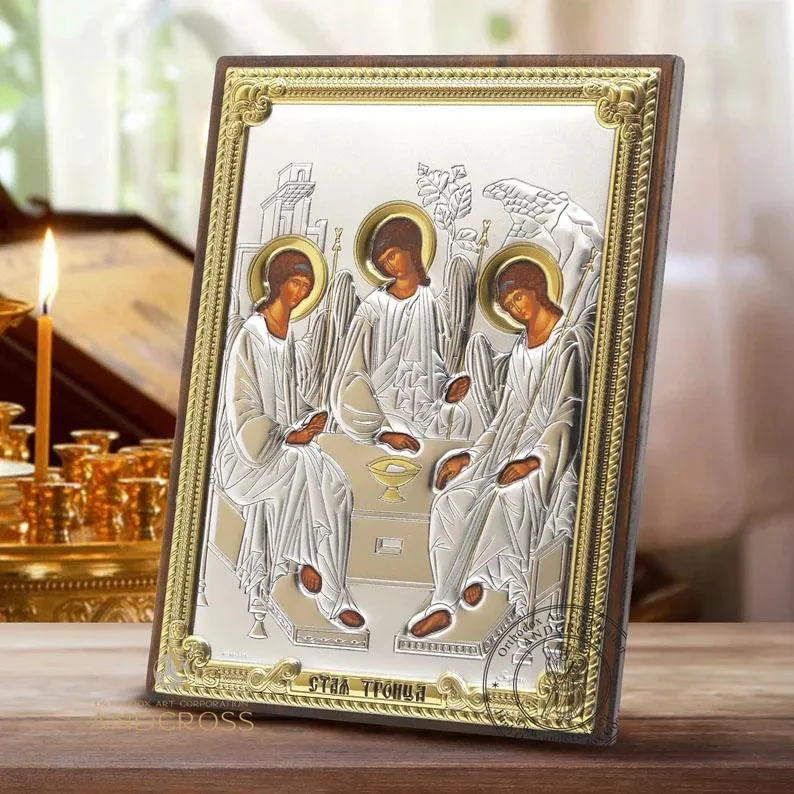
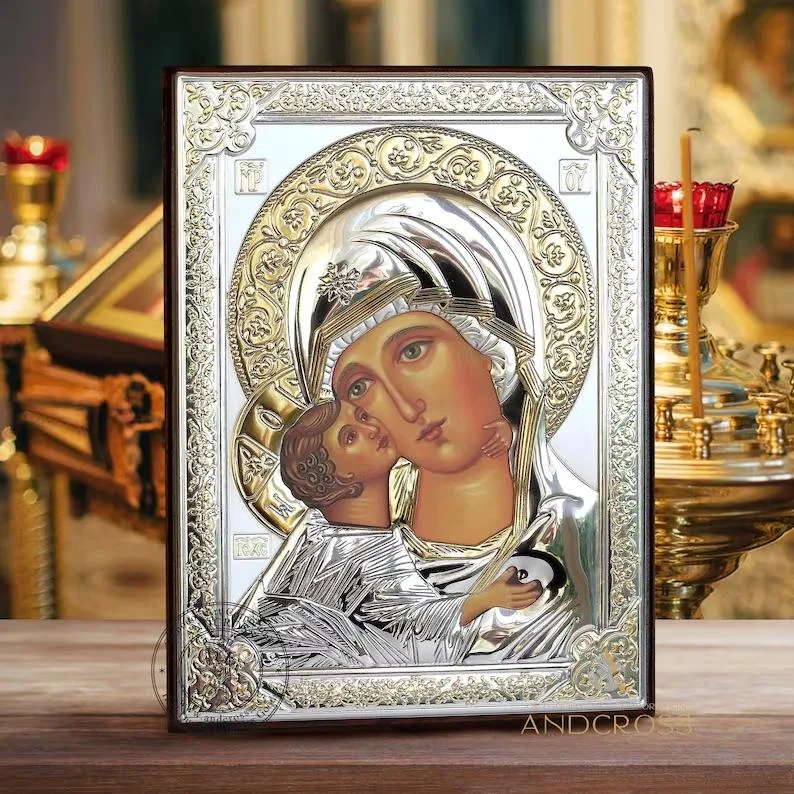
A silver-plated icon keeps that tradition within reach of an ordinary household. The icons in our catalogue are made to order for Andcross. The base is MDF or natural wood. The cover, with its relief ornament, is coated in 999 silver applied by physical vapour deposition (PVD). Some covers combine silver and gilding, and on many icons the faces and garments are in colour, so the image stays clear and alive.
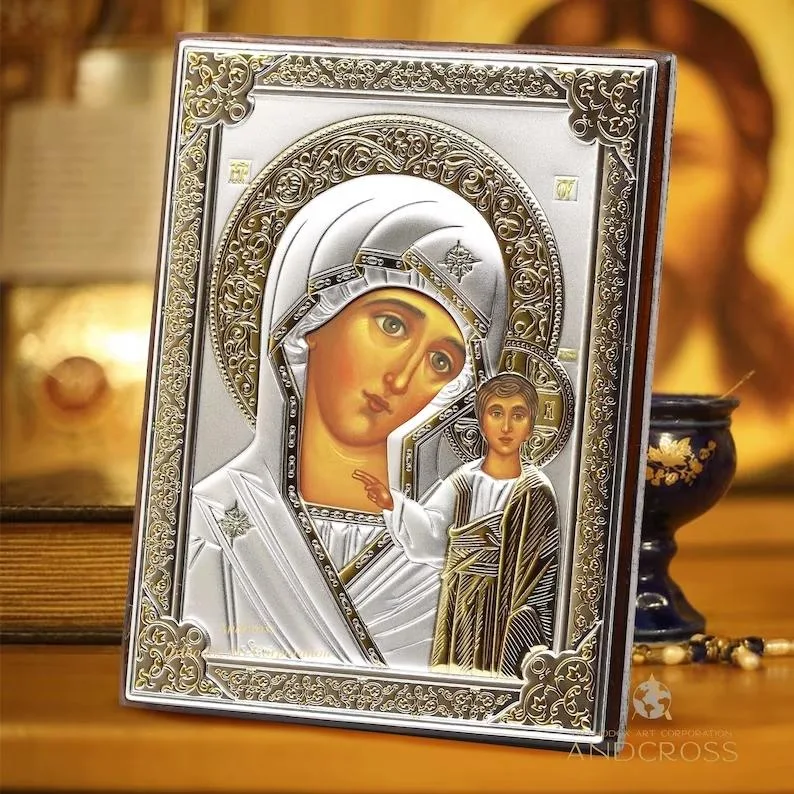
The sizes suit different places in a home:
- 6.4 x 5 cm: small icons to take when travelling, keep in the car or on a desk;
- 8 x 11 cm: for a small prayer corner or a shelf;
- 13 x 18 cm: the most popular size for a home icon corner;
- 21 x 28 cm: a central icon for the corner, or a present for a major occasion.
Many of them come in a gift box, a case or a glass frame. You can see every size and image in our silver-plated icons section.
Beauty and prayer
People sometimes ask whether the shine of a cover distracts from prayer. The experience of the Church is that beauty itself is not the problem. The problem begins when someone values an icon for its metal rather than for the image. When an icon in a silver cover is bought for prayer and given its place in the icon corner, its beauty helps the household treat that corner with care: keep it clean, keep unrelated things away from it, light the lamp on feast days.
The beauty of an icon is a human answer to the beauty of God's world. The masters who made covers worked slowly and carefully because they knew what the object was for. The same holds at home: we adorn what we love.
A silver-plated icon in the home
Silver-plated icons sit well beside icons painted on wood. The centre of the corner usually belongs to icons of Christ and the Mother of God. Around them go the patron saints of the family and the saints the family turns to most often: St Nicholas, the Guardian Angel, St George.
A few practical points:
- hang or stand icons so that the faces are at eye level or a little higher;
- leave room for a candle or a lamp, but not right against the cover;
- keep photographs, souvenirs and calendars away from the icons;
- if the icons differ in size, put the largest in the middle and the smaller ones at the sides.
Our article on the Orthodox icon corner covers where to place it and which icons to start with.
Honouring an icon at home
An icon at home deserves the same respect as an icon in church. It is not a decoration for the dinner table, and it does not belong on top of the television or on a windowsill among the plants. If your icon is new and you would like it blessed, take it to your parish church and ask the priest. Our guide on how to bless an icon explains what happens and what to say.
Veneration is always directed to the face on the icon, never to the cover. An icon in a plain frame and an icon in a silver oklad are equal in meaning. The finish is a matter of place, occasion and taste, never a measure of piety.
Caring for a silver-plated icon
The silver layer on an icon is thin, so it needs gentle care:
- wipe the cover with a dry soft cloth, without water or cleaning products;
- do not use silver polish or polishing cloths, which are made for solid silver and can damage the coating;
- do not hang the icon by the cooker, in the bathroom or directly above a radiator;
- keep lamps and candles at a distance so that soot does not settle in the relief.
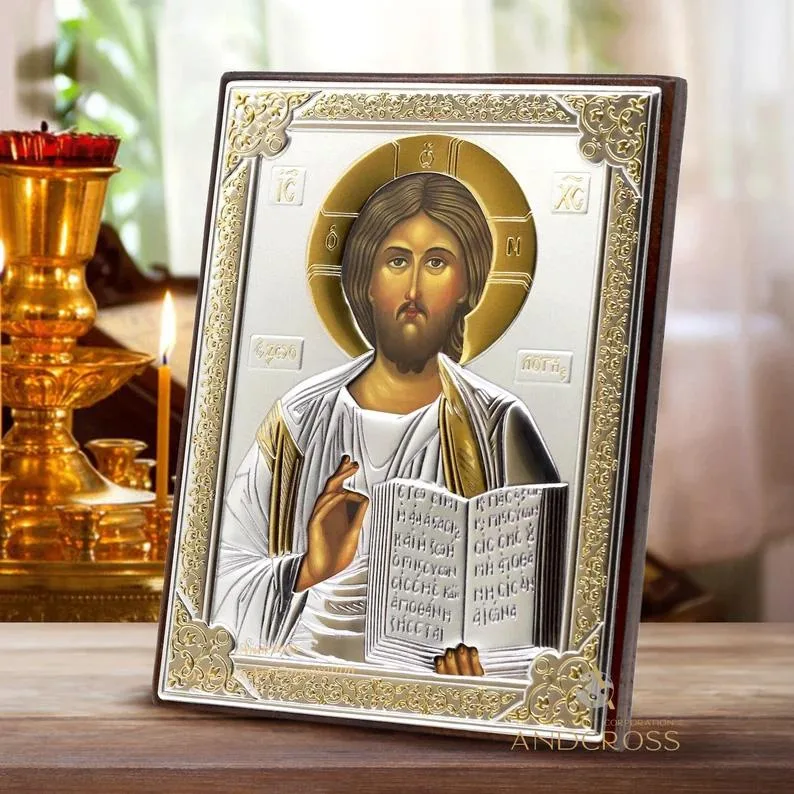
With that care the cover keeps its light colour for many years, and the painted faces and inscriptions stay sharp.
Where to begin
If your home has no icons yet, begin with Christ and the Mother of God. If you already have an icon corner, think about which image is missing: the patron saint of your family, St Nicholas or the Holy Trinity. Browse our silver-plated icons in every size, and if you are buying for someone else, read our guide on which icon to give.