Submit a prayer note
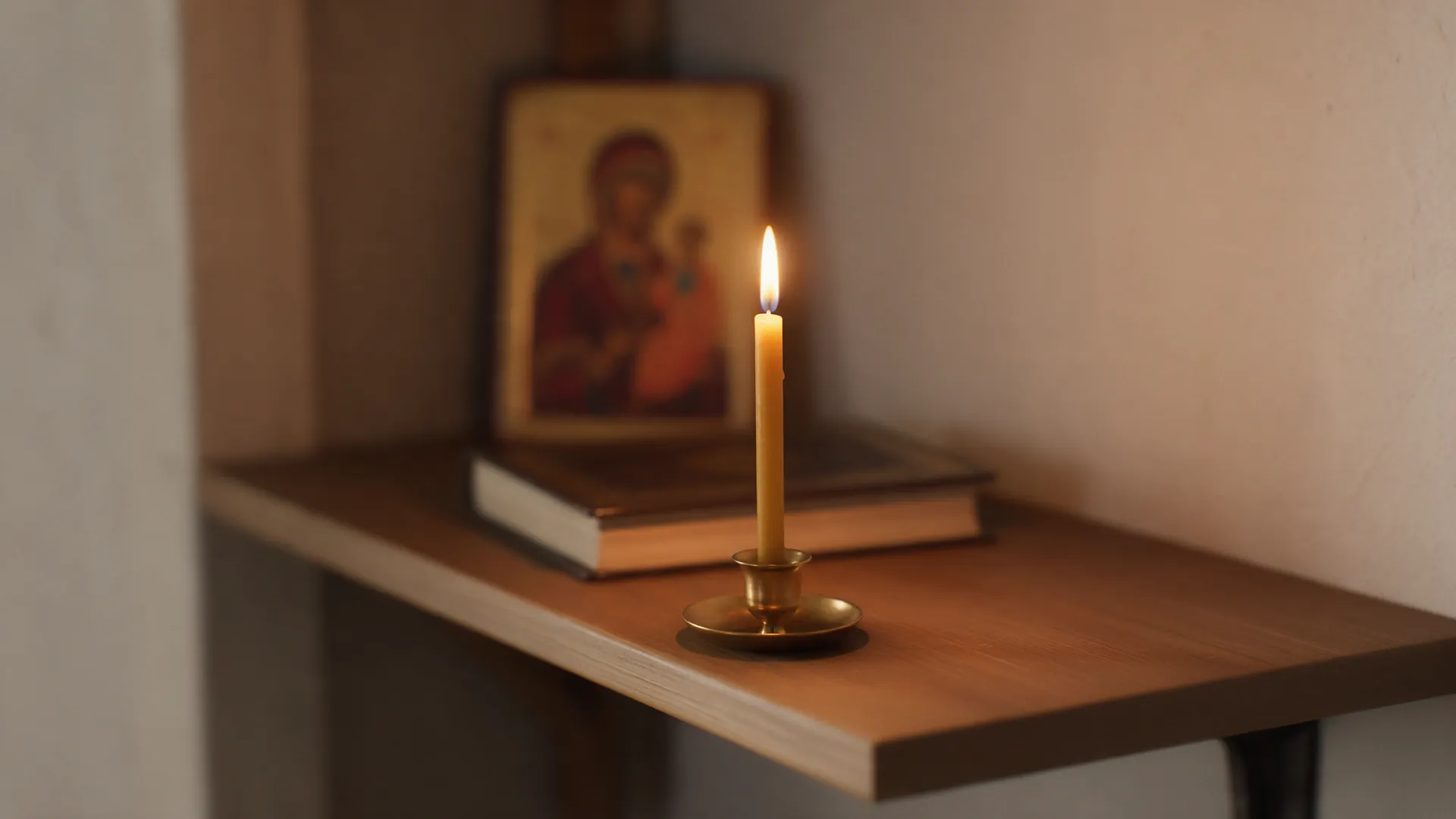
Orthodox candles at home serve the same purpose as the candles in church: they burn before the icons while someone prays. Many families bring thin church candles home from a feast-day service, keep a bundle beside the prayer book, or buy their first box when someone in the family falls ill or dies.
The questions tend to be the same. Is it right to light a church candle at home? On which days? What do you say? What do you do with the stubs? This article answers them from ordinary Orthodox practice, and adds the safety points that are easy to forget in a small flat.
Why Orthodox Christians light candles at all
In church a candle is a small offering. You buy it, light it from another flame and set it before an icon, and in doing so you give something of your own to God along with your prayer. The flame is a reminder of Christ, the Light of the world, and of the attention a person brings to prayer.
At home the meaning is the same. A candle in the icon corner marks the moment when the day's business stops and prayer begins. Many families use a vigil lamp, the lampada or kandili, rather than a candle, since it burns longer and more steadily; our article on setting up an Orthodox icon corner describes it. On feast days both are often lit together.
A candle is a sign that goes with prayer. It has no power of its own, and prayer without a candle is just as real.
When to light a church candle at home
There is no fixed rule. By custom, families light a candle:
- for morning and evening prayers, or at least on Sundays;
- on the great feasts and on the name day of each member of the family;
- when reading an akathist, a canon or the Psalter;
- when praying for someone who is ill, travelling or facing something hard;
- on days of remembrance for the departed: the ninth and fortieth days, anniversaries and Soul Saturdays.
For those days and the prayers that go with them, see Orthodox prayers for the departed.
Some candles come home from church with a story. At Pascha, Orthodox Christians receive the light at midnight and many carry their lit candle home, using its flame to light the lamp in the icon corner and marking a small cross with its smoke above the front door. In Slavic parishes the same is done on Holy Thursday evening, after the reading of the twelve Passion Gospels. Such candles are kept and lit again in hard moments.
Praying with a candle
A simple order for prayer at home:
- Stand before your icons, make the sign of the cross, light the candle and set it firmly in its holder.
- Read the morning or evening prayers, or the prayers that suit the occasion, from your prayer book.
- Name the living and the departed you are praying for.
- Add a few words of your own: thanks, a request, repentance.
If the whole family prays together, one person can read aloud while the others listen. Children love to be the one who lights the candle, with an adult beside them. A short prayer every day does more than a long one once a month.
Afterwards you can let the candle burn down while you stay in the room, or put it out. Orthodox custom is to snuff a candle before an icon with a snuffer or with damp fingers rather than blow it out.
Church candles are for prayer only. Rituals of "cleansing a house with a candle", reading the future in wax drips and similar practices are condemned by the Church as superstition. If someone recommends them, ask a priest.
Beeswax church candles and candle holders
Traditionally, Orthodox church candles are made of beeswax. A beeswax church candle burns evenly, gives little smoke and smells faintly of honey. The Church sees in pure wax an image of a pure offering, gathered by bees from many flowers. Candles with paraffin are cheaper, but they smoke more and drip faster, and the soot ends up on your icons and ceiling. For home prayer, beeswax is the better choice.
Church candles are thin, so an ordinary dinner-candle holder will not take them. At home people use:
- a small holder with a narrow socket and a drip tray;
- a holder for several candles, if the family prays together;
- a bowl of sand, as in many churches, where a candle stands upright on its own.
To make a thin candle stand firmly, warm its base for a moment over another flame and press it into the socket while the wax is soft.
Keeping the flame safe
A candle is most dangerous when someone leaves the room "just for a minute" and forgets it. A few rules:
- always use a stable holder or a bowl of sand, never the bare shelf;
- keep the flame well away from curtains, paper icons, dried palm or willow branches and any shelf above;
- never leave a burning candle unattended or go to sleep with it lit;
- with small children or pets at home, place the candle high or light it only while the family prays;
- trim a long wick so that the candle smokes less.
If an icon darkens from soot over the years, do not rub it with solvents. Dust it gently with a soft dry brush and leave any real cleaning to a restorer.
What to do with candle stubs
Church candle stubs are not thrown in the bin with household rubbish. Instead:
- Take them to church. Many parishes collect stubs and send the wax to be melted down.
- Burn them down at home during prayer, standing several in a bowl of sand.
- If neither is possible, burn them safely outdoors or bury them in a clean place where people do not walk.
The same applies to broken candles and to wedding candles that can no longer be kept.
Where to find church candles
Most people buy candles in their parish. Our catalogue also has a section of church candles for prayer at home.
Among them are candles from the St Gabriel series. Like the rest of that series, they are consecrated in Samtavro monastery in Mtskheta, most of them at the relics of the saint: we bring the items to Samtavro on our trips and consecrate them there. The monastery's letter confirming this is published on our consecration page. Every item card states where it was consecrated.