Submit a prayer note
Orthodox prayer for the departed begins at the deathbed and does not stop at the grave. The Church keeps praying for the person by name in the days after the funeral, on set days through the year and at every Divine Liturgy. Families take part in that prayer at home and in church, and many find in it the one thing they can still do for someone they love.
This article explains the days on which the Orthodox pray for the dead, the Saturdays set aside for remembrance, the memorial service, how to send names for repose, and a simple way to pray at home. The practical rules for writing names on a note are in a separate guide, how to write an Orthodox prayer list.
Why the Orthodox pray for the dead
The Church believes that the soul lives on after death and that love joins the living and the departed in one body of Christ. Those who have died can no longer repent or do good themselves, but their family and the whole Church can ask God's mercy for them. That conviction runs through the services: the departed are remembered at the Liturgy, at memorial services and in the morning prayers of every Orthodox prayer book.
Praying for someone who has died asks for nothing complicated. A name and a few words are enough: "Give rest, O Lord, to the soul of Thy servant." A short hymn sung at Orthodox funerals sums up what the Church asks: that Christ give the soul rest with the saints, "where there is neither sickness nor sorrow nor sighing, but life everlasting".
Prayers for the departed on certain days
For the first forty days after a death the person is called the newly departed, and the family's prayer is especially concentrated. Three days within that period are marked by ancient custom.
- The third day. Usually the day of the funeral. It recalls the Resurrection of Christ on the third day.
- The ninth day. Linked with the nine orders of angels, among whom the Church asks that the soul be counted.
- The fortieth day. The most important of the early memorials. Forty days is a time of trial and preparation throughout Scripture, and Christ ascended on the fortieth day after His Resurrection.
The count starts from the day of death, which is day one. On these days the family brings names to the Liturgy, asks the priest to serve a memorial, and prays at home.
After that, the departed are remembered on the anniversary of death, on their name day and on their birthday. Families of Greek tradition often hold memorials at three months, six months and one year as well. Many households also read the Psalter for the departed during the first forty days.
Soul Saturdays and the memorial service
Saturday is the day of the week the Church gives to remembering the dead. Several Saturdays in the year are set apart for it and are known as Soul Saturdays, or in Slavic parishes as Parents' Saturdays:
- the Saturday before Meatfare Sunday, a week before Great Lent;
- the second, third and fourth Saturdays of Great Lent;
- the Saturday before Pentecost.
Slavic Churches also keep Radonitsa, the Tuesday after Thomas Sunday, when families visit graves with the Paschal greeting, and a Saturday in autumn before the feast of St Demetrius. The dates move each year with Pascha, so check your parish calendar.
The memorial service itself is called a Panikhida in Slavic use and a Mnemosyno in Greek. A shorter form, the Trisagion for the departed, can be served at the graveside or in church after the Liturgy. In Greek and Balkan parishes the family brings koliva, a dish of boiled wheat with sugar and nuts, recalling Christ's words about the grain of wheat that dies and bears fruit. The service ends with the singing of "Memory eternal".
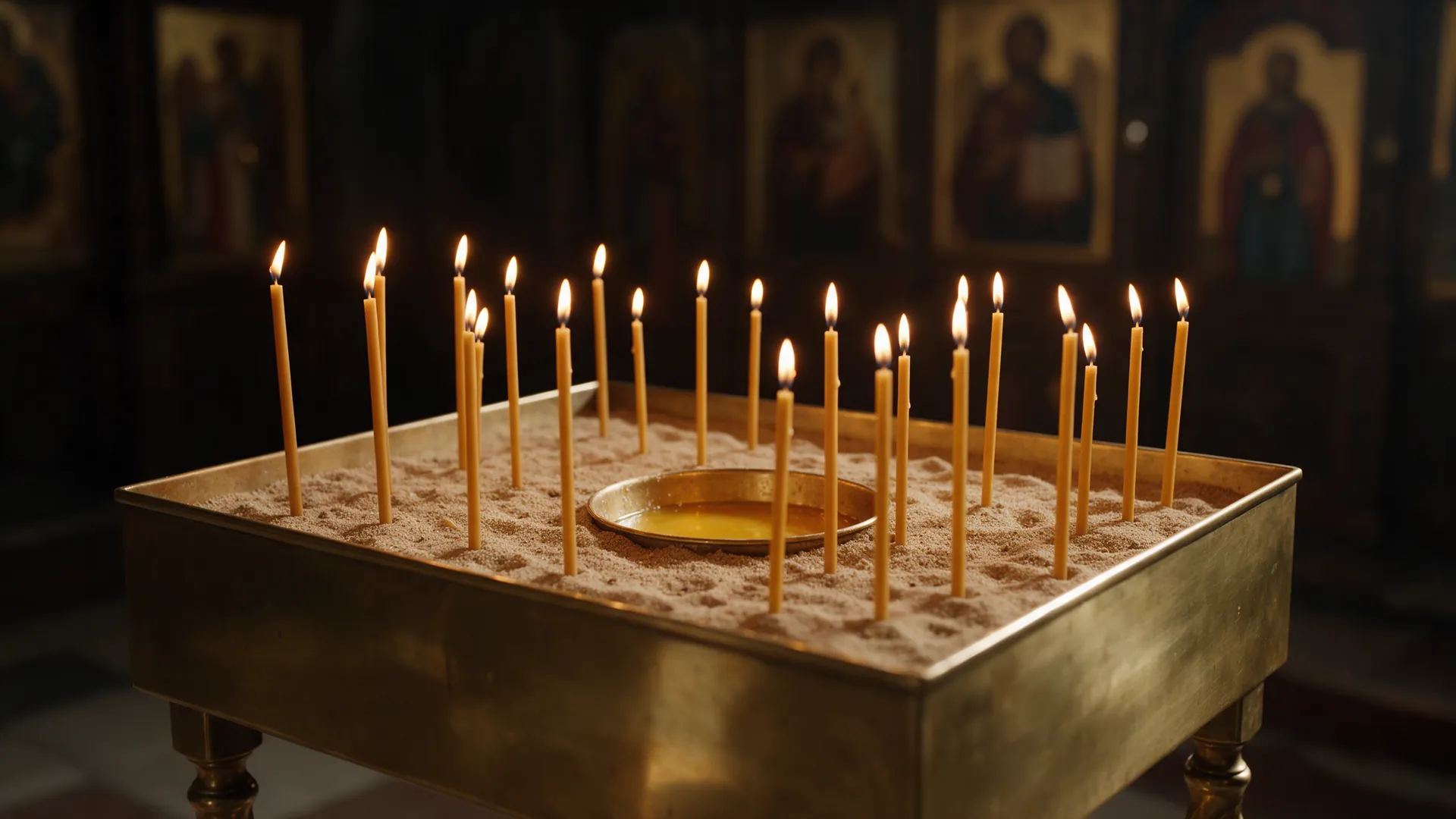
In Slavic churches there is also a special table for the departed, a stand with a small crucifix and rows of candle holders. Candles for the dead are placed there, and on Soul Saturdays people bring bread, flour or fruit, later shared with those in need.
Names for repose at the Liturgy
The most constant form of prayer for the departed is the list of names given in before the Liturgy. During the preparation of the gifts, the priest takes a small particle of bread for each name, and at the end of the service these particles are placed in the chalice with a prayer that their sins be washed away.
Only those baptised in the Orthodox Church are named on these lists. An Orthodox prayer for the departed who were not Orthodox is still possible and good: pray for them at home, in your own words. God hears that prayer too.
A short rule for praying at home
Every Orthodox prayer book includes a prayer for the departed among the morning prayers, with room to add names. Many families keep a small book of names, living and departed, so that no one is forgotten.
A simple rule might look like this:
- Light a candle or the lamp before your icons.
- Read the prayer for the departed from your prayer book, or simply say: "Give rest, O Lord, to the souls of Thy servants," and name each person.
- If you have time, read a section of the Psalter. Psalm 118 (119 in most English Bibles) is read at Orthodox funerals and suits prayer for the dead.
- Finish in your own words, thanking God for the person and asking His mercy for them.
When a candle is appropriate at home and how to keep it safe is covered in church candles at home. Candles for your prayer corner are in our candles section.
Almsgiving has always gone with prayer. Helping someone in need in the person's memory, or doing a good deed they would have done, is part of remembering them.
Sending names for repose to a monastery
Through our site you can send a prayer note for the departed to two monasteries in Georgia: Samtavro monastery, at the relics of St Gabriel, and the Monastery of the Nativity of the Most Holy Theotokos in Borjomi.
- On the prayer notes page, choose the monastery and the note for the departed.
- Enter up to five names of people baptised in the Orthodox Church.
- Make a donation. Right after payment you receive an email with the names and the type of note.
We hand the note to the monastery ourselves: in person on our nearest trip or, if no trip is coming soon, by email within 1-2 days. The note will be delivered to the monastery and the names will be commemorated at the divine service. Your notes stay in your personal account, which makes it easy to send them again for the fortieth day or an anniversary. The full conditions are on the prayer notes terms page.