Submit a prayer note
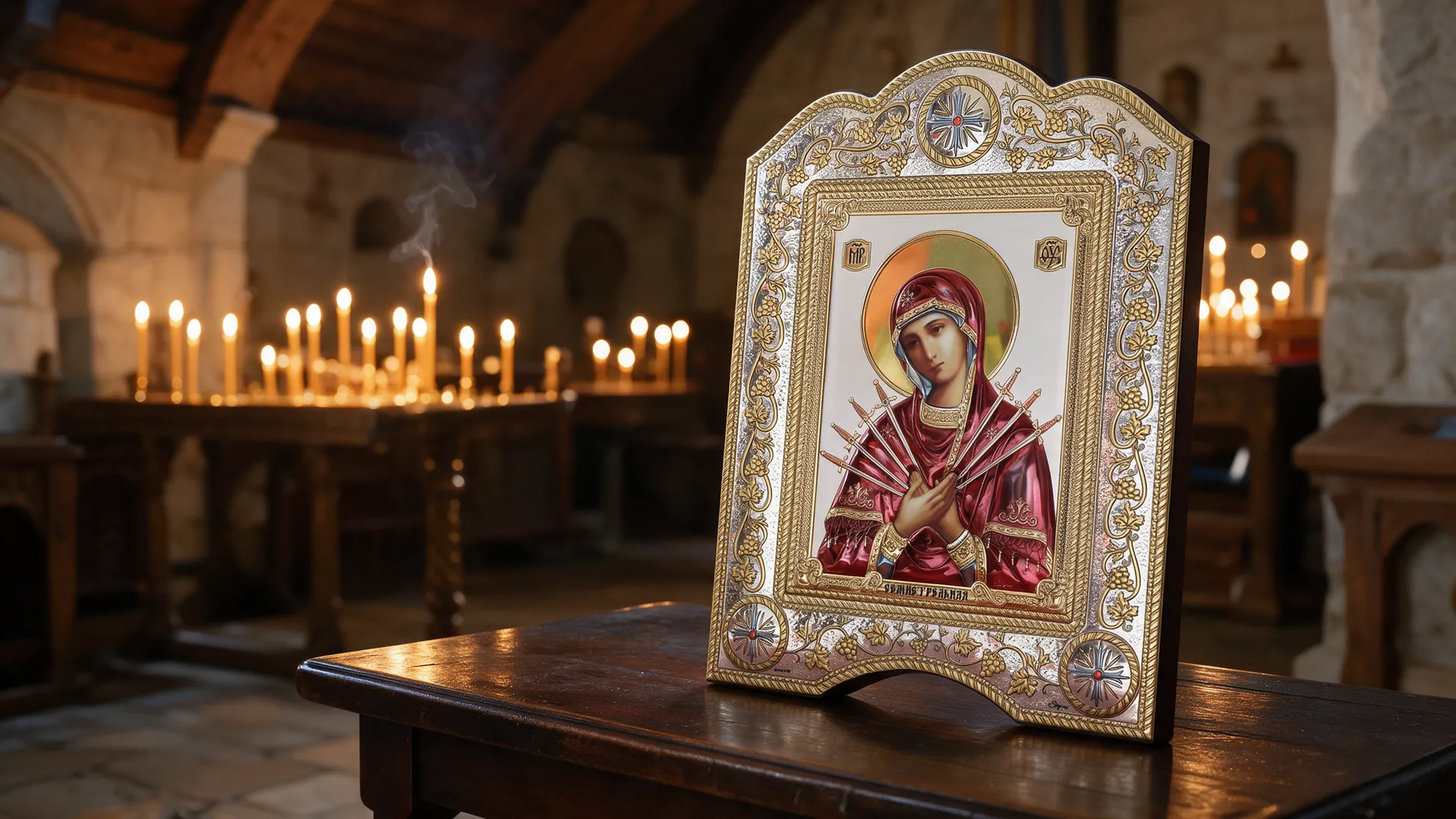
The Seven Swords icon shows the Mother of God alone, without the Christ Child, with seven swords pointed at her heart. In Orthodox churches it is known by two closely related names: the Seven Arrows icon and the Softening of Evil Hearts. People turn to it when there is anger in the family, when a relationship has broken down, or when their own heart has grown hard.
To understand the Seven Swords icon meaning, you need one verse from the Gospel of Luke and a little knowledge of how icon painters use numbers. This guide covers both, explains how the two versions of the icon differ, and describes how Orthodox Christians pray before it at home.
The prophecy of Simeon
Forty days after the birth of Christ, Mary and Joseph brought the Child to the Temple in Jerusalem. There they were met by Simeon, a righteous old man who had been promised that he would not die before seeing the Messiah. He took the Child in his arms, blessed God and then spoke to Mary: "Yea, a sword shall pierce through thy own soul also, that the thoughts of many hearts may be revealed" (Luke 2:35).
The sword is the grief Mary would feel at the foot of the Cross. Icon painters took Simeon's words literally and showed swords entering her heart. In Slavonic usage the swords came to be called arrows, which is why the same image is often called the Seven Arrows icon.
The second half of the verse matters as much as the first. Her suffering reveals "the thoughts of many hearts". Standing before her sorrow, a person begins to see his own heart: the anger and cruelty that wounded her Son.
Why seven swords?
In Scripture seven is the number of fullness and completion. The seven swords therefore stand for the whole of the Mother of God's suffering on earth, from the flight into Egypt to Golgotha and the burial of her Son.
Orthodox writers also offer a second reading. The seven swords are the seven chief passions that wound the human soul: pride, love of money, lust, anger, envy, gluttony and despondency. Our sins wound the heart of the Mother of God because she loves each person as a mother loves a child. Seen this way the icon is also a call to repentance. Whoever prays before it asks to be freed from the very things that hurt other people.
The two readings sit comfortably together. In both, the Mother of God shares human pain because she has carried the heaviest pain a mother can know.
Western Christians will recognise a similar image in Our Lady of Sorrows, where the seven swords stand for seven particular sorrows of Mary. The Orthodox icon grew from the same Gospel verse but is usually explained in the broader way described above.
The Seven Arrows and the Softening of Evil Hearts
The two icons look very alike and are often confused:
- On the Seven Arrows icon the swords are usually arranged three on one side and four on the other.
- On the Softening of Evil Hearts there are three swords on the left, three on the right and one coming from below, straight to the heart.
Other arrangements also exist, so the inscription on the icon is the surest guide. In meaning the two are one image, rooted in the prophecy of Simeon, and they share the same feast. The name Softening of Evil Hearts says plainly what people ask for before it: that a hardened heart, someone else's or one's own, may become gentle again.
According to tradition, the Seven Arrows icon became widely known in the nineteenth century. It had lain face down in the bell tower of a small country church dedicated to St John the Theologian, and people walked on it as if it were a step. A man who had long suffered from lameness was told in a dream to pray before it. The icon was found, cleaned and set up in the church, and from that time it was honoured as wonderworking.
What to pray for before the Seven Swords icon
Orthodox Christians believe that help comes from God through the prayers of the Mother of God. The icon gathers our attention and turns it to her. People most often pray before this image:
- for peace in the family when there are quarrels and resentment;
- for reconciliation with someone they have fallen out with;
- for the softening of hard and angry hearts, including their own;
- in deep sorrow, in illness, or when someone close is in trouble;
- to be freed from bitterness, hostility and the wish for revenge.
There is a short troparion to the icon which begins "Soften our evil hearts, O Theotokos". You will find it in fuller prayer books. A simple prayer is just as fitting: "Most Holy Theotokos, save us." The Church teaches us to pray for those who have hurt us without any wish for them to suffer, asking good for them.
When the trouble concerns someone you love, you can also ask for prayer for them at holy places. Our article on praying for loved ones explains how this works.
Feast day of the Seven Swords icon
The Church honours both the Seven Arrows and the Softening of Evil Hearts on 13 August. Churches that follow the old (Julian) calendar keep the feast on 26 August. A second commemoration falls on the Sunday of All Saints, the first Sunday after Pentecost.
Where to place the icon at home
Many people hang the Seven Swords icon opposite the front door so that it greets everyone who enters. This is a popular custom, not a church rule. The icon can equally stand in the icon corner beside the icons of Christ and the Mother of God. For help choosing other icons of the Theotokos, see our guide to choosing an icon of the Mother of God for your home, and for the usual order of icons, our article on the Orthodox icon corner.
Choose a canonical image with a clear inscription. The icons section holds icons from the workshops of the Pskov-Caves and Danilov monasteries, each with the workshop certificate on the back and blessed in the monastery where it was made. Whether a Seven Swords icon is among them at the moment, the section itself will show.