Submit a prayer note
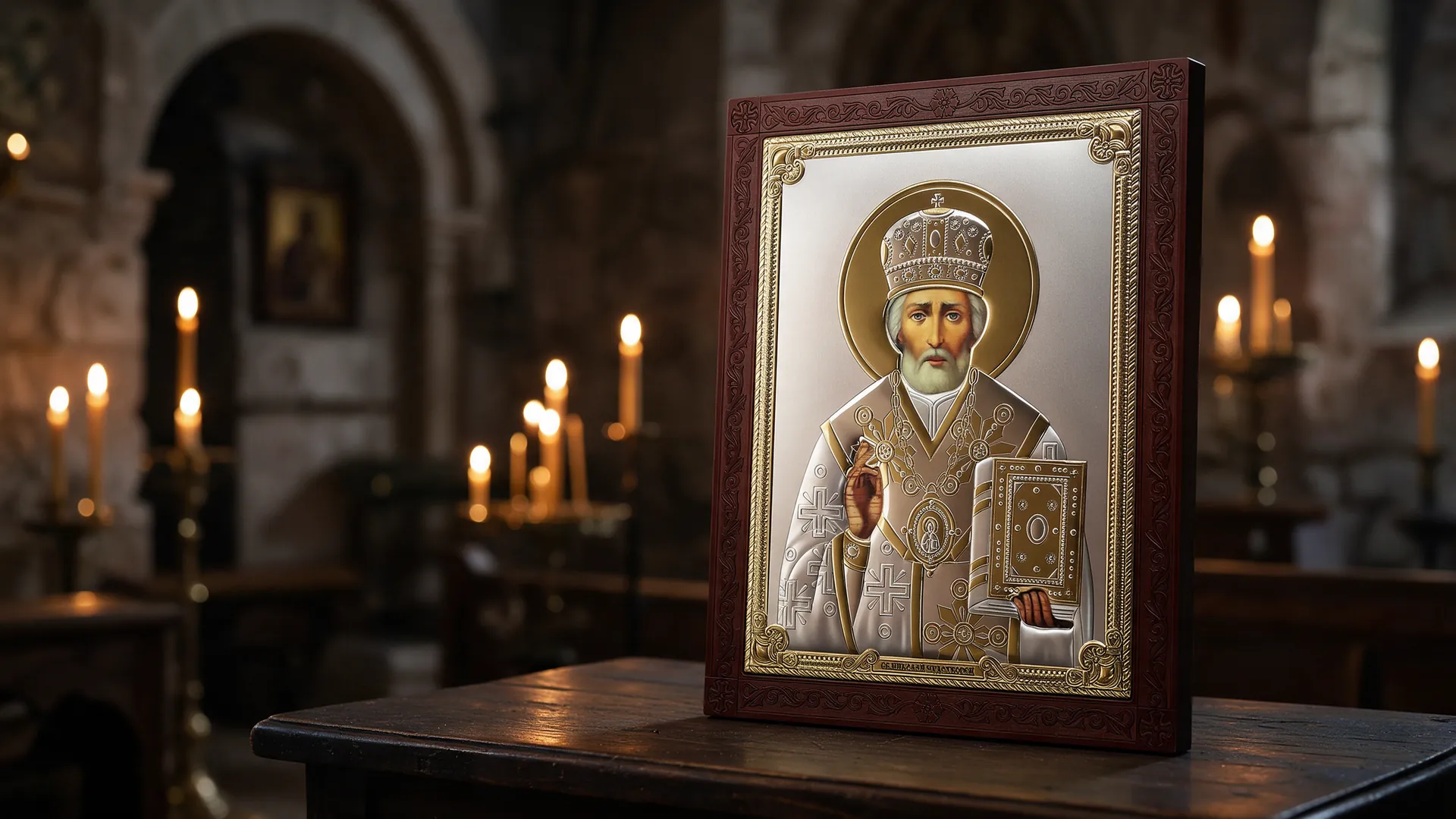
Few saints are as widely loved as St Nicholas the Wonderworker, Archbishop of Myra in Lycia. In Orthodox homes his icon often stands beside those of Christ and the Mother of God, and his face is easy to recognise: an elderly bishop with a high forehead and a short, rounded white beard, blessing with one hand and holding the Gospel in the other. Understanding the St Nicholas icon meaning starts with the man himself.
This guide covers his life in brief, the main ways he is painted, the less familiar Nicholas of Mozhaisk and the life icon, what people pray to him for, and his feast days.
The life of St Nicholas of Myra
Nicholas was born in the late third century in Patara, a port town in Lycia on the south-west coast of Asia Minor. He grew up in a devout family, gave himself to the service of God from youth and became archbishop of the city of Myra.
Several episodes from his life explain most of what you see in his icons and hear in prayers to him:
- A man who had lost everything was about to give up his three daughters to a life of shame. Nicholas came at night and secretly left gold at the house, so that each girl could marry.
- He stopped an executioner's sword and saved three innocent men condemned to death.
- He appeared in a dream to the Emperor Constantine and defended three army commanders who had been falsely accused.
- At his prayer a storm died down and a ship full of travellers reached the shore safely.
He was imprisoned for his faith under Diocletian and survived the persecution. Tradition holds that he took part in the First Ecumenical Council at Nicaea in 325. He died in old age, and in 1087 his relics were taken from Myra to Bari in southern Italy, where they remain. The Western figure of Santa Claus grew, over many centuries, out of the memory of his secret gifts.
How St Nicholas is painted
The most common St Nicholas icon is a half-length image. He wears a bishop's vestments with the omophorion, the wide stole marked with crosses that hangs over a bishop's shoulders. His right hand blesses; his left holds a Gospel book, closed or open.
Look near his head and you will often see two small figures in the upper corners: Christ holding a Gospel and the Mother of God holding an omophorion. They recall a tradition linked with the Council of Nicaea. After Nicholas was stripped of his episcopal insignia, Christ and the Theotokos appeared and returned the Gospel and the stole to him, a sign that his zeal for the faith was accepted.
Other versions show him from the shoulders up, or standing at full height. Many local icons of St Nicholas are named after the towns where they became famous, but almost all keep the same recognisable face.
Nicholas of Mozhaisk and the life icon
One unusual version is known as Nicholas of Mozhaisk, after a carved wooden statue from that town. The saint stands at full height holding a sword in his right hand and a walled church in his left. The sword is read as defence of the faithful and as the sword of the Spirit, the word of God. The church stands for the city and for the Church, both of which he guards with his prayers.
A life icon of St Nicholas is built differently. The central panel holds his portrait, and around it run small scenes from his life: his birth and baptism, his consecration as bishop, the gold for the three daughters, the rescue of the condemned men, the dream of Constantine, the calming of the storm and the translation of his relics. You can read such an icon like a book, one scene at a time.
What Orthodox Christians pray to St Nicholas for
The icon itself does not work wonders. It is a window towards the saint, and any help comes from God through his prayers. With that in mind, the usual requests follow the stories of his life:
- for travellers, sailors and anyone on the road;
- for children, for their future and for daughters to find a good husband;
- for those in poverty, debt or without work;
- for people who are falsely accused, and for a just outcome in a dispute;
- for health, your own and that of people you love.
Orthodox prayer books include the troparion to St Nicholas, which begins "A rule of faith and an image of meekness", and a longer prayer to him. A short prayer of your own is just as fitting: "Holy Father Nicholas, pray to God for us." If you are unsure which saint to turn to in a particular need, our article on which saint to pray to may help.
St Nicholas is honoured in every Orthodox land. St Gabriel of Samtavro, according to the memories of his doctor, wore large icons of the Mother of God and St Nicholas on his chest beside his cross, and in his last hours he kept his eyes on an icon of St Nicholas the Wonderworker. You can read more about the elder on the St Gabriel of Samtavro page.
St Nicholas feast days
The Church remembers St Nicholas on two main days and every week:
- 6 December, the day of his repose. Churches that follow the old (Julian) calendar keep it on 19 December.
- 9 May, the translation of his relics to Bari, kept on 22 May by the old calendar.
- Every Thursday, when the services remember the apostles and St Nicholas.
Many Orthodox Christians go to the Liturgy and receive Communion on his feast.
Choosing a St Nicholas icon for your home
At home his icon usually sits in the icon corner next to or just below the icons of Christ and the Mother of God. Our guide to setting up an Orthodox icon corner explains the usual order. A small St Nicholas icon is also a common companion for travel and a natural gift for anyone named Nicholas.
Choose a canonical image with an inscription and a clearly painted face. In the icons section you will find icons from the workshops of the Pskov-Caves and Danilov monasteries, each with the workshop certificate on the back. They are blessed in the monasteries where they are made, and every listing states where. The section itself shows which images of St Nicholas are currently there.