Submit a prayer note
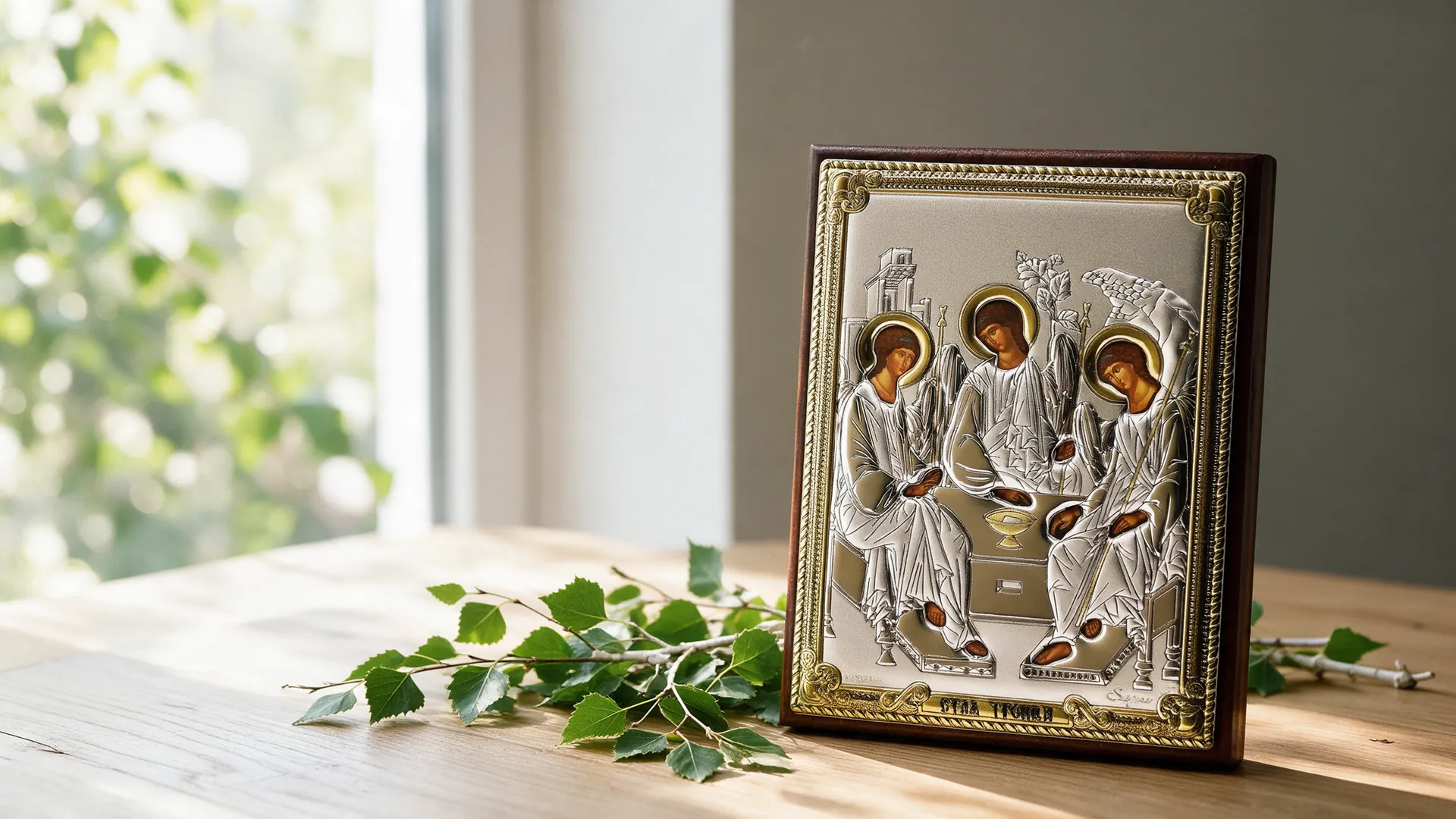
The Holy Trinity icon shows three angels seated around a table with a cup. To understand the meaning of the Holy Trinity icon, you have to start with a story from Genesis and then look closely at how icon painters, above all Andrei Rublev, turned that story into an image of God Himself.
For Orthodox Christians the Trinity is the heart of the faith: one God in three Persons, the Father, the Son and the Holy Spirit. No picture can explain this, and the icon does not try. It shows a moment when God made Himself known to a man, and it invites us to stand before that mystery in prayer.
This guide covers the biblical scene behind the icon, Rublev's version and its details, the question of which angel is which, other images of the Trinity, and how the icon is used in prayer at home.
The Hospitality of Abraham
Chapter 18 of Genesis tells how Abraham was sitting at the door of his tent by the oaks of Mamre in the heat of the day when three men appeared before him. He ran to meet them, bowed to the ground and asked them to rest under the tree. Sarah baked bread, a calf was prepared, and the guests ate. Then they told Abraham that his elderly wife would bear a son.
Abraham speaks to the three visitors as to one Lord. From early times the Church read this as a foreshadowing of the Trinity, and the icon based on it is often called the Hospitality of Abraham or the Old Testament Trinity.
Why angels, and not the Father, Son and Spirit drawn directly? The Gospel of John says that no one has ever seen God the Father. Only the Son became visible, by taking on human nature, and the Spirit appeared as a dove at Christ's baptism. The appearance at Mamre gave iconographers a way to point to the Trinity without inventing a likeness of the Father.
From early mosaics to Andrei Rublev
The scene appears in Christian art from the first centuries: in the Roman catacombs, in the mosaics of Santa Maria Maggiore in Rome and San Vitale in Ravenna. These early versions are full of narrative detail. The angels stand or sit in a row, Abraham and Sarah bustle about with dishes, and a servant sometimes leads in the calf.
Over the centuries the household details faded into the background, and the image became less about Abraham's meal and more about the God he welcomed. The holy Trinity icon by Andrei Rublev, painted in the first quarter of the 15th century for the Trinity cathedral of the monastery founded by St Sergius of Radonezh, took this furthest. Rublev removed Abraham, Sarah and the calf altogether. Only the three angels remain, seated around an altar-like table, with a house, a tree and a mountain behind them.
A church council in 1551 directed that the Trinity should be painted as Rublev had painted it, and his icon has served as the model ever since. Rublev himself is venerated by the Church as a saint.
Holy Trinity icon meaning, detail by detail
Rublev's icon is quiet and spare, and nearly every element carries meaning. The main points of its iconography:
- The circle. The three figures fit inside an unseen circle, an ancient sign of eternity and perfect unity.
- The bowed heads. Each angel inclines towards another. The movement expresses the love and agreement between the three Persons.
- The cup. On the table stands a chalice with the head of a calf. It recalls Christ's sacrifice on the Cross and the Eucharist.
- The staffs. Each angel holds a traveller's staff, a sign that all three have equal authority.
- The blue. Every figure wears some blue, the colour of heaven and of divinity, which binds the three together.
- The house, the tree and the mountain. They keep the memory of Abraham's tent and the oak of Mamre. They are also read as images of the Church, of the tree of life and the Cross, and of the soul's ascent to God.
For more on how colours, halos and inscriptions work across Orthodox icons, see our guide to icon symbolism.
Which angel is which?
People often ask who is depicted on the icon, and in particular which angel stands for which Person. There is no single answer, and the icon itself carries only the common title "Holy Trinity", with no individual names.
The most widespread reading sees the Son in the central angel, who wears a deep crimson tunic with a gold band and a blue cloak, with the tree, a reminder of the Cross, rising behind him. The angel on the left, towards whom the other two incline, is linked with the Father, and the angel on the right, in a green cloak, with the Holy Spirit. Other theologians have proposed different arrangements. All of them are interpretations, and you can pray before the icon without settling the question.
Other images of the Trinity
Not every Trinity icon follows Rublev. You may also meet:
- The New Testament Trinity. The Father as an elderly man, Christ beside Him, and the Spirit as a dove. This type became common late, and the Church has treated it with caution because the Father has never been seen.
- Theophany, the Baptism of Christ. Here the Trinity was revealed: the Son is baptised in the Jordan, the Spirit descends as a dove, and the voice of the Father is heard.
- Pentecost. The descent of the Holy Spirit on the apostles. On the feast of Pentecost, also called Trinity Sunday in the Orthodox Church, this icon or the Old Testament Trinity is placed in the middle of the church.
If you are choosing a Trinity icon for your home, the Old Testament Trinity with the inscription "Holy Trinity" is the safest and most traditional choice.
Praying before the Holy Trinity icon
Prayer before this icon is addressed to God Himself, so there is no narrow list of intentions. Orthodox Christians traditionally come to it:
- to give thanks at the end of the day, after an illness, or after a hard time has passed;
- to ask a blessing before something important: a new job, exams, a move or a long trip;
- to repent, especially before confession;
- to pray for the family and the home when there seems to be no way forward.
The best-known prayer to the Trinity is part of the morning prayers: "O Most Holy Trinity, have mercy on us. O Lord, cleanse us from our sins. O Master, pardon our transgressions. O Holy One, visit and heal our infirmities, for Thy name's sake." The doxology "Glory to the Father, and to the Son, and to the Holy Spirit" closes many prayers and is itself a confession of the Trinity.
The Fathers of the Church looked for earthly comparisons for this mystery. St John of Damascus spoke of fire and its light: the light comes from the fire, remains in it and is never separated from it. St Spyridon of Trimythous is said to have shown the unity of the Trinity at the First Ecumenical Council with a single clay brick, a story told in our article on St Spyridon. The Fathers themselves warned that every such image falls short.
Pentecost, the fiftieth day after Easter, is the great feast of the Trinity. Churches are decorated with green branches and grass, and at vespers, served straight after the liturgy, the faithful kneel for the first time since Easter.
Where to place a Trinity icon at home
In an icon corner the Trinity usually goes on the top tier, above the icons of Christ and the Mother of God. If there is only one shelf, it stands beside them and above any icons of the saints. Our guide to the Orthodox icon corner explains the full arrangement.
Look for an icon that follows the tradition and carries an inscription. The icons section of our shop has icons from the workshops of the Pskov-Caves and Danilov monasteries, with a workshop certificate on the back. They are consecrated in the monasteries where they are made, and each product page states where the icon was consecrated.