Submit a prayer note
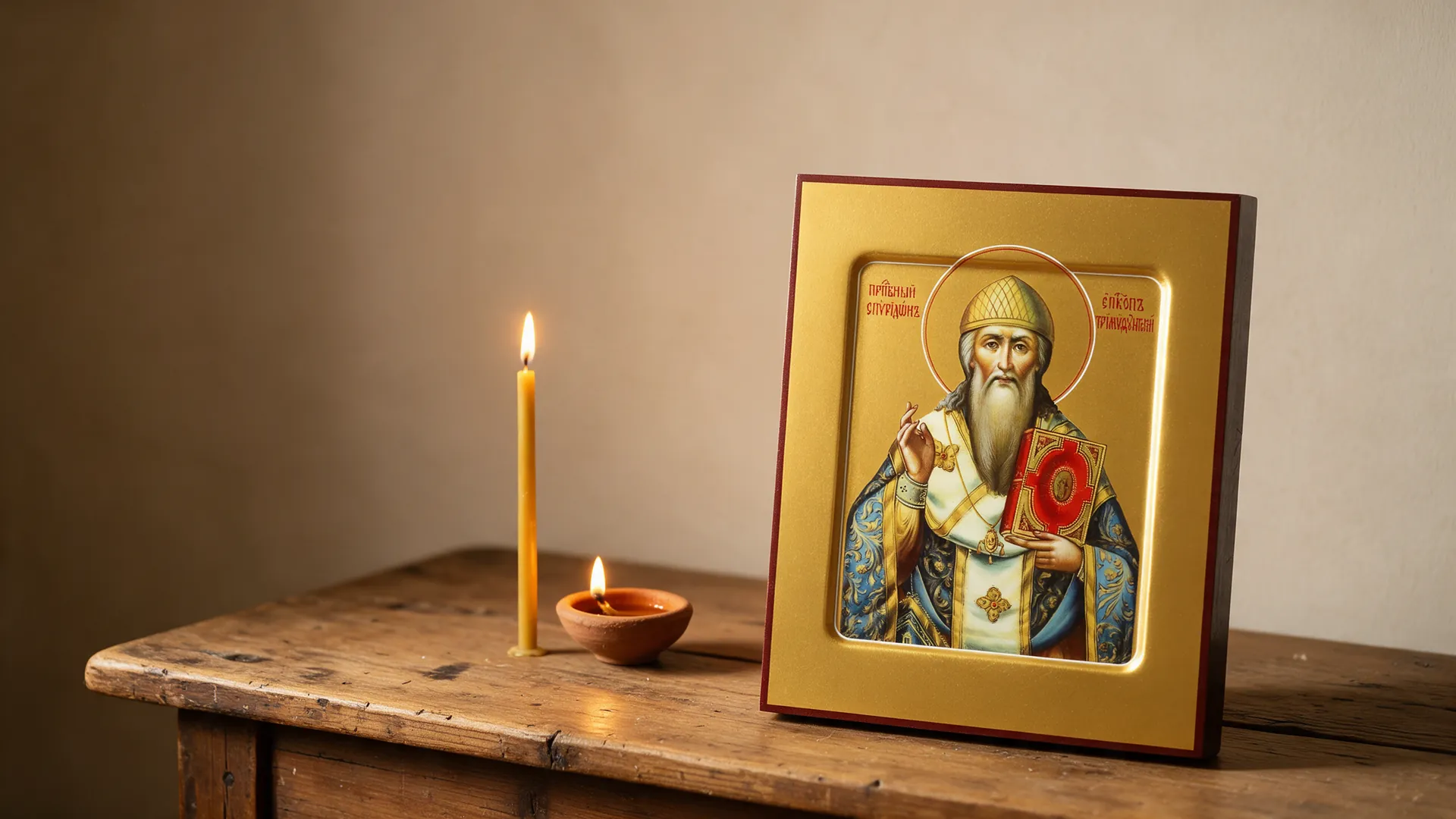
A St Spyridon icon is easy to pick out on a church wall: an old bishop in a woven shepherd's hat, often with a flock of sheep behind him. St Spyridon of Trimythous, also called St Spyridon the Wonderworker, is loved by Orthodox Christians from Greece to the Baltic, and his icon is one of the most common images of a saint in Orthodox homes.
People are drawn to him because he lived an ordinary working life and never lost touch with the troubles of ordinary people. This article covers his life, the miracles that shaped his iconography, his relics on Corfu, and how Orthodox Christians pray before his icon.
Who was St Spyridon of Trimythous?
Spyridon was born on Cyprus towards the end of the 3rd century and grew up as a shepherd. He married and had a daughter, Irene. Though he was far from rich, his house was open to travellers and the poor, and he fed and lodged anyone who knocked.
After his wife died young, he gave himself to the service of the Church and was chosen as bishop of Trimythous, a town on Cyprus. As a bishop he kept the habits of a shepherd. He went on tending sheep, worked in the fields, walked rather than rode, and dressed plainly.
St Spyridon took part in the First Ecumenical Council at Nicaea in 325, which confessed the Son of God to be of one essence with the Father. He reposed in old age, around the middle of the 4th century, while at prayer. The Church keeps his feast on 12 December, which falls on 25 December in the civil calendar for churches that follow the Julian calendar.
The miracles behind the icon
The life of St Spyridon is full of miracles, and many of them deal with very earthly matters: harvests, debts, courts and family.
At Nicaea a philosopher argued against the teaching on the Holy Trinity. Spyridon picked up a clay brick, and according to tradition fire rose from it, water ran down and the clay remained in his hand. Three elements in one object, he said, just as there are three Persons in one God. Some icons show him holding this brick. Our article on the Holy Trinity icon looks at that mystery more closely.
Other well-known stories from his life:
- Rain in a drought. When Cyprus suffered a famine, his prayer brought rain and saved the crops.
- The snake turned to gold. A poor farmer was refused a loan of grain by a rich neighbour. Spyridon turned a snake into a lump of gold, which the farmer left as security. Once the debt was repaid, the gold became a snake again.
- The flooded river. Hurrying to save a friend who had been falsely accused and sentenced to death, he found a river in flood. He prayed and crossed it on dry ground, and the judge, hearing of it, released the innocent man.
- The thieves in the sheepfold. Thieves who came to steal his sheep could not leave the fold until morning. Spyridon let them go and gave them a ram so their night's work would not be wasted.
His life also tells of healings, of the dead raised to life, and of his knowing in advance when he would die.
How to recognise a St Spyridon icon
The detail that sets him apart is his hat. In most icons he wears a tall cap woven from willow or reed, the kind a shepherd wore in the sun, as a reminder that he kept his flock even as a bishop. Over his shoulders lies the omophorion, the bishop's stole marked with crosses. He holds the Gospel and blesses with his right hand.
You will also find:
- full-length or half-length images in bishop's vestments;
- icons with sheep in a landscape, recalling his first work;
- icons where he holds the brick with flame above and water below;
- icons with scenes from his life painted in small panels around the edge;
- paired icons with St Nicholas, another 4th-century bishop and wonderworker who, according to tradition, also attended the Council of Nicaea.
In Greek churches an agios Spyridon icon may carry his name in Greek, but the hat makes him recognisable in any language. For the other saint so often painted beside him, see our article on the St Nicholas icon.
His relics on Corfu
St Spyridon was buried on Cyprus. Centuries later his relics were moved to Constantinople, and in the 15th century to the island of Corfu. They rest today in the church named after him in Kerkyra, the island's main town. The relics are incorrupt, and pilgrims of many confessions come to venerate them.
One tradition about the relics is especially well known. The velvet slippers on the saint's feet wear out and have to be replaced from time to time. Devout people say that St Spyridon still walks the world, as he did in life, going wherever help is needed. Several times a year the relics are carried in procession through the streets of Kerkyra.
Why people turn to St Spyridon
Orthodox Christians understand that help comes from God, through the prayers of the saint, and the icon is where we stand to ask for those prayers. Because of the stories in his life, St Spyridon is especially remembered by people:
- looking for work or worried about their income;
- buying, selling or searching for a home;
- struggling with debts;
- facing unjust accusations or a court case;
- caring for someone who is ill;
- going through a difficult time in their marriage or with their children.
The saint never treated any need as too small, and people bring him the plainest worries of daily life. The answer to prayer comes by God's mercy and does not always take the form we expect. If you are unsure which saint to turn to in your situation, our guide on which saint to pray to may be useful.
Praying before the icon at home
There is no special formula. You can speak to the saint in your own words, briefly and attentively. A short invocation, "Holy Father Spyridon, pray to God for us", can be repeated through the day. Orthodox prayer books and separate booklets contain his troparion and kontakion, and there is also an akathist to St Spyridon for longer prayer.
A few practical suggestions:
- Read his life before you start praying to him, so you know whom you are addressing.
- Add a prayer to St Spyridon to your morning or evening prayers, and keep it up after the difficult time has passed.
- Follow his example where you can: share with those in need, welcome a guest, stand up for someone treated unfairly.
- Give thanks to God and to the saint when your prayer is answered.
In an icon corner, a St Spyridon icon goes beside the icons of other saints, below the images of Christ and the Mother of God. Our guide to the Orthodox icon corner explains the arrangement. A small icon also fits on a desk or in a bag for travelling.
Icons for prayer at home are collected in the icons section of our shop. It includes icons from the workshops of the Pskov-Caves and Danilov monasteries, consecrated in the monasteries themselves, as well as silvered icons. Each product page says where the icon comes from.