Submit a prayer note
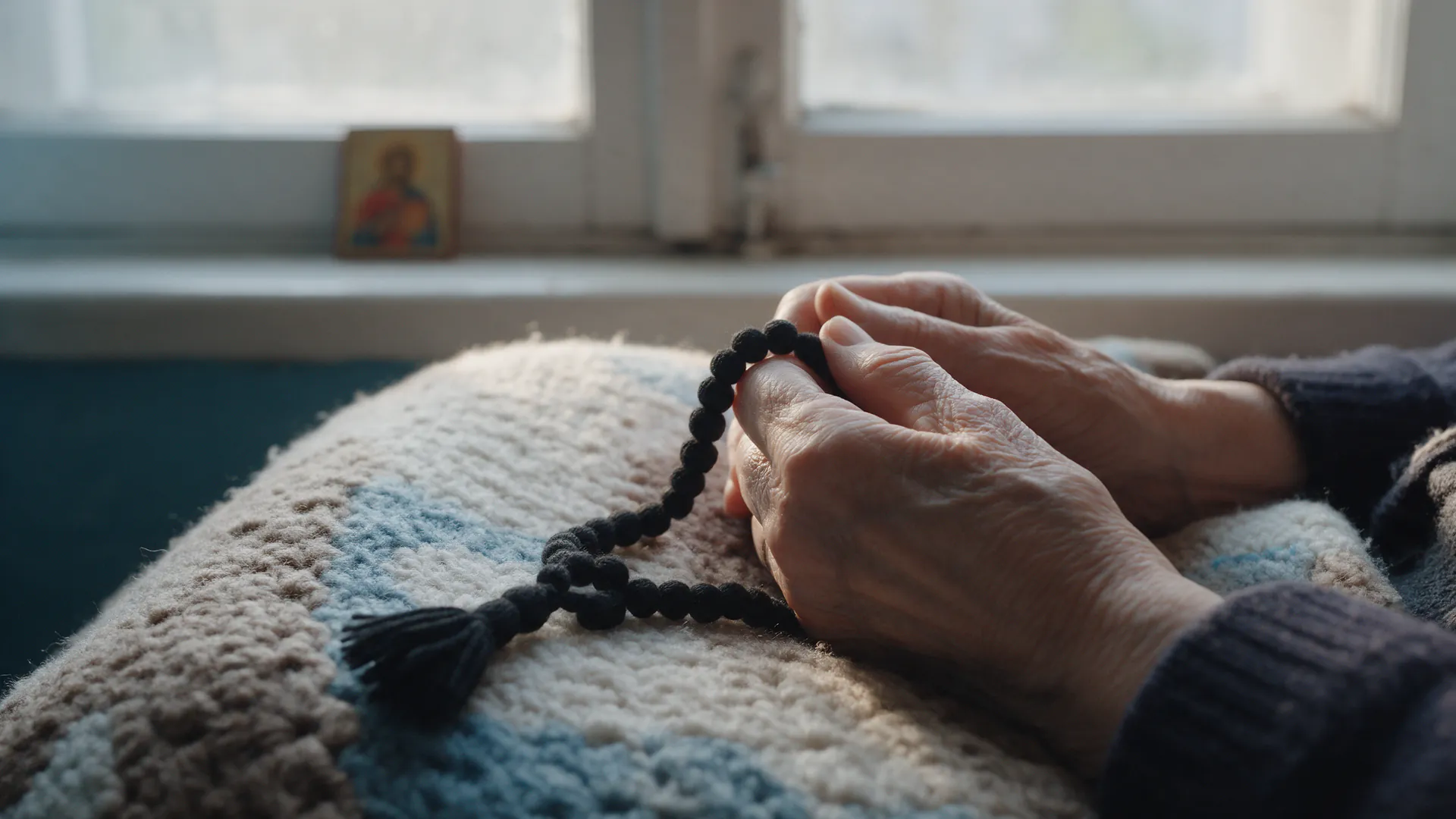
When someone you love falls seriously ill, prayer often comes before anything else. You may be sitting in a hospital corridor, or at the kitchen table after a hard phone call, looking for an Orthodox prayer for the sick and not sure where to begin. The good news is that you can begin right now, in your own words, exactly where you are.
This article gathers what the Orthodox tradition offers in illness: short prayers for home, the saints asked for help, the sacraments the Church gives to the sick, and how to have a sick person's name commemorated at a monastery. One thing should be said plainly at the start. Prayer is not a way of securing a particular outcome. We ask, and whatever help comes, comes by the mercy of God and through the prayers of His saints, sometimes in a form we did not expect.
Short prayers you can say today
The simplest prayer for a sick person is spoken in your own words before an icon: "Lord, have mercy on Your servant Mary. Ease her suffering and give her and all of us patience." God hears that, and He hears the wordless sigh at a bedside too.
Through the day you can repeat the Jesus Prayer with the person's name: "Lord Jesus Christ, Son of God, have mercy on Your servant George." It fits anywhere: on the bus, in a waiting room, in the middle of a sleepless night.
Orthodox prayer books also contain a prayer for the sick addressed to God as Master and Almighty King, who chastens but does not destroy. It asks Him to visit the sick person in His mercy, to forgive their sins and to raise them up from their bed of sickness. Read it at morning and evening prayers, adding the name. Many families also read Psalm 91 (Psalm 90 in the Orthodox numbering), a psalm of trust in God's protection.
A few practical points:
- pray together with the sick person, even briefly, if they are able to listen;
- if they cannot pray, pray for them, quietly, in their presence;
- add the names of the doctors, nurses and carers to your prayer;
- give thanks for every good day and every bit of relief.
Orthodox prayer for healing the sick, alongside medicine
People sometimes wonder whether going to the doctor shows a lack of faith. The Church settled that question long ago. The Wisdom of Sirach tells us to honour the physician, because the Lord created him, and not to despise the medicines God has given. Several saints were physicians themselves, and St Luke of Simferopol went on operating as a surgeon after he became an archbishop.
So prayer and treatment go together. Keep appointments, follow the doctors' advice, make decisions about treatment with them, and in prayer ask God to give them wisdom and to strengthen the one who is ill.
Which saint to pray to for healing
In sickness Orthodox Christians turn first to Christ, the Physician of souls and bodies, and to the Mother of God, often before her icons "the Healer" and "the All-Queen" (Pantanassa). Among the saints, those most often asked are:
- St Panteleimon the Great Martyr and Healer, a physician who treated the poor without payment;
- Sts Cosmas and Damian, the Unmercenary brothers, also physicians;
- St Luke of Simferopol, surgeon and archbishop;
- St Nektarios of Aegina, loved in the Greek tradition by people facing serious illness;
- St Gabriel of Samtavro, whose relics in Mtskheta draw many who pray for sick relatives;
- the patron saint of the sick person, and your own.
Any saint you know and love can be asked to pray with you. For saints traditionally asked in other needs, see which saint to pray to.
The sacraments for the sick
For an Orthodox Christian, illness is a time when the sacraments matter most. If the sick person is conscious and willing, ask a priest to come: he can hear confession and give Holy Communion at home or in hospital. Many people return to the Church in exactly this way, after years away.
The Church also has a sacrament given specifically to the sick: Holy Unction, the anointing with blessed oil. St James writes: "Is anyone among you sick? Let him call for the elders of the church, and let them pray over him, anointing him with oil in the name of the Lord." In Unction the Church asks God for healing of soul and body and for the forgiveness of sins. Speak to your parish priest to arrange it.
If the person is not baptised, or not ready, nothing is forced on them. The family prays for them at home, and that prayer is no less needed.
Sending the name of the sick to a monastery
Many families ask for a sick relative to be commemorated in church, and some also send the name to a monastery and the relics of a saint. On the note the baptismal name is written without a surname, with "the sick" before it: "the sick George", "the sick Mary". No diagnosis or explanation is needed; God knows the need better than we do. During a long illness, a note can be sent regularly. More on the format, with a sample, is in how to write an Orthodox prayer list.
Through our site, prayer notes go to two monasteries in Georgia. At Samtavro monastery the notes are taken to the relics of St Gabriel. At the Monastery of the Nativity of the Most Holy Theotokos in Borjomi, the ossuary keeps the remains of monks who, according to the monastery tradition, were martyred during ancient raids on the monasteries of the gorge. Pilgrims come there to pray for health and for help in illness and sorrow, and are anointed with blessed oil.
To send a note, go to the prayer notes page, choose the monastery, enter up to five names of people baptised in the Orthodox Church and make a donation. We hand the note over ourselves, in person on our nearest trip or by email within 1-2 days, and the names are commemorated at the divine service.
When the illness is long
Sometimes people pray for months and nothing seems to change. That is hard, and it helps to remember that prayer is not measured by results. It holds the sick person and the family close to God, gives strength to endure and to keep loving, and keeps despair at bay. Many families say it was during a long illness that they learned to pray properly.
Caring for the sick is itself a prayer. Feeding, turning, sitting with someone through a frightening night: these are the works of mercy of which Christ said, "I was sick and you visited Me." Pray for the carers too, yourself included. Tiredness and short temper come to everyone, and there is no shame in asking God for patience.
If you do not know where to start, start with one sentence in the morning and one at night, and one prayer note for the sick. The rest will follow.