Submit a prayer note
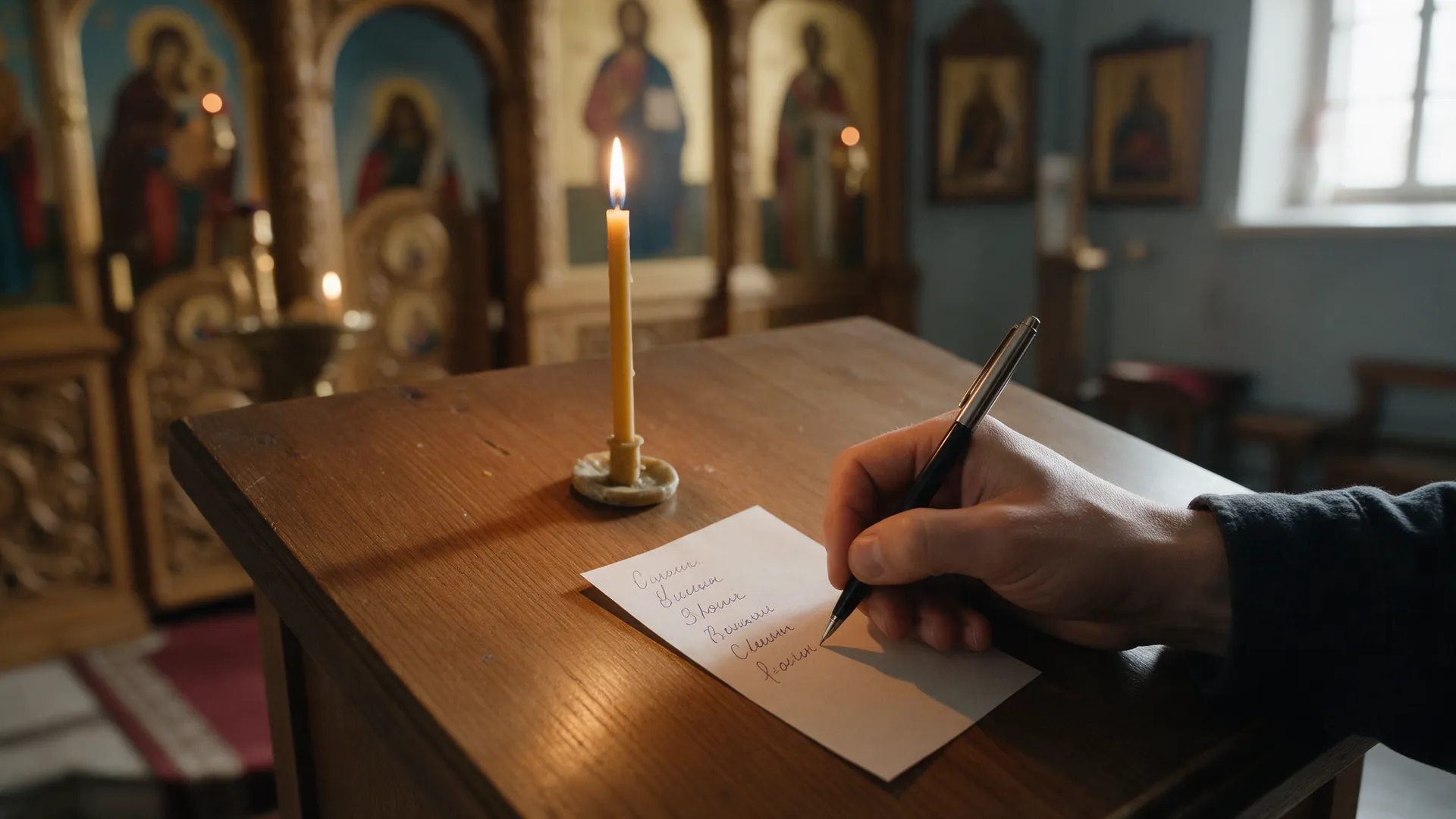
An Orthodox prayer list looks simple: a heading and a column of first names. Yet anyone writing one for the first time runs into questions. Which name do I use for my sister, who was baptised Photini but is called Lana by everyone? Do I write "Mum"? Can I put my own name down? What about a friend who was never baptised?
This guide covers the names on an Orthodox prayer list, the few words the Church uses before a name, who can be included, and what a finished note looks like. The rules are short, and they all serve one purpose: that the priest can read the names of your loved ones clearly and pray for them with attention.
If you would like to know first why Orthodox Christians send names to be commemorated at all, read praying for loved ones. This page is about the practical side.
The basics of a commemoration list
In English-speaking parishes the slip goes by several names: a prayer note, a commemoration list, names for the altar. The format is the same everywhere.
- At the top, write "For the living" (in some parishes "For health") or "For the departed" (or "For repose"). Many people draw a small cross above it.
- Keep the living and the departed on separate notes. They are prayed for at different points in the service.
- Write one name per line, clearly, in block capitals if your handwriting is hard to read. A priest may read hundreds of names in one morning.
- Use first names only: no surnames, patronymics, titles or nicknames.
- Keep each note short. In a parish, around ten names per note is usual; for longer lists, write more than one note.
If you pray for your spiritual father or a monk or nun you know, their names usually come first, then your own and your family's, then everyone else.
Writing the names: baptismal names only
The name on a commemoration list is the name a person received at baptism, in the form used for the saint. That is often, but not always, the name on their passport.
- Nick becomes Nicholas, Liz or Beth becomes Elizabeth, Kate becomes Catherine.
- Sasha becomes Alexander or Alexandra, Yuri becomes George.
- A woman called Svetlana is often baptised Photini, and Photini is what goes on the note.
- Converts frequently take a saint's name at baptism or chrismation: someone known at work as Jennifer may be Juliana in church. Use the church name.
In Church Slavonic and other Slavic languages, the names on a note take the genitive case, the form that answers "for whom". An English name such as John or Mary keeps its usual spelling. If you do not know someone's baptismal name, ask them or their family. If there is no way to find out, choose the closest saint's name and, when in doubt, ask a priest.
You do not need to write "servant of God" before each name; everyone named is a servant of God. And if a name ends up in the wrong form, do not worry. God knows whom you are praying for. The rules exist for good order and for the priest who reads the names aloud.
Words used before a name
A small set of words may be added before a name to tell the priest something important. On a note for the living:
- infant, for a child under seven: "infant John";
- child or youth, roughly from seven to fifteen;
- the sick, for someone seriously ill: "the sick Mary";
- expectant mother, for a woman who is pregnant;
- traveller, for someone on the road or abroad;
- soldier, for someone in military service;
- prisoner, for someone in prison.
Clergy and monastics are named with their rank: "Priest Nicholas", "Archpriest Peter", "Deacon Andrew", "Nun Nina".
On a note for the departed:
- newly departed, for the first forty days after death;
- ever-memorable, on anniversaries and other days of remembrance;
- slain, for someone who died a violent death;
- soldier, for someone killed in service;
- infant, for a child under seven.
Words such as "Mum", "my godson", "student" or "lost soul" are not used. If someone is struggling, write "the sick" where it applies and carry the rest in your own prayer. For more on remembering those who have died, see Orthodox prayers for the departed.
Who can be named on an Orthodox prayer list
A prayer list is for people baptised in the Orthodox Church. That includes:
- family and friends, including those who no longer come to church;
- godchildren and godparents, and anyone who has asked you to pray for them;
- yourself; asking the Church to pray for you is entirely proper;
- people who have hurt you, since praying for them is what Christ asked of us.
People who are not baptised, people of other faiths and anyone you are not sure was baptised are not written on the note. Remember them by name in your prayer at home, where you can speak to God about them freely. For someone who has taken their own life, commemoration in church is a matter for the bishop's blessing; the family prays for them at home.
A sample prayer list
Here is what a note for the living might look like, with five names, the number our prayer notes take:
For the living
- Priest Nicholas
- the sick Mary
- expectant mother Anna
- child Sergius
- George
And a note for the departed:
For the departed
- newly departed John
- ever-memorable Eudokia
- soldier Peter
- infant Alexis
- Helen
No surnames, no "Grandpa", no explanations. Just the church name and, where needed, one accepted word before it. If one of your names belongs to someone who is seriously ill, our article on Orthodox prayer for the sick may help.
Submitting prayer names to a monastery
Through our site you can submit prayer names to two monasteries in Georgia: Samtavro monastery, at the relics of St Gabriel, and the Monastery of the Nativity of the Most Holy Theotokos in Borjomi.
- On the prayer notes page, choose the monastery and the type of note: for the living or for the departed.
- Enter up to five names of people baptised in the Orthodox Church.
- Make a donation. Right after payment you receive an email with the names and the type of note.
We hand the note to the monastery ourselves: in person on our nearest trip or, if no trip is coming soon, by email within 1-2 days. The note will be delivered to the monastery and the names will be commemorated at the divine service. All your notes are kept in your personal account, and the full conditions are on the prayer notes terms page. If you are unsure how to write a name, write to us and we will advise.