Submit a prayer note
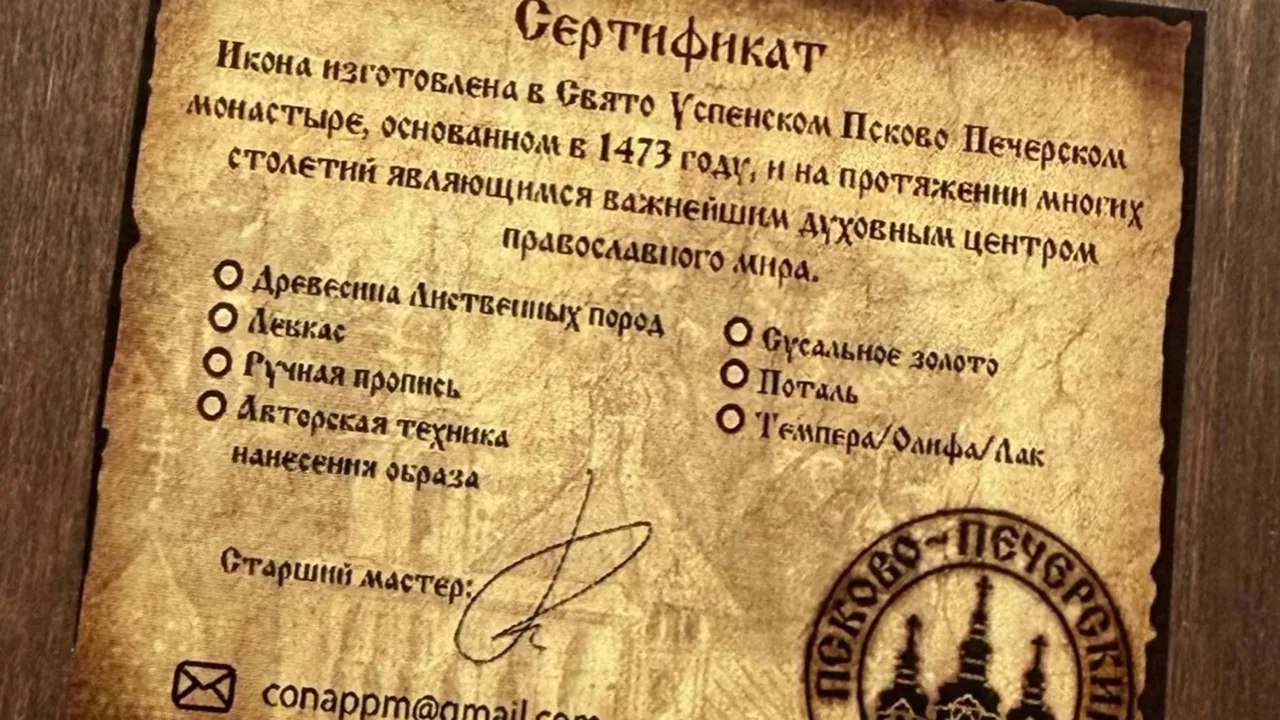
On the back of every icon from the workshops of the Pskov-Caves monastery there is a small label in the style of an old manuscript. Buyers often ask what exactly it confirms, so here is the certificate line by line, as it is printed on the icons in our shop.
The certificate is not a decoration. It shows where the icon was made, what it is made of and who in the workshop is responsible for it.
Where the icon was made
The first lines say that the icon was made in the Holy Dormition Pskov-Caves monastery, founded in 1473, which for many centuries has been one of the most important spiritual centres of the Orthodox world.
The monastery stands in Pechory and grew around caves known as the God-made caves, where the brethren are buried to this day. It has never been closed in its whole history, including the Soviet years. The icons of its workshops are consecrated in the monastery itself and come to us already consecrated.
The materials
The certificate lists what the icon is made of:
- hardwood: the board of the icon is made of deciduous wood, which holds its shape and does not crack with changes of humidity;
- gesso (levkas): the traditional chalk and glue ground on which the image lies;
- gold leaf: real thin gold for the halos and backgrounds;
- potal: imitation leaf, used where a golden shine is needed at a lower cost;
- tempera, drying oil, varnish: the paint and the protective layers that keep the image from light and dust.
The techniques
Two more lines describe how the image is made. Hand finishing means that the master paints over details by hand: the lines of the faces, the folds of the clothes, the inscriptions. The author's technique of applying the image is the workshop's own method of transferring the image to the gesso before it is finished by hand.
So the certificate describes the icon honestly: it is a workshop icon on a wooden board with gesso and gold, finished by hand, not a printed picture on a board and not a unique painted icon by a single iconographer.
The signature and the seal
At the bottom is the signature of the senior master of the workshop and the round seal of the Pskov-Caves monastery with its churches. The workshop email is printed next to them. The signature and the seal confirm that the icon was accepted by the workshop and comes from the monastery.
A photo of the certificate is published on the consecration of items page together with the other documents of the centre.
How to keep such an icon
An icon on gesso does not like damp and sudden changes of temperature. Keep it away from a radiator and a window that is often opened, wipe the dust with a soft dry cloth and do not wash the surface. If a lampada burns in front of the icon, make sure it does not stand too close.
The icons of the workshops are collected in the section Pskov-Caves monastery icons, and the history of the monastery is told on the page of the Pskov-Caves monastery and in the article Pskov-Caves monastery: history, caves and shrines.
 Pskov-Caves monastery